
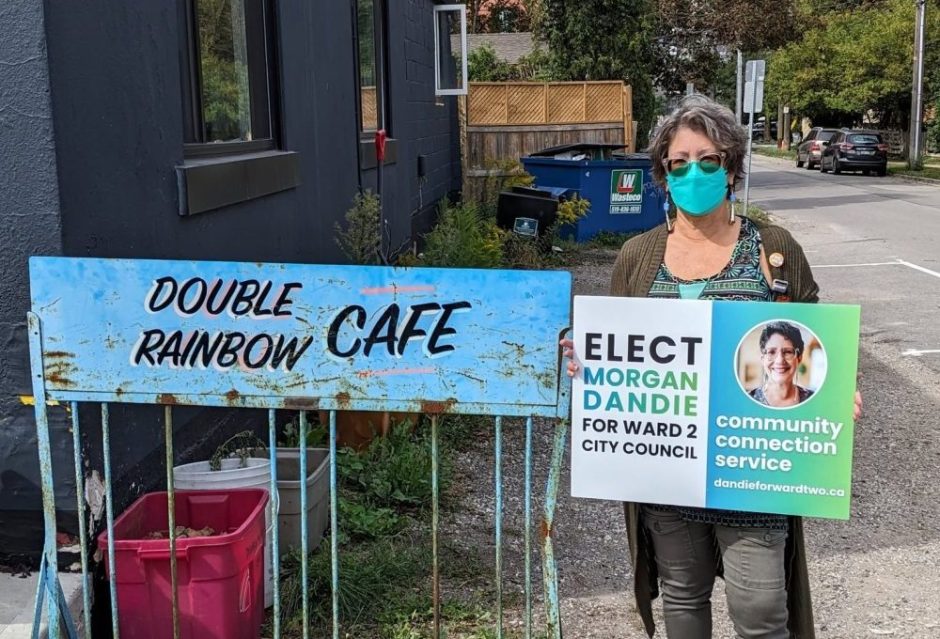
“I have spent the last seven years preparing to be a full time city councillor. Over this past term, in addition to attending most city council meetings in person, I attended many advisory committee meetings, with special interest in the Joint Committee for Land Ambulance and Social Services. I am deeply connected and involved in the community. Providing service to the people at the level of government closest to their day-to-day life is something I know I will do well.”
Why do you want to be a city councillor?
I love my chosen city of Guelph! In 2014 I chose Ward 2 as the place to buy my dream turn-of-the-century farmhouse.
I have spent the last seven years preparing to be a full time city councillor. Over this past term, in addition to attending most city council meetings in person, I attended many advisory committee meetings, with special interest in the Joint Committee for Land Ambulance and Social Services.
I am deeply connected and involved in the community. Providing service to the people at the level of government closest to their day-to-day life is something I know I will do well.
What is your background and experience, and how do you think that will serve you as a city councillor?
Last year, when I mentioned my intention to seek appointment for the remainder of the term for the Ward 6 seat to MP Dominique O’Rourke, her response was “You are well qualified.” The years I have spent learning the job of city councillor demonstrates my ability to serve in the role.
I hold an Honours Diploma in Business Administration, and my career as an Administrative Professional spanned thirty years. Working as the front line person in small family businesses, medium sized corporations and internationally renowned multinational corporations taught me that a budget is a budget, big or small, you have to keep the numbers top of mind.
I am proud that my work for Siemens with a team building multimillion dollar industrial wastewater treatment plants all over the world, bringing projects in on time and on budget, based upon my project forecasting, provided the entire division with bonuses because our department consistently met and exceeded project mandates. Mitigating potential project delays following the earthquake, tsunami and nuclear incident in Japan was the impetus to develop a Vendor Report Card protocol, augmenting the Vendor Follow up System I initiated and maintained.
I know how to look at systems, determine where they are working and find where they can be improved.
Given Strong Mayor Powers, how do you see your role as a city councillor when the mayor can override the will of council with just three votes?
How Strong Mayor Powers are wielded depends upon who is elected mayor.
If the next mayor delegates Strong Mayor Powers to Staff, as the current mayor did, then I believe the way council has operated this past term is a decent example of how Guelph should be governed.
If the next mayor chooses to hold Strong Mayor Powers and use them to advance their personal agenda, how Guelph operates will fundamentally change.
In this city we elect 13 people to represent our interests and deliver the services we depend upon every day. If Strong Mayor Powers are used, then a small minority of four people have the potential to do whatever they want. The responsibility of a councillor is to do what is best for the citizens of Guelph, not push the agenda of a minority of council.
Affordability is important to a lot of voters, and municipal budgeting can be very difficult. How will you balance the needs of a growing city with the demands for low or zero tax increases over the next term?
Providing services to the people of Guelph is the reason city council exists. The only stable source of income the city has is property taxes and water/wastewater rates.
Historically, maintaining low tax increases has created a backlog of infrastructure repairs that is far too long. Guelph is mandated to grow to 208,000 people by 2051, and unless the province makes good on its promise to “make municipalities whole” is delivered, the current population is responsible to pay for the infrastructure required to meet that growth because Development Charges are either waived or don’t have to be paid until occupancy.
I believe focusing on making our transit system work for more people and ensuring our cycling infrastructure is fully connected can make affordability better in Guelph. If people can get where they need to be, when they need to be there, without having to own that second or third car to make their family function well, they can save up to $16,000 per year.
Council this past term has done a lot of housing policy, but that hasn’t translated into more shovels in the ground. How will you help close the gap over the next four years?
There are over 9,000 approved housing units in Guelph. The best thing the council did to get those shovels in the ground was to pass the “use-it-or-lose-it” water and wastewater allocation policy.
Advocating to the province to provide mechanisms for municipalities to hold developers accountable to proceed with approved projects within specified timelines is the only way I can see to get the already approved housing built.
Aside from the demands for more housing, land use planning also means assuring that there’s enough room to account for growth in business, institutional and commercial land uses, how will you balance all these priorities?
The city has between 354 and 391 net hectares of vacant, developable employment land for future growth, with around 155 hectares considered “shovel-ready”. Due to recent planning updates and redesignations, we are approximately two hectares short of the employment lands we need to 2051; this is what happens when the province overrides local planning decisions.
Assuming the municipality has the ability to enforce local zoning and planning, ensuring the right mix of employment lands is available to meet provincial requirements to 2051 means carefully considering any further redesignations.
Water availability is a growing concern. How will you ensure that Guelph has the capacity it needs to support this growing city?
The recently passed “use-it-or-lose-it” water and wastewater allocation measures are our best tool to ensure we have the water capacity needed to support mandated growth. The city will have to continue searching for additional wellhead locations as well.
The biggest thing I would like to see happen, to protect our fresh drinking water in the largest city in Canada that is almost wholly dependent upon ground water, is to have a ban enacted on any new water intensive industry.
Trust in government and institutions is major issue. How will you keep your constituents well informed about city hall business, and help them feel included when it comes to decision making?
One of the best conversations I had while knocking doors back in June was with a resident who does not have internet. They live a life without digital interaction, and they feel very disconnected from their city since our legacy media outlets have stopped producing and delivering newspapers to the door.
I asked this person if a monthly newsletter, delivered to their mailbox, would help them feel better connected; of course their answer was “YES”.
Once elected, I will distribute a letter of introduction to every household in Ward 2, giving an option to receive a copy of a monthly newsletter in their physical mailbox when the emailed version is sent.
As a candidate, I have already established consistent times to meet with people in local cafes, and as a full time councillor having dedicated Office Hours in the community will continue. Holding regular townhall type gatherings is another way I will connect with and inform Ward 2 residents.
What would you say is *your* issue? What is the one thing you want to talk about on the campaign trail this fall and have a thorough debate about it before this election is over?
Water is Life.
I have already mentioned the issue of no hyperscale AI data centres in Guelph, and a ban on any new water-intensive industries within our borders.
We have finite access to drinking water from an aquifer that already has a breach in the aquitard, the layer that protects the purity of our drinking water. Guelphites must continue to be encouraged to conserve water, and council has a responsibility to ensure fresh drinking water is available for the 208,000 residents we are mandated to grow to by 2051.
The existing monitoring of water and wastewater allocation is the first line of defense to ensure we keep our water flowing as the public good it is.
What perspective do you think you will bring to council that is not currently reflected?
I see connections and throughways that are not always apparent to others.
I earned an Honours Diploma in Business Administration and was an Administrative Professional across various industries for over thirty years. I then returned to college, where I finished first in my class with an Honours Diploma as a Medical Office Assistant and worked in doctors’ offices and an addictions treatment facility.
My recent lived experience with housing and food precarity provides a layer of understanding that most people are glad they don’t have.
The combination of experience with finances from multimillion-dollar international projects to thriving in the legislated poverty of ODSP provides me with a depth and breadth of knowledge few get to develop.
Is there anything else you want to tell voters as they make their decision?
Renters pay property taxes every single month and have the right to vote!

