
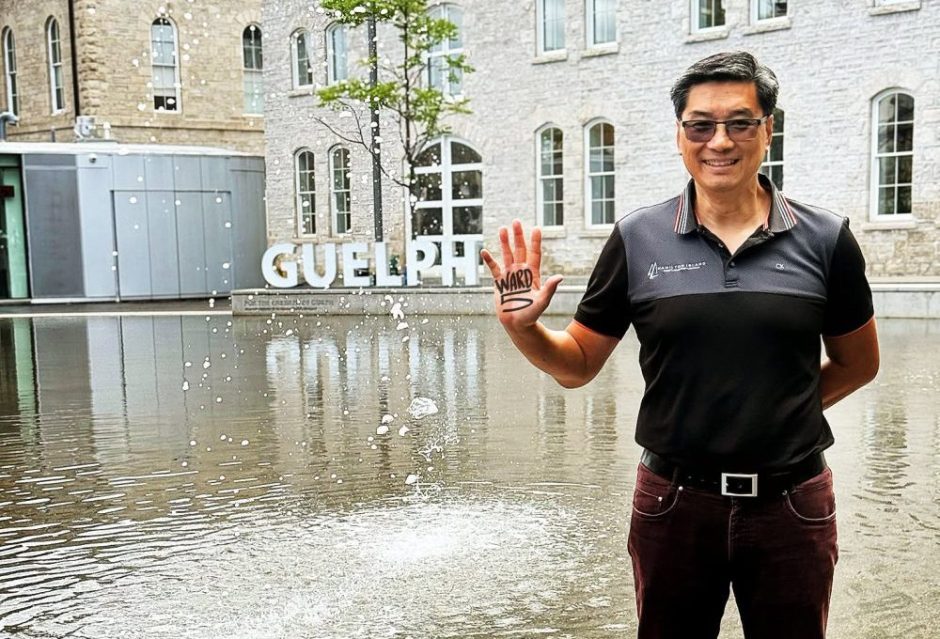
“I hope residents will look at my 35-year record and ask whether I have demonstrated the judgment, care and governance experience they want in their councillor. I won’t promise that I’ll know everything or always agree with everyone. What I can promise is that I’ll show up, listen, ask questions, do my homework and make decisions based on what I believe is best for Ward 5 and Guelph.”
Why do you want to be a city councillor?
I’ve spent 35 years in the care business, and that taught me that real change happens when you show up, listen carefully, bring the right people together and then actually do something.
I’ve called Ward 5 home for more than 27 years. I’ve raised my family here, built businesses here, volunteered here and worked with some of the people in our community who face the greatest challenges. Now that I’m retired, I have the time, experience and energy to give back in a different way.
I’m not running because I’ve always wanted to be a politician. I’m running because I believe I can be useful. I want to bring a practical, people-first approach to City Hall and make sure Ward 5 residents feel heard and well represented.
What is your background and experience, and how do you think that will serve you as a city councillor?
I’m a pharmacist, former small-business owner and longtime community volunteer. Over a 35-year career in community pharmacy, I learned to listen, solve problems, manage budgets and teams, and make decisions where there were often competing needs and no perfect answer.
During the last decade of my pharmacy career, I became increasingly involved in addiction medicine, mental health and outreach. That experience showed me how often people fall through gaps between housing, healthcare and community services. It strengthened my belief that we need coordinated, practical support that treats people with dignity and addresses the underlying causes of the challenges they face.
I co-founded TEAM ROC and helped establish Edinburgh Place and Sidney House, creating 24 supportive-housing beds. I have served with organizations including Stonehenge Therapeutic Community and Hospice Wellington. Today, I serve as Board Chair of the Guelph Symphony Orchestra and Interim Chair of Sanguen Health Centre.
I’ve also run businesses. That teaches you very quickly that every dollar must have a purpose, that you need good people around you, and that leadership isn’t about having all the answers yourself.
Council needs people who can listen to different perspectives, ask good questions, make difficult decisions and remain accountable for those decisions. That is the experience I would bring.
Given Strong Mayor Powers, how do you see your role as a city councillor when the mayor can override the will of council with just three votes?
Strong Mayor Powers change some of the mechanics of municipal government, but they don’t change what I believe the responsibility of a councillor should be.
Ward 5 residents are electing someone to represent them, ask difficult questions, scrutinize decisions and work constructively with the rest of council. I would take that responsibility seriously regardless of who occupies the mayor’s chair.
I also believe relationships matter enormously. I have spent much of my career bringing together people who don’t necessarily agree with one another. My approach on council would be the same: build trust across the table, understand why people hold the positions they do, and work to find enough common ground to get good things done.
You won’t win every vote. But you should always be able to explain why you took the position you did and whom you were representing when you took it.
Affordability is important to a lot of voters, and municipal budgeting can be very difficult. How will you balance the needs of a growing city with the demands for low or zero tax increases over the next term?
I understand why people are frustrated. Property taxes are putting real pressure on household budgets, particularly for seniors on fixed incomes and families whose other costs have also risen.
But I don’t think it is responsible to simply promise a particular tax number before seeing the budget and understanding the consequences.
I spent decades running a small business. My approach was always to understand what we were spending, what value we were getting for it, and what the trade-offs were. I would bring that same discipline to the City’s budget.
As Guelph grows, we have to maintain roads, water and wastewater systems, transit and the other core services residents depend on. At the same time, council has a responsibility to scrutinize spending, find inefficiencies, measure results and distinguish between what we need and what would simply be nice to have.
My principle is pretty simple: respect taxpayers’ money, measure the trade-offs, and cut waste, not care.
Council this past term has done a lot of housing policy, but that hasn’t translated into more shovels in the ground. How will you help close the gap over the next four years?
I think this is exactly where council needs to become more focused on outcomes.
Passing a policy or approving a plan is not the same thing as creating a home. If projects aren’t moving forward, we need to understand where they are getting stuck. Is it approvals? Infrastructure? Financing? Construction costs? Market conditions? Or something else?
I want the City to sit down with builders, housing providers, residents and staff and identify those barriers honestly. Where municipal processes are unnecessarily slow or complicated, we should fix them.
At the same time, speed cannot be our only measure of success. Ward 5 has established neighbourhoods experiencing significant change, including around the university. Growth is necessary, but residents deserve meaningful input into how that growth occurs.
For me, the objective is thoughtful growth: getting more housing built while making sure infrastructure and neighbourhood planning keep pace with it.
Aside from the demands for more housing, land use planning also means assuring that there’s enough room to account for growth in business, institutional and commercial land uses, how will you balance all these priorities?
A healthy city can’t just be somewhere people sleep. People need places to work, shop, learn, gather and build businesses.
My background as a small-business owner shapes how I look at this. Commercial and employment lands aren’t an afterthought; they’re part of building a financially and socially sustainable city.
Ward 5 demonstrates that particularly well. We have the University of Guelph, Stone Road Mall, established neighbourhoods, small businesses and major transportation corridors all interacting within the same ward.
Planning decisions therefore need to look beyond the immediate development application and ask what kind of community we’re creating 10 or 20 years from now. Housing matters enormously, but so do jobs, institutions, local businesses, transportation, green space and community amenities. Good planning has to consider the whole picture.
Water availability is a growing concern. How will you ensure that Guelph has the capacity it needs to support this growing city?
This is one where I don’t think candidates should pretend there is a simple answer.
Water and wastewater capacity are fundamental to how much and how quickly Guelph can grow. Before approving growth assumptions, council needs reliable information about our existing capacity, future supply, infrastructure requirements and the cost of expanding those systems.
I would want council asking those questions early rather than discovering constraints after development has already been planned.
Guelph has to grow within its infrastructure capacity and invest ahead of problems where the evidence tells us that additional capacity will be required. Water is too fundamental to public health and our city’s future to make decisions based on assumptions.
Trust in government and institutions is major issue. How will you keep your constituents well informed about city hall business, and help them feel included when it comes to decision making?
This may be one of the most important parts of the job.
For 35 years as a pharmacist, people came to me with problems. Before offering a solution, I had to listen. I don’t think representing a ward should be very different.
I want to be visible and accessible — at community events, neighbourhood meetings, local businesses and regularly out talking to residents. I also want to create opportunities for people to talk to their councillor outside of a crisis or controversial planning application.
But communication has to work both ways. It isn’t enough for City Hall to tell people what has already been decided. Residents need opportunities to contribute while decisions can still be influenced.
And when council ultimately makes a decision people disagree with, councillors should explain why. People may not always agree with my vote, but they should never have to wonder where I was or why I made the decision I did.
What would you say is *your* issue? What is the one thing you want to talk about on the campaign trail this fall and have a thorough debate about it before this election is over?
I actually hope we have a serious conversation about what kind of community we want Guelph to be as it grows.
Growth isn’t just about the number of houses we build or the tax rate. It’s about whether people still feel connected to their neighbours and whether they feel they belong here.
I’m very interested in rebuilding some of the community and volunteer connections that we’ve lost. That can mean supporting arts and culture, creating opportunities for young people, strengthening neighbourhood volunteer networks, and simply finding better ways for neighbours to help neighbours.
I’ve spent my career in healthcare, including working with people experiencing homelessness, addiction and mental illness. One thing that experience taught me is that strong communities don’t happen because the government delivers every solution. They happen when people look out for each other.
I’d like us to have a bigger conversation during this election about how we build community, not just how we build a city.
What perspective do you think you will bring to council that is not currently reflected?
I bring the perspective of someone who has spent 35 years simultaneously in care and business.
Those worlds are sometimes treated as opposites. I don’t think they are.
Running a business taught me to watch costs, manage people, measure results and make difficult trade-offs. Working in healthcare taught me that behind every policy, budget line and statistic there is a person.
My work in addiction medicine and outreach also means I’ve spent time directly with people whom municipal policy discussions often talk about rather than talk with.
I’m not coming to council from a political background. I’m coming as a pharmacist, business owner, board leader, volunteer and neighbour. I think that combination will bring a useful perspective to the table.
Is there anything else you want to tell voters as they make their decision?
I see this campaign a little differently. I’m applying for a job, and the residents of Ward 5 are doing the hiring.
A city councillor is also part of the governing body responsible for overseeing the City’s direction and working effectively with the City’s administration, including the CAO. I have served on multiple boards and understand the difference between governance and day-to-day management. Good governance means setting clear priorities, asking difficult questions, reviewing results and holding leadership accountable while respecting the professional role of staff.
I hope residents will look at my 35-year record and ask whether I have demonstrated the judgment, care and governance experience they want in their councillor.
I won’t promise that I’ll know everything or always agree with everyone. What I can promise is that I’ll show up, listen, ask questions, do my homework and make decisions based on what I believe is best for Ward 5 and Guelph.

