
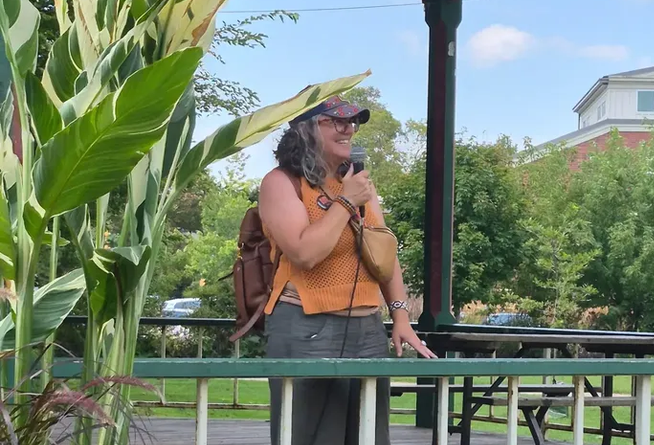
“I believe government should be ambitious, practical, and willing to try. We don’t need a feasibility study for everything. Sometimes we need to pilot, prototype, learn, and improve. We need to ask ‘Why not now?’ rather than constantly deferring good ideas to the future. I want to be a councillor who listens, brings people together, thinks creatively, and gets things done. Guelph has enormous potential. ‘I’m running because I want to help us realize it.'”
Why do you want to be a city councillor?
I’m running for City Council because I’ve been involved in municipal politics for most of my life—and because I believe this is a moment when Guelph needs people who are ready to roll up their sleeves and make things happen.
I first got involved in municipal politics as a teenager, serving on the Mayor’s Task Force for Healthy Lifestyles in Cornwall, Ontario. I later worked as a journalist covering youth culture, politics, and the environment for the *Cornwall Standard-Freeholder*. Since then, my career has taken me through journalism, organizing, campaigning, and teaching. I’ve worked with organizations including the Toronto Environmental Alliance, the Ontario Coalition for Social Justice, and Greenpeace; made deputations at City Hall; and brought my students into the political process. Most recently, I spent four years working as a climate specialist with the Halifax Regional Municipality, where I saw first-hand what is possible when municipal departments work together toward ambitious goals.
I’ve also lived through the growing pains of two rapidly changing cities, Toronto and Halifax. I’ve seen what works, what doesn’t, and what happens when cities fail to plan for growth. I want to bring those lessons to Guelph as we navigate our own transition into a larger city—protecting our environment, addressing affordability, investing wisely in infrastructure, and making sure we take care of people as we care for the planet.
And, frankly, I’ve been dreaming of and scheming to move to Guelph since the early 2000s. I fell in love with our City’s creativity, community spirit, and compassion. I want to help protect those qualities while bringing a renewed sense of optimism and possibility to City Hall.
I believe government should be ambitious, practical, and willing to try. We don’t need a feasibility study for everything. Sometimes we need to pilot, prototype, learn, and improve. We need to ask **“Why not now?”** rather than constantly deferring good ideas to the future.
I want to be a councillor who listens, brings people together, thinks creatively, and gets things done. Guelph has enormous potential. **I’m running because I want to help us realize it.**
What is your background and experience, and how do you think that will serve you as a city councillor?
I went to York University for two degrees in Environmental Studies and was active in student government and student journalism. I thought I would pursue an academic route but left graduate school to become an activist and a Mom. I have worked for multiple non-profit organizations (Toronto Environmental Alliance, Ontario Coalition for Social Justice, Greenpeace to name a few) before returning to school for a Masters in Teaching after helping to found a publicly funded alternative school that my now adult daughter attended. I worked for the Toronto District School Board from 2012-2021. After being unable to find affordable housing in Guelph during the COVID exodus, our family moved to Halifax for a few years prior to coming to Guelph. While in Halifax, I supply taught, helped to manage my daughter’s music career, started up a non-profit focused on Music and Climate/Sustainability and worked as a climate specialist for the Halifax Regional Municipality. I think my diverse background and my experience understanding how municipal politics functions will be enormously helpful in this position. I know how to bring diverse groups of people together around a common cause and work together from a positive place of hope and optimism.
Given Strong Mayor Powers, how do you see your role as a city councillor when the mayor can override the will of council with just three votes?
I first of all want to say that I *strongly* disagree with the Strong Mayor Powers and will continue to talk about how anti democratic they are and fight to have them repealed. I am furious at what Doug Ford has done to erode local democracy including preventing municipalities from using ranked ballots. I see my role as working hard to make sure our Mayor limits their use of such powers and communicating with my constituents and helping to organize their input and ongoing involvement with City Hall.
Affordability is important to a lot of voters, and municipal budgeting can be very difficult. How will you balance the needs of a growing city with the demands for low or zero tax increases over the next term?
Affordability matters, but we need to be honest about what municipal government can and cannot do. As Ken Chew has suggested, it can be tempting to argue that the City is simply burdened by inefficiency and that we can cut taxes without sacrificing services. I don’t think that is a responsible way to talk to residents. Municipalities can cut services and still face rising costs, which is why tax increases can sometimes be unavoidable.
I would rather tell people the truth about the choices before us. Guelph should introduce participatory budgeting and stronger transparency so residents can see the constraints, understand the trade-offs, and help set priorities. Leadership means explaining why we pay taxes and what they provide—and deciding together whether our money is better when pooled to deliver services collectively. We need fewer easy promises and more honest conversations.
Council this past term has done a lot of housing policy, but that hasn’t translated into more shovels in the ground. How will you help close the gap over the next four years?
I have spoken to housing experts across the country about how we fill the gap. I recently attended the 2026 Massey Lecture called Housing Inc. delivered by Leilani Farha where she delves into the complexity of the housing crisis. Her lecture reminded me that there are no simple answers and anyone who claims to have a silver bullet doesn’t understand the issue. Council has done a lot of housing policy, but policy alone does not put shovels in the ground. The housing crisis isn’t a mystery—it is the result of choices about land, finance, regulation, and what we choose to build.
Over the next four years, I want Guelph to be much more proactive. We should identify publicly owned land that can support affordable and supportive rental housing, following models like Toronto Builds that maintain public ownership while creating complete communities. We should also make much better use of what we already have: preserving existing affordable homes, retrofitting buildings, pursuing adaptive reuse, and bringing vacant homes and underused properties back into active use.
We also need to confront the financialization of housing. Housing should be a foundation for people, not simply an investment vehicle. That means partnering with other levels of government, non-profits, co-ops and community organizations to build housing that meets actual community need.
And affordability is bigger than housing. We need good, living-wage jobs, food security, and development that broadens the tax base without sacrificing public services. Most importantly, we need to stop treating homelessness as inevitable. Safe, adequate housing is a foundation for a safe and healthy city.
I would set a goal of securing at least 500 new affordable and supportive rental homes on public or non-profit land, with annual progress reported publicly. I would also establish a City-owned land inventory within the first year, identify at least three priority sites for affordable housing, and launch a Guelph version of Toronto Builds to move those sites from planning to construction.
We should fast-track affordable and non-profit housing approvals, use municipal incentives where they produce real affordability, and create a program to identify vacant or underused buildings suitable for conversion. We should also protect existing affordable rentals and support retrofits so we aren’t losing affordable homes as we create new ones.
The housing crisis isn’t a mystery. It is the result of choices about land, finance and policy. We need to make different choices—putting housing first as a place to live, not primarily as a financial asset—and then measure ourselves by homes actually built, not policies passed.
Aside from the demands for more housing, land use planning also means assuring that there’s enough room to account for growth in business, institutional and commercial land uses, how will you balance all these priorities?
We shouldn’t treat housing, jobs, and commercial space as competing priorities. The goal should be a “complete” Guelph where residents can live, work, and access services locally. I am inspired by the human-centric approach in the 15-minute city planning model where where daily essentials (grocery stores, schools, parks, and work) are reachable within a 15-minute walk, bike ride, or public transit trip from home. This requires deliberate planning: protecting employment lands while intensifying underused properties to broaden our tax base. We must prioritize mixed-use developments that combine housing with employment and services, rather than isolated zoning. And ultimately, growth must pay its fair share, contributing the infrastructure we need. Good planning isn’t about choosing between housing and jobs—it’s about building a city that works for everyone.
Water availability is a growing concern. How will you ensure that Guelph has the capacity it needs to support this growing city?
I have already been working toward a moratorium on data centres because Guelph cannot afford to make major decisions about water and electricity without understanding their long-term impacts. Data centres can consume enormous amounts of both while creating relatively few local jobs. I believe we need to pause and have that conversation before committing these resources.
Guelph residents understand that water is precious. We rely on groundwater, and as a city with significant floodplain areas, we also need to get much better at capturing and managing rainwater. We should expand conservation, rainwater capture, groundwater recharge and reuse, and make water efficiency a requirement of new development.
I also strongly oppose privatizing water. Water is a public good, not a commodity. We need to protect it, conserve it, and ensure that growth stays within the limits of the resources that sustain Guelph.
Trust in government and institutions is major issue. How will you keep your constituents well informed about city hall business, and help them feel included when it comes to decision making?
I’ve been an active participant in municipal politics as a resident for decades, and I know first hand how important meaningful public participation is. And yet, people are busy, and not everyone wants to follow municipal politics closely. That’s why we elect councillors to do this work. But when residents care about an issue, they should be able to participate without feeling excluded, dismissed or ignored. And I want to find engaging, empowering and innovative ways to increase everyone’s understanding and engagement with all levels of government.
I want more accountability and transparency, more opportunities for direct democracy, and a searchable record of how every councillor votes. Residents should be able to easily see what decisions are being made and how their representatives voted.
I’ll also work with like-minded councillors to create a newsletter that digs into municipal issues and shares accessible information about City policy and debates. I’ll hold regular office hours and make responsiveness a priority.
Trust is built by being transparent, accessible and accountable—not just during elections, but throughout the entire term.
What would you say is *your* issue? What is the one thing you want to talk about on the campaign trail this fall and have a thorough debate about it before this election is over?
My issue is the relationship between good climate leadership and affordability. I want to have a serious debate about the idea that we have to choose between making life more affordable and taking climate action. I believe that’s a false choice.
The biggest opportunities are often the things that make both our climate and our household budgets better: energy-efficient homes that cost less to heat, better public transit and walkable neighbourhoods that reduce our dependence on cars, retrofitting existing buildings rather than constantly building new ones, and protecting green infrastructure that helps manage flooding and extreme weather.
Housing and climate are also deeply connected. Buildings account for roughly 40% of global energy consumption and a huge share of greenhouse-gas emissions. If we build and retrofit homes to be efficient, affordable and resilient, we can lower both emissions and monthly costs.
I want Guelph to be a leader in showing that climate action isn’t about asking people to sacrifice. Done properly, it means lower bills, healthier neighbourhoods, better housing and a more resilient city. That’s the climate conversation I want to have.
What perspective do you think you will bring to council that is not currently reflected?
I think I bring a perspective that is both deeply connected to Guelph and informed by experience elsewhere. I’ve loved this city for decades, but I’ve also lived here more recently, and I’ve spent significant time in cities like Toronto and Halifax, seeing both good and bad planning and how different municipalities approach growth and change.
That gives me an inside-and-outside perspective. I know what makes Guelph special, but I’m not convinced we need to reinvent every wheel ourselves. There are innovative ideas being tried in other cities that we should be willing to learn from, adapt and make work in a distinctly Guelph way. We also need to learn from mistakes made elsewhere.
I want to bring political imagination, curiosity and a willingness to ask, “Why not?” to Council while respecting what already works here. Guelph doesn’t need to become Toronto or Halifax. We can learn from other places while building a city that reflects our own values, strengths and character.
I think that combination of love for this city, experience elsewhere, and willingness to try new approaches is something I can bring to Council that isn’t currently represented.

