

It was a long one this week at city council with three meetings and several potential issues of controversy. One shareholder meeting went by with zero controversy, but the other one literally packed the gallery with concern about trails along the railways. At the regular meeting, the Committee of the Whole ratification still had some juice, especially around a (for some reason) controversial bridge. Here’s the recap…
Shareholder Meetings of Council – June 23, 2026
The first of three meetings on Tuesday was the shareholder meeting for Guelph Municipal Holdings Inc, the holding group for Guelph’s shares in Alectra Utilities. Nothing terribly controversial here, just reporting that the net income was $24 million higher than budget and slightly higher than the projected income. Alectra is owned by several different municipalities around Ontario, and while there were some questions about the utility’s upgrade plans in the coming years, the shareholder received the report without a lot of further interrogation.
The Guelph Junction Railway shareholder meeting was very, very different though. While Gene Matthews, the CEO of GJR, was mostly focused on talking about the business, there were six delegates that wanted to talk about trails. Additionally, the gallery was packed with people who were all there to support that advocacy work, especially when it comes to two specific issues: support for completing the Guelph-to-Goderich (G2G) trail, and the seeming closure of the track crossing on the Radial Line Trail south of the Guelph Innovation District. In the case of the latter, the concern is signage that warns people away from crossing there and directing them to more dangerous or difficult to reach crossings in order to continue on the trail.
But danger was top of mind, Matthews said. The trails are under different ownership than the tracks, so when you’re crossing the tracks, you’re leaving the trail legally speaking, which leaves GJR with a liability issue. Advocates countered by saying that the danger is minimal with slow moving trains that people on the trail will be able to see coming, but they were also concerned that GJR was putting its business interest ahead of community interest, and that trail development was secondary to the desire to move more freight.
Matthews, whose other job at the City is the general manager of parks, said that he actually shares the concerns of the delegates, but there is a matter of capacity because this was a shareholder meeting of GJR, and no one can direct anything on the City side of the ledger. Also, while GJR does pay a dividend into the treasury, it cannot direct what that money can be spent on or why. As for that signage, it’s inelegant, but GJR was only recently able to hire a safety officer so the new signs represent some catch-up work that should have maybe been done years ago.
After approving receipt of the report, members of the shareholder had some additional notes. First, Councillor Phil Allt proposed an expansion of the GJR board to include a community member so that concerns like the ones presented here might be better represented inside the governance model. Next Councillor Leanne Caron offered a direction for GJR to follow City corporate policies on community engagement on any expansion work, which Matthews said was fine though there is some regulatory stuff they can’t do engagement about. Third, Councillor Linda Busuttil moved to direct GJR staff to look at funding opportunities to support the creation of rail crossings.
Lastly, a complex motion from Councillor Rodrigo Goller asked to broaden the GJR mandate to support the City’s master plans, to synchronize capital work with the City, establish a framework for liability sharing between GJR and the City when it comes to rail trails, and to develop a framework to allocate portions of the dividend to safety infrastructure. There was some wordsmithing, and the fourth piece about the dividend was dropped because it’s a direction not within the shareholder’s ability to pass, but the other three parts of this motion were approved.
With that, the Guelph Junction Railway shareholders meeting was ended… One hour and 15 minutes after the regular meeting of council was supposed to start.
Click here to see the complete recap of the meeting.
Regular Meeting of Council – June 23, 2026
Things got started quickly at the regular meeting, with approval of the consent agenda from Committee of the Whole, and the Paramedic Service Response Performance 2025 and Performance Plan Recommendation for 2027. Council then heard the 2025 Consolidated Financial Statements and External Audit Findings Report, for which there was a question about the City’s credit rating, but otherwise the audit was returned with no serious errors.
The first big item for discussion concerned the Usage of City Hall as an Overnight Warming and Cooling Centre info report, which Councillor Erin Caton asked to be pulled for a trio of motions. Caton’s motions asked Wellington County to review all service and entry processes for overnight shelter admittance for individuals and to look at collecting data around why people are refused access to the system. There were three delegates who talked about the issues people are facing when using the overnight shelter system, including people not knowing why they’re banned. In cases, people also don’t want to end up at the same shelter as someone they used to know prior to recovering from their addiction to substances, or perhaps even some who was violent with them in a past relationship.
Mayor Cam Guthrie, who was appearing via video from the Global Covenant of Mayors meeting, asked if such a review has already been done by the County. Busuttil, who is the chair of the Joint Social Services and Land Ambulance Committee, said that it is her understanding that the County has the information that Caton is seeking given some of the verbal reports at the committee. In other words, the motion was asking county staff to organize the information and make it available to the City; Busuttil added that this should be relatively easy given its recent awards for collecting social services data. Caton’s motions were approved.
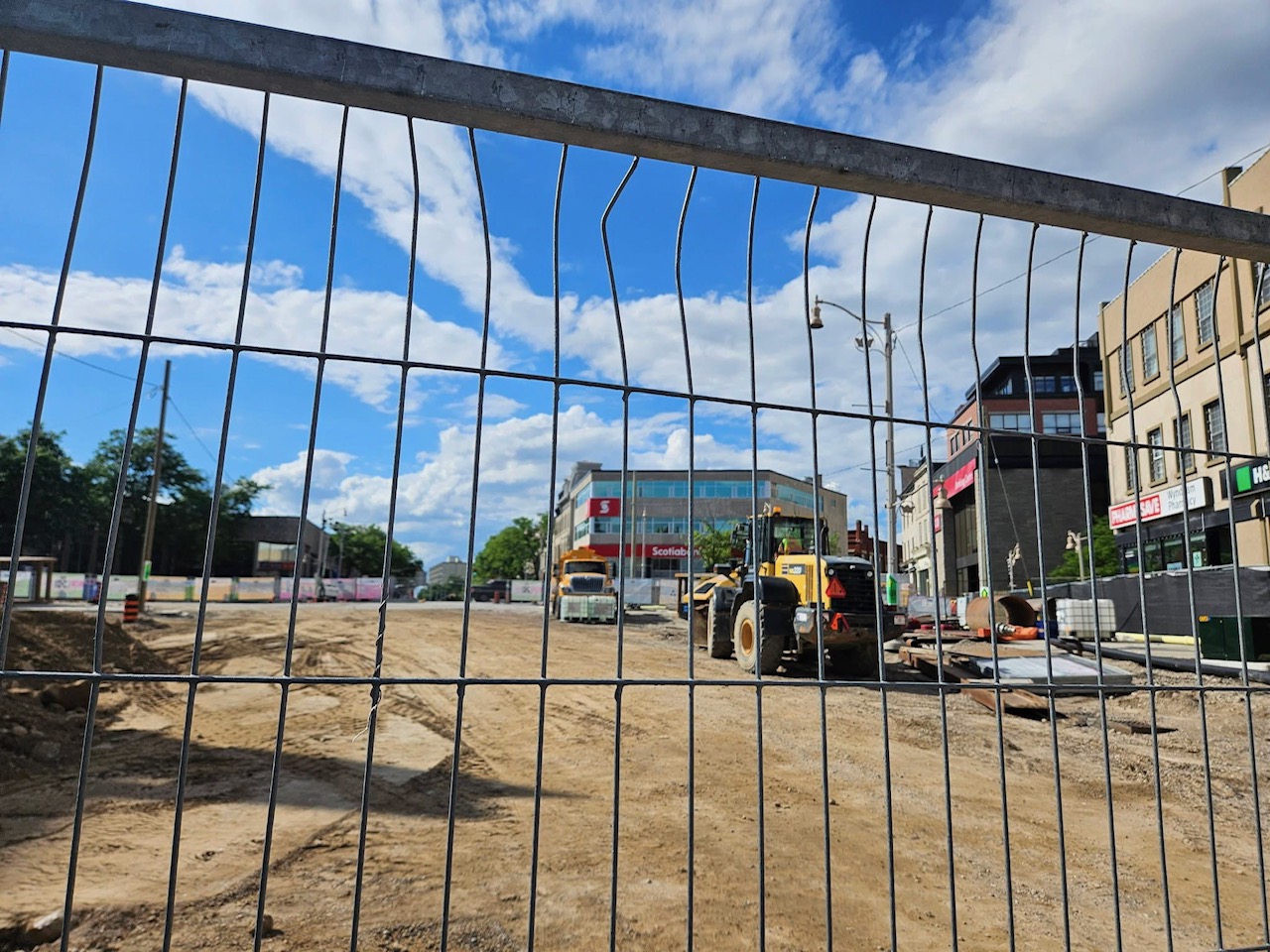 Next, another council motion this time on Parking Mitigation Opportunities Downtown, which came from Ward 2 Councillor and Downtown Guelph Business Association rep Carly Klassen. The motions asked council staff to find “operationally feasible” parking mitigation efforts to support downtown businesses above and beyond the existing mitigation efforts already in place. That would come with a price tag of up to $25,000 that will be paid from the Downtown Infrastructure Renewal Program mitigation budget that could then be combined with matching funds from the DGBA. The motions presented in the meeting added a fourth line not in the agenda about requesting the next mayor to top up those funds in their budget.
Busuttil offered an amendment to Klassen’s motion to add transit options along with the parking ones, though Guthrie later countered quite candidly that downtown businesses are not looking for transit options. In terms of what the mitigations might be, DCAO Colleen Clack-Bush said that they’d rather not talk about free transit or parking since those things are valuable to the City, and free parking is already being offered on the Macdonell Street lot. Caton offered the suggestion of downtown businesses sponsoring discounted bus passes, but there didn’t seem to be a lot of enthusiasm on Klassan’s part to follow up in that. The four motions were approved.
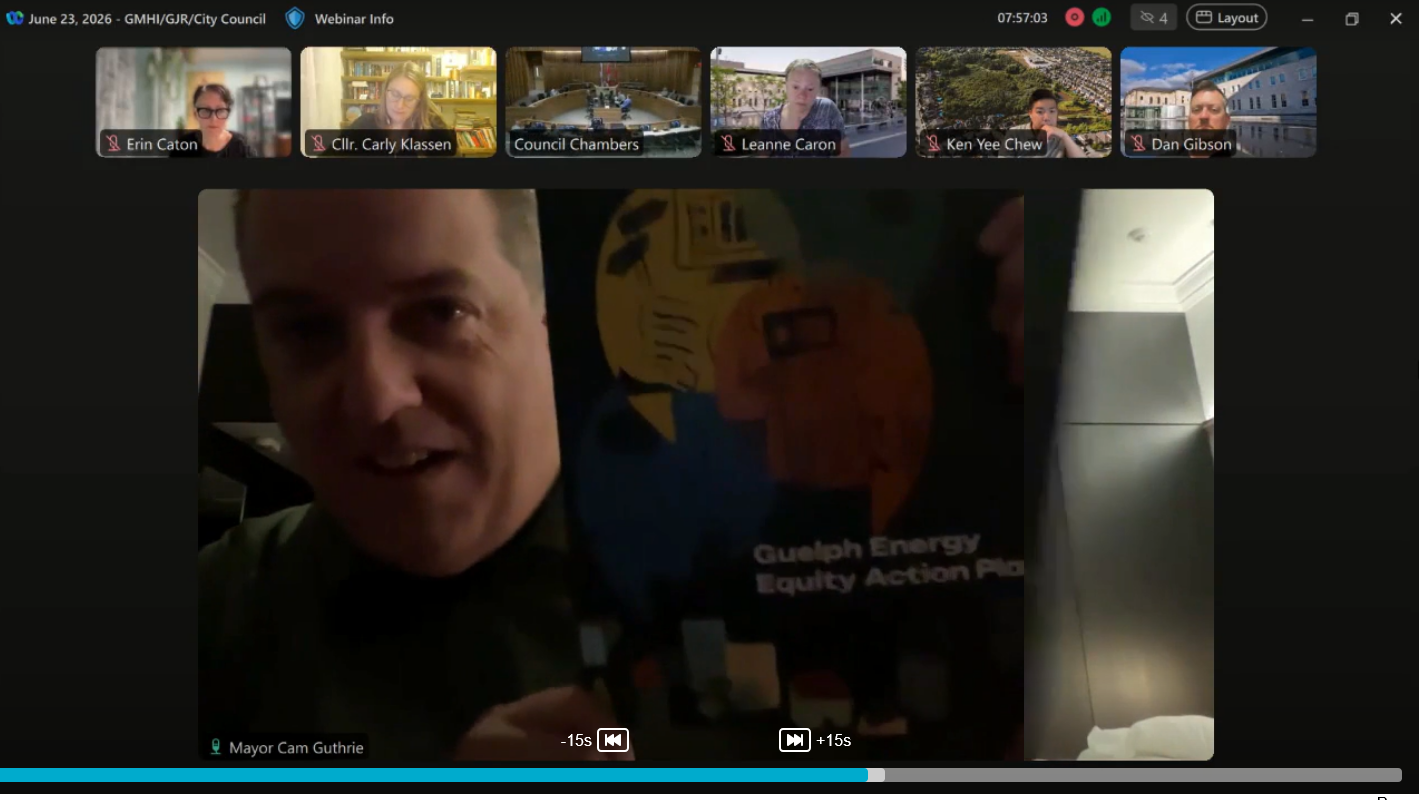
Advancing Energy Equity in Guelph was approved rather swiftly after one delegate, with Guthrie noting that he had several printed copies that he was about to handout at the Global Covenant of Mayors to European leaders suffering serious heatwaves back home.
Then, council briefly revisited the Community Investment Strategy Update with one delegation from the chair of the Eden Mills Writers Festival who asked for community grant funds to be separated into different streams so that arts groups are competing with social welfare groups for the same pot. It was noted though that the new microgrant program will be offered in streams even though the multiyear community benefit grants are not.
Advancing Energy Equity in Guelph and the Community Investment Strategy Update were both approved.
 With the clock ticking to 11 pm, that left one item, the most controversial one of all, the McQuillan’s Bridge Municipal Class Environmental Assessment. At Committee of the Whole, council approved the rehabilitation of the historic bridge, but not without some vocal dissent from a couple of members, the question was whether or not anyone was in a mood to reconsider.
Three delegates spoke to the historical value of the bridge, and then the fighting started. Responding to one delegate’s mention of hypocrisy around designating a bridge and then decided to demolish it, Councillor Dan Gibson said he took exception because council last year approved components of the conservatory on the University of Guelph campus and then approved its demolition in the same meeting. Guthrie took exception to another delegate who said that some members of council were overly simplifying the debate as “old bridge equals bad and new bridge equals good”, at least so far as the cost goes.
Many of the same points were reiterated including time spent (and money wasted) at the Ontario Land Tribunal, the City’s culpability in demolition by neglect, the potential life cycle of the two options, and the other capital priorities in the forecast. Before the vote, Guthrie had a vague warning about how “people were watching” this vote, and how the city can have bridge here and save a million dollars too, but nothing changed from Committee of the Whole with Mayor Guthrie, and Councillors Gibson, Billings, Richardson, and Chew being the only ones to vote against staff’s preferred option for the bridge. Neglected no more, pending budget approval, work should begin on the McQuillan’s Bridge in 2028.
The meeting wrapped five minutes for 11 pm thus avoiding a vote to go beyond.
Click here to see the complete recap of the meeting.

