
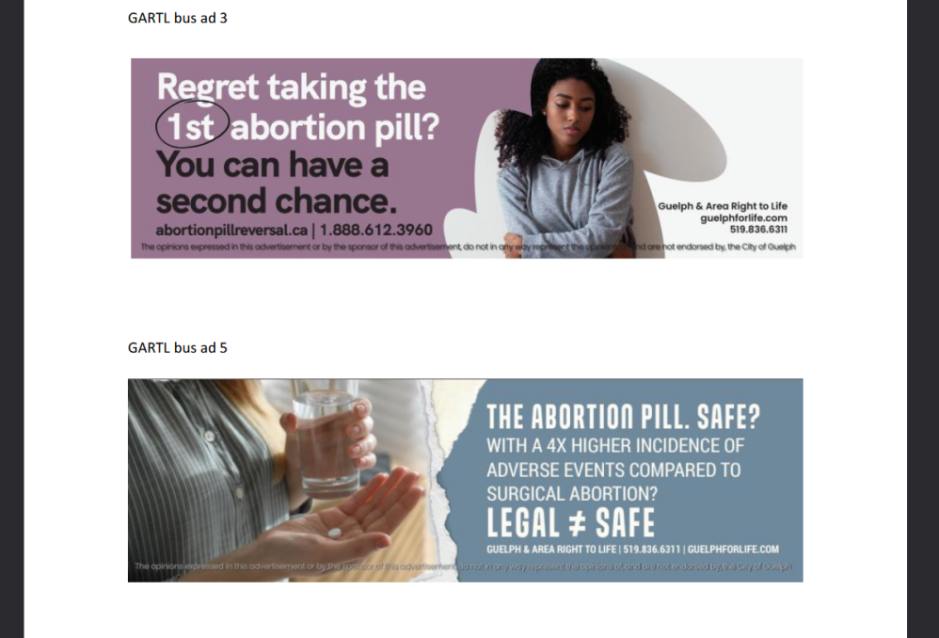
Just when you thought you were out, they pull you back in… Just over two years after the Ontario Superior Court of Justice said that the City of Guelph didn’t offer a good enough justification for removing three anti-abortion bus ads from Guelph Transit vehicles, the same group is back with a complaint about the City’s refusal to post a new ad. A meeting of the Advertising Review Panel next Friday will determine what happens next.
The two ads in question, which you can see above, promote a website offering information about progesterone, which is a steroid hormone that women secrete in the first 10 weeks of pregnancy. According to the U.S. National Library of Medicine, “Progesterone plays a vital role in the maintenance of the uterus during pregnancy. As such, an important issue of concern regarding the loss of this steroid hormone correlates with miscarriage and pre-term labor.”
While progesterone has it uses, it can also come with adverse affects with chronic use including abdominal cramps, back pain, vaginal bleeding, hypertension and dizziness. For their purposes, Guelph & Area Right to Life and similar groups are promoting progesterone as a way to reverse a medical abortion, which is performed using a combination of two medications: mifepristone and misoprostol. After taking mifepristone, you wait six to 48 hours before taking misoprostol to complete the treatment, but many anti-abortion groups alleged that if take progesterone before you take misoprostol you can stop a medical abortion.
“But these claims haven’t been proven in reliable medical studies — nor have they been tested for safety, effectiveness, or the likelihood of side effects — so experts like the American College of Obstetricians and Gynecologists reject these untested supposed treatments,” notes a post on Planned Parenthood.
The medical evidence that progesterone can “reverse” an abortion remains sparse, and part of the problem in accruing that evidence seems to be the dangers of studying it. In 2019, a University of California, Davis study was cancelled after three of 12 women receiving progesterone had to be taken by ambulance to the hospital for vaginal bleeding.
Despite this easily Google-able information, Guelph and Area Right to Life said in a letter provided for the meeting that “over 4,000 mothers, including Canadian mothers have their child in their arms because of the abortion-pill reversal method.” Although much of GARTL’s argument in favour of the ads are based on the Right to Freedom of Expression, they also affirm in their supporting documents that the science of reversing a medical abortion is sound. The City of Guelph apparently disagrees.
“The ad in question directs people to a website that provides information that could be construed as medical advice, and the subject matter of which both the Society of Obstetricians and Gynecologists of Canada and the American College of Obstetricians and Gynecologists have issued statements asserting that abortion pill ‘reversal is not supported by science,” said Laura Mosseau, manager of strategic communications at the City, in a email dated August 16, 2023.
“Similar to our rationale for not approving the other ad making claims about a legal and Health Canada approved treatment, there are also legal risks to the City in allowing this information to promoted on City property.”
The SHORE Centre, which provides medication abortions in Guelph through the Guelph Community Health Centre, agrees. “The ads, claiming that medication abortions can be ‘reversed’ after the first pill, and that the abortion pill isn’t safe are not supported by scientific evidence and are designed to generate fear of this safe and effective medication,” said a statement posted on social media.
SHORE also notes that “Abortion pill use has a lower risk of serious complications than surgical abortion. Childbirth is 4 times riskier than the abortion pill for serious complications,” which seems to directly reference one of the two ads that seems to inverse that statistic provided by SHORE. According to the NLM, “The pregnancy-associated mortality rate among women who delivered live neonates was 8.8 deaths per 100,000 live births. The mortality rate related to induced abortion was 0.6 deaths per 100,000 abortions.”
The review will take place in the council chambers at City Hall on Friday April 12 at 2 pm. Jakki Jeffs, president of Guelph and Area Right to Life will present her case, and Allison Thornton, associate solicitor for the City, will respond before the panel adjourns in-camera to reach a decision.
The members of the panel include the general managers of Strategic Communications and Community Engagement, Guelph Transit, Culture and Recreation, and Economic Development and Tourism, as well as the Deputy CAO of Corporate Services who acts as chair.

