
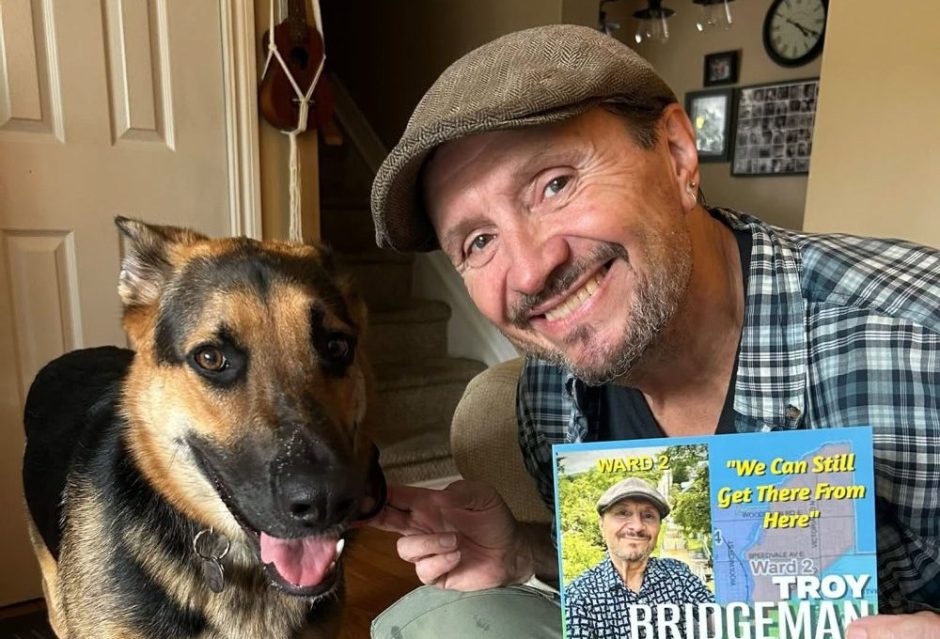
“As a journalist, I regularly hear people complaining about the amount of control our democratically-elected governments have over our lives yet they say very little about the growing control tech companies have over our lives and over our governments for that matter. If you want to protect democracy and ensure your government represents your needs and protects the interests of future generations, inform yourself and – VOTE!!!!!”
Why do you want to be a city councillor?
People have been encouraging me to get into politics for years. I chose, instead, to indulge my passion by being a journalist and for decades I was fully immersed in the world of politics. I have met and interviewed Prime Ministers, Premiers, Opposition Leaders, Ministers, MPs, MPPs, Mayors, Councillors, as well as candidates and staffers from every level of government. There are a few exceptions, but I genuinely liked most of them and admired them for their service.
I often wondered if I could live up to the standard I held them to as public servants and now is the time to put myself to the test.
I know it is going to be a challenge especially with the world getting crazier by the minute, but I am as ready as I’ll ever be.
What is your background and experience, and how do you think that will serve you as a city councillor?
I was born in Guelph at St Joseph’s Hospital on August 28, 1961. For the first nine years of my life I lived with my parents and siblings in a house on Hearn Ave in Guelph. My family moved to a farm in Puslinch in 1970 and we were bussed to elementary and high school in Guelph.
My parents enrolled me in piano lessons when I was three years old and at the tender age of nine, my younger siblings and I began singing professionally in a country/pop group called the Fearless Five. Some might say my talent peaked in those formative years but I continue to write, perform and record music.
My first real job was as a tobacco primer on my Uncle’s farm when I was 14 and I have held several other jobs, almost all in Guelph, but too long to list, over the past 51 years.
I started working as a journalist in the late 80s but wasn’t certified until 1991 when I graduated from the Print Journalism program at Conestoga College. I freelanced for the Guelph Daily Mercury and several arts and culture magazines until they all went out of business. I accept no responsibility for that outcome.
I went back to college in the early 2000s to study broadcast journalism and worked for Rogers Television for about three years after that.
I describe myself as a freelance multimedia journalist and continue to produce “content” for any news service that will pay for it and for my personal multimedia projects.
Given Strong Mayor Powers, how do you see your role as a city councillor when the mayor can override the will of council with just three votes?
I am not a fan of Strong Mayor Powers and given the highly polarized nature of modern politics, I worry about those powers being abused. I can foresee no issue at this time where I would support the imposition of these powers and I will resist any attempt to do so. We have to work together as elected representatives to find acceptable compromises or admit that democracy is just another idealistic, antiquated concept.
Affordability is important to a lot of voters, and municipal budgeting can be very difficult. How will you balance the needs of a growing city with the demands for low or zero tax increases over the next term?
The recent property tax increase has been universally unpopular with homeowners. I have yet to meet anyone who says we don’t pay enough taxes. I will oppose any new tax increases for the next two years and after that keep increases in step with accepted cost of living formulas.
Council this past term has done a lot of housing policy, but that hasn’t translated into more shovels in the ground. How will you help close the gap over the next four years?
Property development and home building are essential and legitimate businesses. All legitimate businesses need to turn a profit to stay in business. We can’t expect these businesses to build homes at a loss. However, more shovels in the ground does not always translate into more affordable homes. This is a complex issue that requires action at all levels of government. I was against the Ford government eliminating development fees and making it cheaper for homebuilders to build homes most people, especially first-time homebuyers, can’t afford. Cutting those fees reduced municipal revenues and did nothing to improve the housing crisis here. We have to get creative at the municipal level and put pressure on the other levels of government to get ahead of this problem.
Aside from the demands for more housing, land use planning also means assuring that there’s enough room to account for growth in business, institutional and commercial land uses, how will you balance all these priorities?
We have vacant land in designated business zones throughout the city so, we should be encouraging new businesses to set up there before rezoning residential and green spaces. Every application should be considered relative to the number of new, good jobs they are bringing to the city and their contribution to the community as a whole. Local, independent businesses should be prioritized.
Water availability is a growing concern. How will you ensure that Guelph has the capacity it needs to support this growing city?
By listening to experts and challenging developers and businesses to come up with better processes and policies to protect our water resources. This is another example of the negative impact of partisan politics. If you appear to care about protecting our water resources you are labeled as a left-wing radical, but none of us can survive without clean, fresh water. Limiting the growth of AI data centres is a good start.
Trust in government and institutions is a major issue. How will you keep your constituents well informed about city hall business, and help them feel included when it comes to decision making?
I think my training and experience as a journalist will help me in that respect. I intend to be very transparent and to use the journalistic skills I have honed over the last 3.5 decades to clearly and concisely communicate what is happening in council to my constituents using the tools and platforms I already use to report on community events and issues.
What would you say is *your* issue? What is the one thing you want to talk about on the campaign trail this fall and have a thorough debate about it before this election is over?
Affordability, because every issue I am passionate about falls under that label. I have seen how individuals and groups in the city have worked to feed and clothe the homeless and food insecure people in our community.
The late poverty activist Ed Pickersgill once told me with a mixture of pride and sardonic wit that, “Guelph has the best fed and best dressed homeless people in Canada.”
Often the people volunteering are members of that community themselves. The generous nature of Guelphites is something we should celebrate, but it will be tested as the situation worsens.
We must do what we can to support local, independent businesses so they can compete with the larger chains attempting to, move in, put them out of business and monopolize the retail markets.
We must also look at local ways to regulate the growth of AI and the tech industry and its influence on nearly every aspect of our lives.
What perspective do you think you will bring to council that is not currently reflected?
I am a journalist and for more than three decades I have been holding politicians and others in power to account. I am not a political partisan and as a journalist I am professionally and ethically bound to looking at issues with as much objectivity as possible. I have been saying that “there is too much politics in politics” these days and I am concerned by how much partisan ideology, common in Federal and Provincial politics, has seeped into municipal government. Why, for example, are homelessness and environmental protection, partisan issues?
I am reluctant to describe myself as a centrist because that too comes with an “either-or” partisan label. I intend to look at issues objectively and make decisions, to vote, based on established facts and economic realities.
Is there anything else you want to tell voters as they make their decision?
For the last four years I have been assisting in the research and producing a podcast with Guelph professor and author Christopher DiCarlo, called All Thinks Considered, that looks at the growing impact of AI tech. The podcast is funded by a think tank in the UK called Convergence Analysis. Guests of the podcast have included military and government consultants as well as journalists and celebrity intellectuals such as Steven Pinker and Peter Singer.
Much of the topics of discussions have been over my head and above my pay grade, but I have grasped some of it.
The consensus is that AI technology is going to fundamentally change society in irreversible ways. I won’t get into every aspect, but one significant impact will be economic.
Two scenarios were recognized.
One, is that AI promises/benefits fail to materialize and the stock market bubble, fuelled by those promises, bursts leading to a catastrophic global market crash.
Two, is that AI lives up to all its potential and 70 per cent of all human jobs are replaced/eliminated by AI software.
The impact this will have on all of us, not to mention all levels of government responding to rampant unemployment and dramatic reductions in tax revenue, is almost unimaginable. Homelessness will become the norm. Crime will reach historic levels as people become desperate to survive.
It sounds like the plot to a horror sci-fi movie, but it is a genuine threat that we are not prepared for.
Passing by-laws that punish and marginalize the poor and homeless; that serve to relocate them away from our affluent gaze, is short-sighted and cruel, especially when we do nothing to mitigate the impact of AI.
In many cases the government and the general public are embracing the technology. We trade our data (our personal information and identification) away to privately-owned tech companies, for the joy of creating idealized, digital images of ourselves or to produce art and literature we are either too lazy or unskilled to make.
Whether or not these companies are actively subverting democracy, it is in their financial interest to do so, and I have seen little evidence they care about anything else.
One last, brief observation, if I may, about the foolishness of political partisanship.
The two dominant and competing socio-economic systems we have adopted in one way or the other since the dawn of the industrial age – capitalism and socialism – are dependent on one element “the worker” and by extension, “the consumer”. The worker to manufacture the product and the consumer who earns enough money working to buy the product.
How do either systems work in principle when 70 per cent of the workers aren’t working?
We’ll save that rant for another day.
As a journalist, I regularly hear people complaining about the amount of control our democratically-elected governments have over our lives yet they say very little about the growing control tech companies have over our lives and over our governments for that matter.
If you want to protect democracy and ensure your government represents your present needs and protects the needs and interests of future generations, inform yourself and – VOTE!!!!!

