
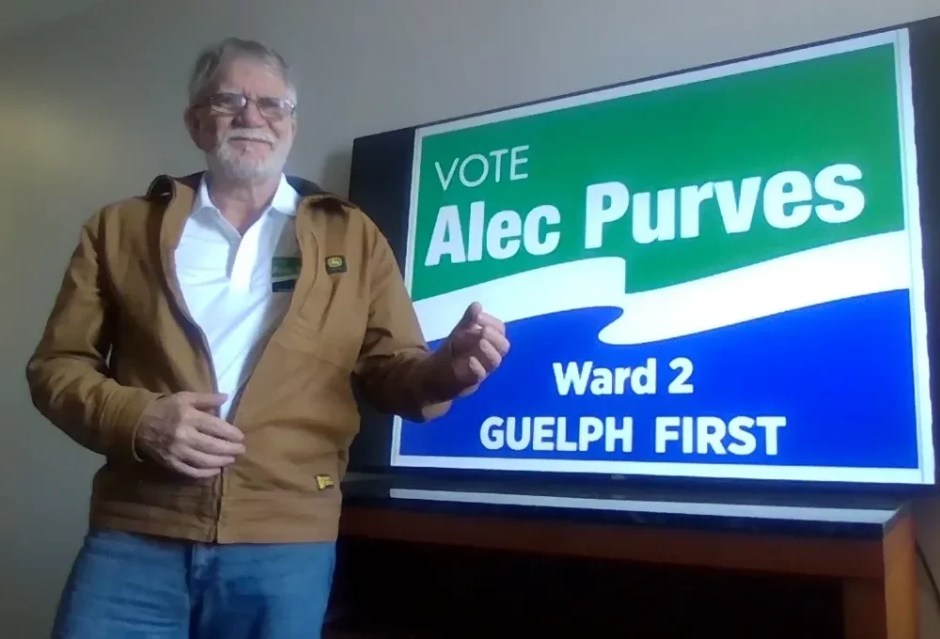
“The unique perspective I bring to Guelph City Council—which is currently lacking—is the lived experience of a frontline worker combined with the technical background of a financial auditor. Most council members view the city’s challenges from a high-level, corporate, or purely political lens. I live and work directly at the intersection of Guelph’s most pressing fiscal and social issues.”
Why do you want to be a city councillor?
I want to be a City Councillor because I care deeply about Guelph and the people who Live here. I believe local government has a direct impact on our everyday lives – from taxes and housing to transit, public safety, food security and the condition of our neighbourhoods.
I’m running because I want City Hall to be more accountable, transparent and responsible with taxpayer’s money. I also believe fiscal responsibility and compassion can go together; we can reduce waste while strengthening support for people who are struggling.
I am not running for a title – I am running to serve.
What is your background and experience, and how do you think that will serve you as a city councillor?
My background in blue-collar work, extensive international and local not-for-profit governance, and decades of community service; has taught me the value of hard work, practical problem-solving and looking out for your neighbours. I want to bring that perspective to Council, listen to residents, and work collaboratively on practical improvements that make Guelph a better and more affordable place to live.
Given Strong Mayor Powers, how do you see your role as a city councillor when the mayor can override the will of council with just three votes?
I strongly believe that I can offer a bridge to counter any mistreatment of Mayoral Powers. As a communitarian; I can offer a unique perspective to work and negotiate with all Council members.
With 12 Councillors plus the Mayor, Council has 13 members total. You would need at least 9 votes to override the veto.
Affordability is important to a lot of voters, and municipal budgeting can be very difficult. How will you balance the needs of a growing city with the demands for low or zero tax increases over the next term?
Balancing robust city growth with low or zero property tax increases requires moving away from traditional “spend-and-grow” municipal budgeting. It requires transforming how a city generates revenue, manages its internal operations, and designs its infrastructure. Municipalities can continue growing while keeping property taxes flat or minimal by focusing on the following five mechanical levers:
1. Optimize the Growth-to-Revenue Ratio (Smart Density)
Growth does not inherently have to trigger high infrastructure costs if the city prioritizes infill development and intensification rather than suburban sprawl. Maximize existing infrastructure: Build housing where water, sewage, roads, and transit networks already exist to prevent expensive capital expansions. Broaden the tax base: Approve multi-unit residential and commercial mixed-use properties to generate higher property tax revenue per square metre without raising the individual tax rate. Leverage development charges: Ensure that property developers pay the full, real cost of new infrastructure (parks, roads, water mains) required by their projects so existing taxpayers do not foot the bill.
2. Implement Line-Item “Value-for-Money” Operational Audits
Instead of reducing critical public services to save money, cities must aggressively hunt for internal corporate inefficiencies. Audit third-party contracts: Challenge high consultant fees and bring specialized work back in-house when it is more cost-effective. Freeze corporate expansions: Pause any increases to upper-management municipal salaries and council pay raises during tight budget cycles. Automate administrative workflows: Digitise building permits, licensing, and fee payments to lower the long-term cost of city administration.
3. Deploy Low-Cost, High-Return Infrastructure Solutions
Cities often default to multi-million dollar engineering projects when more affordable, innovative alternatives are available. Utilize nature-based infrastructure: Use low-cost methods like phytoremediation (using specific plants and trees to clean up toxic brownfield soils) instead of launching multi-million dollar soil excavation and trucking contracts. Prioritize preventative maintenance: Patching roads and servicing water mains early costs a fraction of the price of replacing entirely failed systems later on, protecting the long-term capital budget.
4. Monetize Surplus Municipal Assets
A growing city can unlock hidden revenue by managing its own real estate portfolio more entrepreneurially. Lease air rights and surplus land: Partner with private developers to build affordable housing on top of city-owned parking lots or transit hubs, creating long-term lease revenue streams for the city. Sell non-strategic assets: Liquidate unused commercial land or buildings that are sitting vacant and costing the city money to secure and maintain.
5. Secure Non-Tax Revenue Streams
Relying strictly on property taxes strains residential homeowners. Cities must aggressively pursue alternative funding buckets. Form public-private partnerships (P3s): Bring in private sector capital to co-fund major growth projects like recreation complexes or transit extensions. Maximize upload opportunities: Lobby higher tiers of government (Provincial and Federal) to fully fund social infrastructure programs, mental health initiatives, and emergency shelters. This removes structural social costs from the local property tax base.
Council this past term has done a lot of housing policy, but that hasn’t translated into more shovels in the ground. How will you help close the gap over the next four years?
To close the gap between housing policy and actual construction over the next four years, municipal leadership must pivot from writing rules to actively clearing the path for builders. Passing policies like fourplex zoning or removing parking minimums is meaningless if applications sit in bureaucratic purgatory or if inflation makes projects financially impossible.
My approach to turning policies into active job sites focuses on four mechanical pillars:
1. Approve Infill and Multi-Unit Housing Consistently
A policy on paper means nothing if council votes it down in practice. I have publicly criticized the political inconsistency where council members vocalize concern about the housing crisis but subsequently vote against missing-middle initiatives, such as fiveplexes. Closing the construction gap requires a council that stands by its own rules, eliminates NIMBY-driven delays, and provides developers with the predictable environment they need to secure financing and break ground.
2. Streamline Permitting with “Deemed Approvals”
Long municipal approval wait times kill project viability due to carrying costs and high interest rates. I advocate for enforcing hard statutory timelines on the municipal planning department. If the city fails to process an inline-policy housing application within 12 months, the project should face an automatic fee rebate or a “deemed approved” mechanism. Speeding up approvals removes the administrative drag that keeps projects trapped in the pipeline.
3. Incentivize High-Density Transit Developments
The city needs to align infrastructure choices with development incentives. I have championed projects like the Skyline proposal at Carden/Macdonell, which directly answers the call for downtown density and public transit use without consuming land for massive parking lots. By actively supporting and prioritizing applications that maximize existing infrastructure—like those near the Guelph Transportation Hub—we lower the structural cost of development and get housing built faster.
4. Reform Development Charges to Encourage Starts
Loading massive development charges upfront onto a project before a shovel hits the dirt causes builders to delay or cancel construction. I advocate for restructuring how development infrastructure is financed. Instead of demanding massive upfront cash, the city should work to amortize these capital costs over the long lifecycle of the asset or waive them entirely for dedicated, purpose-built affordable rental housing. Lowering the initial financial barrier to entry immediately makes projects viable in a tough economy.
Aside from the demands for more housing, land use planning also means assuring that there’s enough room to account for growth in business, institutional and commercial land uses, how will you balance all these priorities?
Balancing housing needs with employment, institutional, and commercial land uses requires shifting away from single-use zoning and moving toward complete, transit-supportive communities. A healthy city cannot just be a bedroom community; it must have a robust, localized tax base to remain financially sustainable without overburdening residential property taxpayers. Here is how to mechanically balance these competing land use priorities over the next four years:
1. Mandate Mixed-Use Vertical Zoning
Separating commercial shops from residential neighbourhoods forces sprawling land use and increases infrastructure costs. Commercial Ground Floors: Require new mid-rise and high-rise developments along major corridors to dedicate the ground floor to commercial, retail, or medical services. Residential Upper Floors: Build housing directly above these active commercial spaces to maximize land utility.Built-In Foot Traffic: This provides local businesses with immediate, walking customers while adding housing supply on the exact same footprint of land.
2. Protect and Intensify Employment Lands
Losing industrial and business lands to residential conversions permanently damages the city’s economic future.Strict Boundary Protection: Heavily restrict the conversion of designated employment zones into low-density residential developments.Vertical Industrial & Flex Spaces: Encourage multi-story office, light industrial, and flexible tech-hub spaces to generate more jobs per acre.Tax Base Balance: Maintaining a strong commercial and industrial tax base ensures the city has the revenue to support growing infrastructure without raising residential property taxes.
3. Co-Locate Institutional Services inside Housing Hubs
Major public institutions like hospitals, schools, daycares, and community centres require massive amounts of land that often conflict with housing footprints. Integrated Public Spaces: Design new institutional spaces directly into the podiums of large residential or commercial complexes.Shared Infrastructure: Partner with school boards, healthcare providers, and childcare operators to build multi-functional facilities that share parking, utilities, and green spaces. Service Accessibility: This ensures that as housing density scales up, the necessary healthcare and community infrastructure scales up right alongside it in the exact same neighbourhood.
4. Direct Growth to Existing Transit Infrastructure
Directing all types of growth—business, commercial, and residential—to the same core corridors prevents land-use conflicts and gridlock. Transit-Oriented Communities: Concentrating high-density employment and housing around major hubs, like the Guelph Transportation Hub, allows workers and residents to move efficiently without consuming vast amounts of land for surface parking lots. Reduced Sprawl: This protects surrounding natural spaces and agricultural lands while maximizing the efficiency of the city’s existing infrastructure.
Water availability is a growing concern. How will you ensure that Guelph has the capacity it needs to support this growing city?
Infrastructure capacity is absolutely a growing concern for Guelph residents. A city can pass all the zoning and housing policies it wants, but if the underlying water mains, sewage plants, transit fleets, and electrical grids hit a hard ceiling, growth grinds to a halt.Guelph relies primarily on a finite underground aquifer for its water. This means the city faces strict natural constraints.To ensure Guelph has the capacity it needs to support rapid development without collapsing public services or triggering massive tax spikes, municipal policy must focus on four execution pillars:
1. Enforce Aggressive Servicing Allocation Bylaws
Municipalities cannot allow finite capacity to be hoarded by inactive projects. Guelph introduced a Water and Wastewater Servicing Allocation Policy. This policy establishes an essential tool for managing growth. Use-it-or-lose-it limits: Building capacity is only held temporarily during planning. If a developer sits on land without pulling permits, the city must reclaim and reallocate that water and sewage capacity to “shovel-ready” housing or business projects. Rigorous capacity tracking: Every new housing complex or commercial application must go through strict technical checks to ensure it does not compromise system resiliency for existing neighbourhoods.
2. Prioritize Infill Density Over Suburban Pipe Extensions
Expanding the physical borders of the city to accommodate growth creates a long-term financial deficit. Extending miles of new pipes and roads costs significantly more than maximizing what is already in the ground. Utilize existing capacity: Directing growth to urban transit corridors and downtown zones allows new builds to plug directly into pre-existing water and wastewater networks. Infrastructure efficiency: Multi-unit buildings consume less water and create less infrastructure strain per capita than sprawling single-family subdivisions, preserving room for industrial and institutional expansion.
3. Implement Strict Vetting for High-Consumption Commercial Users
To balance housing growth with commercial needs, the city must be highly selective about the types of businesses it permits. Protect the aquifer: High-consumption facilities—such as massive AI data centres—threaten to drain finite municipal water supplies and overload the local power grid. Prioritize high-yield employment: The city must prioritize low-water, high-density employment sectors (like advanced manufacturing, technology hubs, and institutional medical spaces) that generate high tax revenue without exhausting local utility capacity.
4. Leverage Upper-Tier Infrastructure Funding
Local property taxpayers cannot afford to foot the entire multi-million dollar bill for upgrading heavy utilities like water treatment plants or transit garages. Capital master plans: The city’s multi-million dollar water, wastewater, and stormwater master plans require outside funding. Maximize provincial and federal grants: The city must aggressively tap into provincial programs like the Building Faster Fund and federal green infrastructure grants. This strategy was recently utilized for the groundbreaking of the new Guelph Transit & Fleet Services Facility, ensuring structural growth is funded by higher levels of government rather than local property taxes.
Trust in government and institutions is a major issue. How will you keep your constituents well informed about city hall business, and help them feel included when it comes to decision making?
To restore trust in local government, a city councillor must bridge the gap between City Hall bureaucracy and the everyday resident. Trust is built through structural transparency, early communication, and meaningful, interactive community engagement.My strategy for keeping Ward 2 well-informed and actively involved in municipal decision-making rests on four pillars:
1. Shift from “Notification” to “Early Consultation”
Too often, residents feel excluded because they only learn about a development project or a major street redesign after the plans are practically finalized. Proactive outreach: I will notify surrounding neighbourhoods the moment a development or infrastructure proposal enters the preliminary planning phase, rather than waiting for the legally required, late-stage statutory public meeting. Plain-language summaries: I will translate complex, multi-hundred-page city staff reports into short, clear summaries so residents can quickly understand exactly how a decision impacts their daily lives, tax bills, and neighbourhoods.
2. Implement Accessible, Alternating Town Halls
Relying solely on formal council meetings at City Hall excludes residents who work non-traditional hours, lack childcare, or face transportation barriers.Hybrid options: I will host bi-monthly Ward 2 town halls that alternate between in-person community spaces and accessible online livestreams. Two-way dialogue: These sessions will not just be presentations from the city; they will feature open question-and-answer periods where residents can directly voice concerns and pitch neighbourhood improvements.
3. Establish a Structured “Ward 2 Citizens Advisory Panel”
To ensure decision-making truly includes the community, council needs to hear from a diverse cross-section of residents, not just the loudest voices in the room.Diverse representation: I will form a voluntary citizen advisory panel composed of Ward 2 residents from various backgrounds, including renters, homeowners, small business owners, seniors, and students. Collaborative review: This panel will meet to review major upcoming municipal files—such as the annual city budget—providing direct community feedback to guide my votes at the Council table.
4. Provide Digital Accountability and Voting Records
Constituents should never have to guess why their representative voted a certain way on a critical issue. Regular digital updates: I will maintain an active, public digital newsletter and social media presence detailing upcoming council agendas and explaining my policy positions before votes occur. Transparent explanations: Following major, contentious council decisions, I will publish a clear breakdown of how I voted and the specific fiscal or social rationale behind that choice.
What would you say is *your* issue? What is the one thing you want to talk about on the campaign trail this fall and have a thorough debate about it before this election is over?
The single most important issue to champion on the campaign trail this fall—and the one that demands a thorough, unfiltered debate before election day—is the intersection of fiscal sustainability and social compassion.
This core theme can be framed as: “How can Guelph remain an affordable city for everyday taxpayers while simultaneously funding the vital social infrastructure our most vulnerable residents desperately need?” A full debate on this issue before the election is critical for several key reasons:
1. Forcing a Choice Between “Tax Hikes” and “Service Cuts” is a False Dichotomy
The political debate is often oversimplified: one side wants to raise property taxes to fund social programs, while the other wants to cut services to lower taxes. This narrative must be actively challenged. A thorough debate needs to focus on hunting down internal municipal inefficiencies, freezing bloated politician pay raises, and auditing expensive third-party contracts to find savings. Those exact savings can then be redirected back into frontline community services without adding a single dollar to the local tax burden.
2. Confronting the Invisible Debt Wave
The public deserves a transparent debate about the city’s true financial health. While the current council might celebrate keeping immediate costs down, they have quietly left over $111 million in deferred property taxes and mounting capital debt waiting until after the election wraps up. Candidates must be forced to answer on a debate stage exactly how they plan to manage this structural financial deficit without triggering massive, sudden tax spikes for homeowners and seniors down the road.
3. Demanding Practical, Low-Cost Innovation
Debating this topic allows for the introduction of common-sense, creative solutions that protect both the environment and the city budget. For example, rather than defaulting to a multi-million dollar excavation contract to clean up the contaminated IMICO brownfield site, the debate should centre on nature-based engineering like phytoremediation (using plants and trees to naturally draw out soil toxins). This proves to voters that a candidate can be an environmental steward and a strict fiscal hawk at the exact same time.
4. Direct Accountability vs. Special Interests
Ultimately, this debate highlights who a councillor truly answers to. When a campaign caps individual donations at just $25 and pledges to donate the majority of their councillor salary right back to local food banks, it sets a completely new standard for public service. A dedicated debate on this issue forces opponents to justify their reliance on wealthy corporate developers or special interest groups, shifting the power back to everyday, working-class residents.
What perspective do you think you will bring to council that is not currently reflected?
The unique perspective I bring to Guelph City Council—which is currently lacking—is the lived experience of a frontline worker combined with the technical background of a financial auditor. Most council members view the city’s challenges from a high-level, corporate, or purely political lens. I live and work directly at the intersection of Guelph’s most pressing fiscal and social issues. My background introduces four distinct perspectives to the council table:
1. Direct Frontline Ground Reality
The Current Council Gap: Council relies almost entirely on filtered staff reports, administrative data, and academic studies when discussing downtown safety, housing, and social services.
My Perspective: Working as a night auditor and managing downtown block security overnight on Macdonell and Carden streets means I see the exact reality of Guelph’s housing, mental health, and addiction crises firsthand every single night. I do not need a consulting firm to tell me what is happening downtown; I am there on the pavement keeping our streets secure.
2. A “Working-Class, Communitarian” Economic Lens
The Current Council Gap: The current political debate is polarized. One side focuses exclusively on business interests, while the other advocates for social spending without a clear plan to fund it.
My Perspective: Having spent years working in heavy labour environments like foundries and steel mills, I bring the perspective of a working person who understands the financial strain of inflation. My worldview is fundamentally communitarian — I believe that financial discipline and deep social investment are not opposing ideas, but a cohesive strategy required for community resilience.
3. Oversight Driven by Financial Auditing
The Current Council Gap: Council routinely votes through double-digit tax hikes, automatic developer accommodations, and major salary increases without line-by-line financial pushback.
My Perspective: My professional experience includes conducting financial reports and data auditing for local businesses. I look at the municipal budget with an auditor’s eye, searching for hidden operational inefficiencies, bloated consultant fees, and wasted tax dollars to ensure the City acts responsibly with public funds.
4. Deep Roots in Grassroots Voluntarism
The Current Council Gap: Politicians frequently attend community events for photo opportunities rather than rolling up their sleeves to do the actual work.
My Perspective: My commitment to public service is built on decades of active, boots-on-the-ground volunteer work. Whether volunteering overnight with the Royal City Mission, leading international humanitarian trips, or serving on the board of tri-Pride and community service clubs like the Lions Club; my focus is strictly on community care. I lead by example, which is why I cap campaign donations at $25 and pledge to donate the majority of my council salary back to local food networks.
Is there anything else you want to tell voters as they make their decision?
As you cast your ballot, the final thing to remember is that this election is a direct choice between continuing with the political status quo or choosing a completely new model of public service.
Local politics should not be a stepping stone for career politicians, nor should it be a playground for wealthy special interests. It belongs to you —the everyday workers, families, and seniors who keep Guelph running. When making your final decision, consider these four closing commitments:
1. Leadership That Leads by Example
Many candidates will promise to understand your financial pain while simultaneously voting to increase their own politician salaries. My campaign is built on absolute accountability. By limiting campaign donations to a maximum of $25, I ensure that my vote at City Hall can never be bought by wealthy corporate developers. Furthermore, by pledging the majority of my councillor salary directly back to local food banks and frontline community programs, I am proving that my motivation is pure public service, not personal financial gain.
2. A Proven Balance of Logic and Empathy
You do not have to choose between a candidate who is financially responsible and one who cares about social justice. We can hunt down internal city inefficiencies, audit expensive consultants, and freeze property tax hikes while simultaneously protecting our most vulnerable. True compassion requires fiscal discipline; if the city goes broke, it is the lowest-income residents who suffer first when services break down. I offer a balanced, common-sense approach that protects both your wallet and your community.
3. A Voice Born on the Frontlines, Not in a Committee Room
I am not viewing Ward 2’s challenges from the safety of a corporate office or through the filtered lens of a multi-page municipal staff report. I am out on our downtown streets overnight keeping people safe, working alongside our frontline volunteers, and listening to the real struggles of working-class families. I will bring that raw, honest, unfiltered ground reality directly to the Council table.
4. Unwavering Courage to Hold City Hall Accountable Firsthand
The Current Council Gap: Too many representatives wait until election season to voice opposition to bad policies, choosing compliance over conflict while sitting silently in chambers.
My Perspective: I do not just complain about bad policy online — I actively show up to fight it and offer solutions. I am the candidate who repeatedly went to City Hall, stood before Council as an official delegate, and spoke out directly against their tone-deaf politician pay raises.
A History of Action: I personally went to City Hall to warn Council about the looming municipal financial crisis long before it hit the headlines, and I stood at the microphone to warn against the dangerous, inhumane closing of the overnight warming centre. I bring the perspective of an active watchdog who has spent months defending the public interest directly inside the Council chambers before ever asking for your vote.
Thank you for your time.
Alec Purves
Ward 2 candidate
www.alecpurves2026.com

