
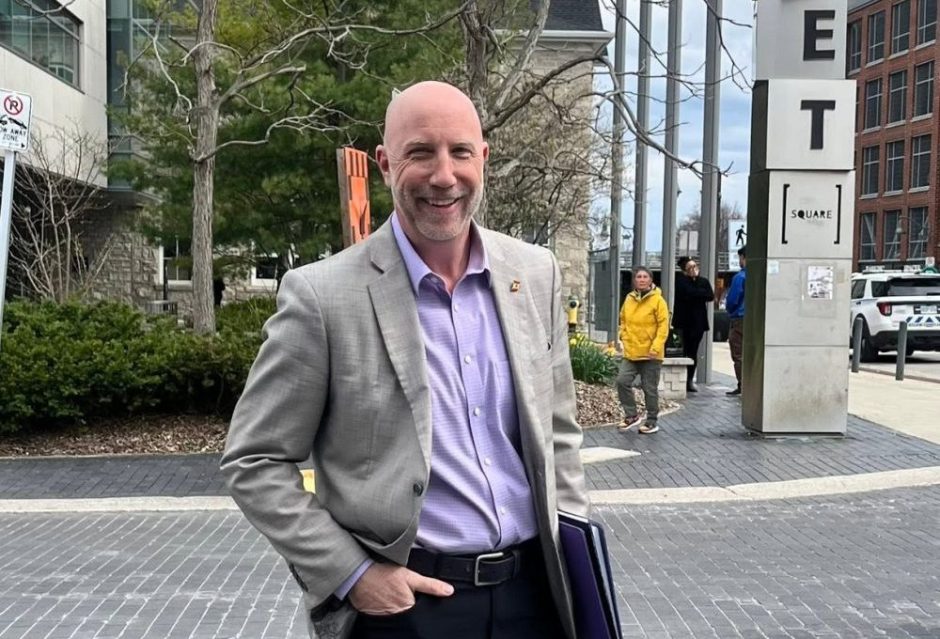
“I believe I will bring a combination of perspectives that is valuable at City Hall: a long-time Ward 5 resident, an educator, someone with a background in business and financial literacy, and someone who has spent his career listening to people and helping them make informed decisions. I also believe council needs to be more assertive in bringing the voice of residents into the development of public policy.”
Why do you want to be a city councillor?
I have been a public servant my whole life. I worked for a municipal summer camp as a student, I’m a public educator, and my wife works in public health. I love my community, Ward 5 and Guelph, and I want to listen to, represent and serve the people who call it home.
Knocking on doors across Ward 5 has made me concerned about some of the frustration I’m hearing from residents.
People are worried about affordability. They’re frustrated when they don’t understand why decisions are being made. They’re concerned about whether their tax dollars are being spent wisely. Increasingly, I hear people asking whether City Hall is actually listening.
I believe in good government. I believe in strong public services, strong communities, opportunity and helping people who need help. But those values depend on public trust.
That’s why I’m running: to listen, take care of the basics, and make responsible financial decisions that residents understand and believe in.
What is your background and experience, and how do you think that will serve you as a city councillor?
I’ve spent my career in education, and I currently serve as Director of Business Education and Financial Literacy at John F. Ross CVI. I’ve lived in Guelph and Ward 5 since 1999, where my wife and I raised our family.
Teaching has taught me how to communicate complicated issues clearly, listen to different perspectives and help people make informed decisions.
My background in business education and financial literacy is particularly relevant to municipal government. Council has limited resources and unlimited demands. Every budget is ultimately about choices and trade-offs, and I think residents deserve councillors who understand that.
But I also bring more than 25 years of living in Ward 5. I know this community, but I don’t want to assume that I know what everyone in it needs. That’s why I wanted to spend time canvassing Ward 5 before setting my priorities for council. I want my priorities to come from conversations with the people who actually live here, not from a campaign platform developed in isolation.
I’ve been asking residents what is working, what isn’t, what they’re worried about and what they want their next councillor to focus on. Those conversations have already shaped how I think about affordability, growth, infrastructure and trust in local government.
I don’t pretend to have all the answers. My approach will be to listen first, understand the problem, look at the evidence, consider the consequences and then make the best decision I can.
Given Strong Mayor Powers, how do you see your role as a city councillor when the mayor can override the will of council with just three votes?
Strong Mayor powers make the individual councillor’s job more important, not less.
I’m not going to City Hall looking for a fight with the mayor, but I’m also not going there simply to support whoever happens to occupy the mayor’s chair.
My job will be to represent Ward 5, ask difficult questions, build relationships with other councillors and advocate for decisions that I believe are in the best interests of Guelph.
I also believe strongly in trying to build consensus.
I was chair of the Jean Little Public School Council, where we used a consensus-based approach to decision-making. Obviously, City Council can’t operate that way on every issue. Council has formal votes, different responsibilities and, sometimes, genuine disagreements.
But the principle still matters.
When we’re making major decisions that affect thousands of residents, I think the goal should be understanding before deciding. That means listening to opposing views, trying to persuade rather than simply taking positions, looking for common ground and making sure people understand the evidence and trade-offs.
If I disagree with the mayor, I will say so respectfully and explain why. If I agree, I’ll say that too. If I think a better outcome can be achieved by working with the mayor and other councillors, that’s what I will do.
I am much more concerned with getting the decision right than winning an argument.
Ultimately, my responsibility is to the residents who elected me. Good government isn’t about who gets the last word. It’s about making the best decisions we can for Guelph.
Affordability is important to a lot of voters, and municipal budgeting can be very difficult. How will you balance the needs of a growing city with the demands for low or zero tax increases over the next term?
I recognize that the Province has downloaded significant costs and responsibilities onto municipalities, and that puts real pressure on property taxes. But that can’t be the end of the conversation. I’m increasingly concerned that Guelph has a structural operating-cost problem. Our current projections already have tax increases well above inflation built into future years. If those projections simply become the starting point for each budget, we’re effectively accepting those increases before we’ve had the conversation about what needs to change. I want us to have that conversation.
What would a budget look like if we set a goal of keeping tax increases below inflation? What are our highest priorities? Where can we find efficiencies? What should we do differently, delay or stop?
I understand that a growing city requires investment. But growth also creates new opportunities for employment, commercial development and assessment that can help offset some of those costs.
My background in financial literacy has taught me that a budget is ultimately about choices and trade-offs. We have finite resources and unlimited demands.
I don’t want to promise zero tax increases regardless of circumstances. I want us to set a clear affordability target, understand what it would take to achieve it, and then make our priorities fit within that reality.
Council this past term has done a lot of housing policy, but that hasn’t translated into more shovels in the ground. How will you help close the gap over the next four years?
I think we need to start measuring success by homes created, not policies passed.
One idea I’ve developed comes from both what I’ve heard repeatedly from residents and what I’ve seen while canvassing student-heavy neighbourhoods in Ward 5: family homes and rental units are being used as student housing because we don’t have enough purpose-built student accommodation.
Students aren’t the problem. They need safe, affordable housing too. But I think we can address two housing pressures at the same time. I would like to see Guelph work with the University of Guelph, Conestoga College, the Province and the federal government on an ambitious expansion of sustainable design, purpose-built student housing — faster than the current planned pace of residence construction. The objective shouldn’t simply be to keep up with future enrollment. We should get ahead of it and create a substantial increase in student housing capacity. If we can move more students into purpose-built accommodation, we can gradually return some of the existing rental units and family homes currently being used as student housing to the broader market. That could have an outsized impact. We’re not just adding new housing; we’re potentially unlocking housing that already exists, including homes that could once again become starter homes for families.
At the same time, any partnership with the University should address enrollment growth. We shouldn’t build additional residence capacity only to have enrollment expand enough to recreate the same pressure on Guelph’s housing market. Future enrollment growth should be accompanied by a credible plan for the housing and infrastructure needed to support it.
The City doesn’t control university enrollment, but it absolutely has a legitimate seat at the table when the consequences of that growth are being felt in our housing market.
We don’t just need more housing. We need to think differently about how we unlock the housing we already have.
Aside from the demands for more housing, land use planning also means assuring that there’s enough room to account for growth in business, institutional and commercial land uses, how will you balance all these priorities?
This is an important part of the growth conversation that sometimes gets lost.
People don’t just need somewhere to live. They need somewhere to work, businesses need somewhere to operate, students need institutions, and communities need schools, recreation and other services.
If we build housing without building an employment base, we increase the number of people who need services without necessarily increasing the tax base that helps pay for them.
I want Guelph to grow its residential, employment, institutional and commercial capacity together. We have tremendous assets to build on — the University of Guelph, Conestoga College, our agricultural and food economy, local entrepreneurs and innovative businesses. I think we should be ambitious about partnerships that attract investment, create good jobs and grow our economy. But all of this has to be connected to infrastructure.
Growth should happen where we can provide the roads, water, and other services needed to support it. We also need to consider the fiscal implications of different forms of development and how they contribute to the tax base.
I don’t want growth for growth’s sake. I want responsible growth that creates housing, jobs and economic opportunity while maintaining the quality of life that makes Guelph attractive in the first place.
Water availability is a growing concern. How will you ensure that Guelph has the capacity it needs to support this growing city?
Water is one of the issues where I think we need to be much more deliberate about the choices we make today. Guelph’s growth depends on a reliable and sustainable water supply. We can’t approve growth first and hope the infrastructure catches up later. We need to understand our capacity and plan well ahead.
That is why I have expressed my concerns with the potential for data centres in Guelph and the demands they can place on our water and electricity systems. I’m not opposed to economic development, but when resources are limited, we need to ask whether a particular use is the best use of that capacity.
If a major water user comes to Guelph, I want council to understand the full picture: How much water will it require? What infrastructure will it require? How many jobs and how much economic activity will it generate? Finally, what is the opportunity cost of dedicating that capacity to one use over another?
Those aren’t anti-business questions. They’re responsible economic-development questions.
We also need to invest in conservation and efficiency. Every litre of water we don’t need to consume is capacity we can use elsewhere.
Water is one of Guelph’s most important strategic resources. Because we rely almost entirely on groundwater, protecting our supply and using it judiciously has to be central to how we plan for growth.
Trust in government and institutions is a major issue. How will you keep your constituents well informed about city hall business, and help them feel included when it comes to decision making?
Trust starts with being present and being accessible. One of the things that has struck me most while canvassing Ward 5 is how many residents have told me they have never had their councillor come to their door — in some cases, not once during the entire time they’ve lived in Guelph. I think that matters.
By the end of the summer, my goal is to have visited every accessible door in Ward 5. I’m doing that because I want to hear directly from residents, but also because I want to demonstrate the kind of councillor I intend to be: someone who is visible, accessible and accountable to every part of Ward 5.
If elected, I want residents across the ward to know my face, know how to reach me and, most importantly, expect a response.
That means regular updates about important council decisions, opportunities for residents to provide input before decisions are made, and clear explanations of how I vote and why.
People don’t have to agree with me. But they should never have to wonder whether their councillor heard them.
I want being accessible and accountable to be part of the job, not just part of the campaign.
What would you say is *your* issue? What is the one thing you want to talk about on the campaign trail this fall and have a thorough debate about it before this election is over?
Can Guelph afford to continue on its current financial trajectory?
I understand that municipalities are under enormous financial pressure. The Province has downloaded significant costs and responsibilities onto cities, and those costs have to be paid for. But I don’t think every municipal financial problem can simply be explained by saying, “It’s Doug Ford’s fault.” At some point, City Council has to take responsibility for the decisions within its control.
I also think we need to be honest about the limits of municipal taxation. Property taxes are not a panacea for every social problem we want to solve. The Province and federal government have access to broader and more progressive tax tools, and some things are simply better addressed at those levels. We need to make sure we’re putting the responsibility and the cost at the right level of government.
Guelph has been seeing tax increases well above inflation and higher than those of comparable municipalities. I’m concerned about a structural operating-cost problem and whether we can afford to continue on this path.
Ultimately, voters have a choice. If you’re satisfied with the current direction and comfortable with perennial tax increases above inflation, then you can support the status quo. But if you believe affordability needs to be tackled head-on, we need councillors willing to look at the underlying operating costs and ask difficult questions about what City Hall does, what it costs and what our priorities should be.
I intend to be a strong voice when I believe something is wrong. But being loud isn’t enough. We need to make the right choices about what City Hall should do, what it should cost, and who should pay for it.
What perspective do you think you will bring to council that is not currently reflected?
I believe I will bring a combination of perspectives that is valuable at City Hall: a long-time Ward 5 resident, an educator, someone with a background in business and financial literacy, and someone who has spent his career listening to people and helping them make informed decisions.
I also believe council needs to be more assertive in bringing the voice of residents into the development of public policy.
City staff have important professional expertise, and councillors need to respect and rely on that expertise. But I worry that council has sometimes ceded too much influence to staff and then simply communicated staff recommendations to the public, rather than bringing residents’ experiences and concerns back to staff to help shape better policy.
The relationship should work both ways. Staff should provide council with the expertise and analysis needed to make good decisions, while elected councillors should bring the lived experience, priorities and concerns of residents into that process.
That’s one reason I have spent so much time canvassing Ward 5 before setting my priorities. I want to understand what residents are experiencing and bring those perspectives to City Hall.
I want to be a councillor who listens to residents, challenges assumptions, asks difficult questions and helps turn community input into better public policy. I believe council benefits when elected representatives are willing to lead and not simply receive recommendations and explain them.
Is there anything else you want to tell voters as they make their decision?
I would simply ask voters to judge me on the kind of councillor I say I want to be — and then hold me accountable for it.
I’ve dedicated my career to public service as an educator. Running for council is an opportunity to extend that commitment by representing my neighbours in city government.
I want to be accessible to every part of Ward 5, not just during an election. I want residents to know how I vote and why. I want to listen before setting priorities, ask difficult questions when something doesn’t make sense, and be willing to change my mind when the evidence tells me I should.
I also want to be honest about the challenges facing Guelph. There aren’t easy answers to affordability, growth, infrastructure or municipal finances. I won’t promise that everyone will get everything they want.
What I can promise is that I will take the job seriously. After more than 25 years of calling Guelph home, I want to spend the next chapter of my career serving the community that has given my family so much.
I’m not running to be the loudest voice at City Hall. I’m running to be a thoughtful, accessible and accountable voice for Ward 5 — and to leave the community better than I found it.

