
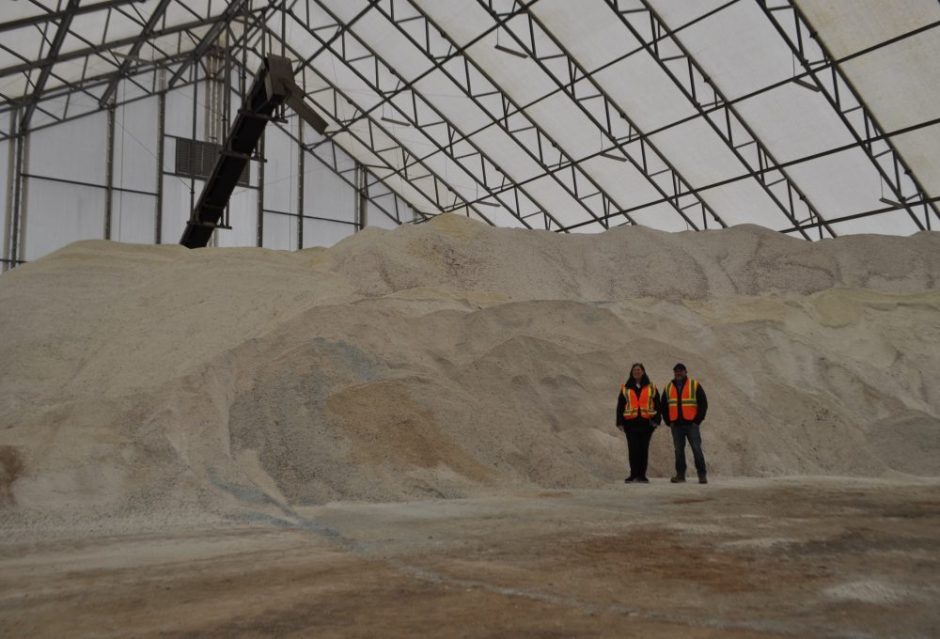
“I believe we have about 7,000 (tonnes) here,” Eleanor Gillon tells the assembled members of the media under the dome in which all of Guelph’s winter salt and sand are stored. The dome itself holds about 8,000 tonnes, but in a usual winter the City of Guelph uses about 7,000 and they needed just about all of it given how heavy it snowed last winter. But are they ready for this winter?
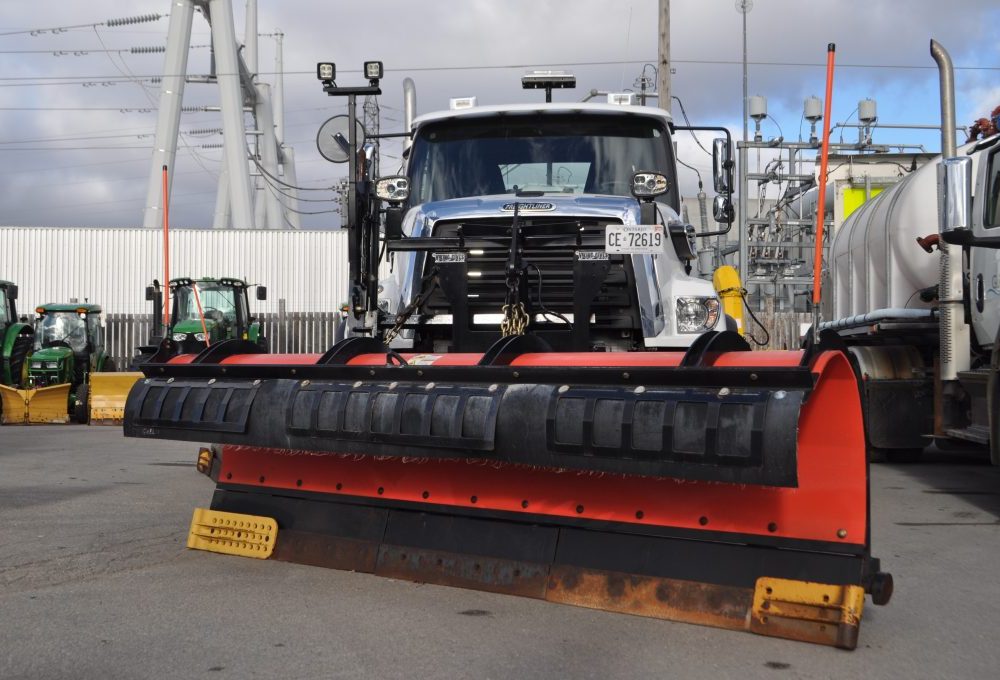
On Tuesday morning, City staff hosted a media availability to set a tone for the coming winter season, and the tone was this year is it’s going to be better. The 7,000 tonnes of salt in the dome, which is part of the City’s operations campus on Municipal Street, made for a good visual and out back were a variety of vehicles the City uses for snow clearing, from sidewalk plows to the massive trucks that clear Guelph’s busiest streets.
In the dome, along with the big pile of road salt, there are relatively smaller piles of blue-tinted sidewalk salt, sand, and tanks full of brine. The trucks enter from the back, fill up on the salt and the brine and then proceed on their route. The brine is laid at the same time as the salt, because that moisture is need to activate the salt. There are three tanks of brine under the dame, each one with 150,000 litres.
So is this better planning? Gillon, who is the City of Guelph’s Public Works Compliance Specialist, says in part, but the big difference is that much of Ontario started winter control at the same time last year, and also much earlier than usual; winter control measures were first deployed on November 9 in 2025.
“Last year, we all ordered (salt) at the same time, and the mine wasn’t ready for that,” Gillon explained. “They’ve told us that they have stocked more in their depots in Hamilton and Toronto, and they are upping their trucking contract as well so that they can have more deliveries sent in.”
Outside, Gillon notes that the vehicles are all multi-purpose so that they can be used all year round, but lately they’ve been prepping for that first snowfall. “Fleet, who are the ones that do the repairs on all our vehicles throughout the winter, are doing a pre-season check on all the vehicles, going through every piece of equipment, and every attachment that goes on the trucks to make sure everything is is ready for for the winter, so we’re basically waiting for snow,” she said.
“We’ve already done most of the training with our full-time staff, we’ve done training with our temp staff, and we’ve had some pre-winter meetings with not just public works, but also communications and HR.”
Communication was a big area in the recent value for money audit for winter maintenance presented to council back in September, and city staff are aware that they have to do better. Doug Godfrey, general manager of operations, said that means making people aware that the goal isn’t getting all roads cleared down to the bare pavement but to make sure that all cars have traction while driving. He also said that they’re making sure people understand that a “significant weather event” can go beyond the moment the snow stops falling.
“I encourage all residents to sign up for the Voyent Alert app. That’s the way that we communicate issues within the city, everything from weather events to other emergencies, so it’s a way for us to provide information going out,” he said.
“Ideally, we’d like to put a reminder out every 24 hours that [a significant weather event] is still in effect, and then we’ll keep doing that until the storm has subsided, but that’s why we’re really emphasizing Voyent because then we can reach out to folks directly through email or mobile phone or through the app as opposed to social or web where they have to go and check themselves,” said Kyle Hayward, a communications officer with the City.
In terms of how that’s different than in years before, Hayward said “the process is more refined” and that staff had “reviewed our SOPs” (standard operating procedures) so that “whenever there is a declaration, we’re going to make sure that updates are timely.”
One thing different this year is that the City no longer makes a distinction between primary and secondary roads, instead there’s just primary roads and residential roads. This is courtesy of the route review that was recommended in the value for money audit. “All of our drivers have gone through those routes because they’re slightly changed and they need to be able to understand what obstacles they might have,” Gallon said.
As always, the City will be looking at salt use as they make the roads safe for winter. Cognisant of Guelph’s status as a groundwater community, the City is participating with University of Guelph and Flodraulic Controls Ltd. on a pilot project to refine and reduce salt use on the city’s roads.
“Some of our trucks and buses have an infrared monitor underneath that are monitoring the grip of the road, and measuring slush, ice, snow, and dry conditions, and using that algorithm, they would like to come up with a a way of controlling the the spreader,” Gallon explained. “The spreader controller is what the drivers use to spread the salt, so if the unit underneath shows the road dry, then they don’t need to use any salt and can adjust the rate of spreading.
“That’s their ultimate goal but right now they’re just collecting data from our trucks and the weather conditions because they’ll need a lot of data to actually create that algorithm,” she added.
Reminder: Annual winter parking restrictions come into effect December 1, which requires vehicles to be removed from City streets between 2 and 6 am through April 1, 2027. Learn more about winter operations here, and learn more about the Voyent Alert app here.

