
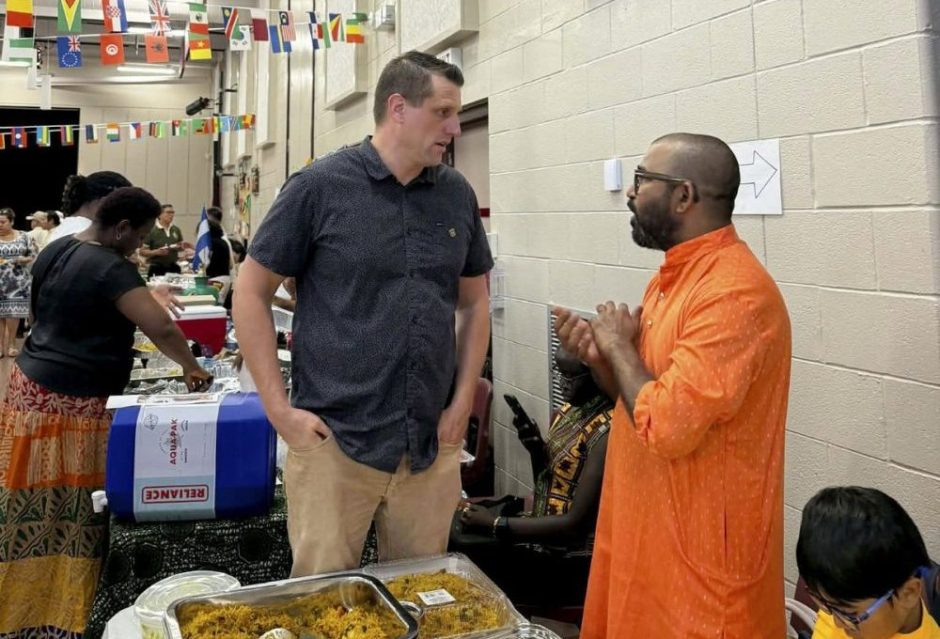
“My commitment to residents at the door has been to be a responsive voice. When constituents email me with a question or concern, I will respond, and I do my best to help in any way I can. I want to focus on the basics, get them right, and earn people’s trust by following through. Ward 6 deserves a councillor who treats every taxpayer dollar the way they’d treat their own household budget, and that’s exactly the kind of representative I intend to be.”
Why do you want to be a city councillor?
I run a small business, and every year I watch the same thing happen to my own bills: property taxes take a bigger bite, and I know a lot of my neighbours in Rickson Ridge are feeling that same squeeze on their own household budgets. That’s really what pulled me into this race. It’s not one single moment, it’s watching friends and neighbours quietly struggle to keep up with the cost of just staying in their homes, while young families and working people who are doing everything right still can’t get into the housing market.
I don’t think the answer is to keep spending the way the city always has and hope it works out. I want a seat at the table specifically to ask whether the money going out the door is actually producing results for residents, and to push City Hall to prioritize the essentials before anything else. If elected, that’s the standard I’d hold every spending decision to.
What is your background and experience, and how do you think that will serve you as a city councillor?
I spent many years in community outreach work, including helping establish overseas a learning centre for youth and supporting newcomers as they settled in Canada. That experience taught me how to engage with people from all walks of life and actually listen to what people need and follow through on it, not just talk about it.
I currently run an e-commerce business from home, which means I’m the one making every decision about where money goes, what’s worth spending on, and what isn’t. There’s no one else to pass that responsibility to. That kind of accountability, where every dollar has to be justified and every decision has consequences, is exactly the mindset I want to bring to how the city manages its budget. Hard-earned tax payer money needs to be spent responsibly to deliver the intended outcomes of programs and services.
Between running a business and my community building work experience, I bring both the financial discipline and the people-focused approach that I believe make for a good city councillor.
Given Strong Mayor Powers, how do you see your role as a city councillor when the mayor can override the will of council with just three votes?
I accept that Strong Mayor Powers exist, they were handed down by the province, and that’s the system we’re working within for now. But I believe they should be used sparingly, not as a default tool. Council exists because residents deserve representatives who know their neighbourhoods and can speak directly to their concerns, ward by ward. When a mayor bypasses that process, even with good intentions, it takes the decision out of the hands of the people residents actually elected to represent them.
Guelph has already seen situations where a decision council made together gets revisited or reversed after the fact by one person. That’s the kind of outcome I worry about, regardless of which side of a given issue anyone lands on. As a councillor, I want to be someone who builds enough consensus on council that the mayor never feels the need to reach for that tool in the first place. My job is to represent Ward 6 and work collaboratively, and I think that collaborative approach is how you keep power balanced at City Hall.
Affordability is important to a lot of voters, and municipal budgeting can be very difficult. How will you balance the needs of a growing city with the demands for low or zero tax increases over the next term?
I don’t think a zero percent increase is realistic for a growing city, and I won’t pretend otherwise just to win votes. What I do think is realistic is slowing down the rate that property taxes have been increasing, over time, so that it stops outpacing inflation the way it has been. To me, that’s a realistic target, not an empty promise.
The way to actually do that is line by line budget review, not with a blanket freeze. Before any new spending gets approved, I want Council asking whether the last dollar spent on that same program actually delivered results for residents. Core services, the things people rely on every day, come first. Everything else needs to earn its place in the budget on the evidence, not on momentum from previous years.
Council this past term has done a lot of housing policy, but that hasn’t translated into more shovels in the ground. How will you help close the gap over the next four years?
Builders plan around certainty, and right now Guelph isn’t giving it to them. I want a hard look at where applications are actually getting stuck in the pipeline, and real accountability for hitting approval timelines, not just publishing them. There’s also a planning piece that gets overlooked. A lot of stalled projects run into pushback because the roads, water systems, or transit around them weren’t sorted out before the development was approved in the first place. If council makes sure city staff have that groundwork done up front instead of scrambling afterward, builders have far fewer reasons to sit on shovel-ready approvals instead of acting on them.
Aside from the demands for more housing, land use planning also means assuring that there’s enough room to account for growth in business, institutional and commercial land uses, how will you balance all these priorities?
Housing can’t be the only lens we plan through. A growing city also needs room for the businesses and more employment opportunities, and those uses shouldn’t get squeezed out because housing targets are the loudest priority in the room. I want to see new development spread more evenly across the city rather than overly concentrated in one area, like we’ve seen happening in the south end. No single part of Guelph should carry all the pressure of growth while other areas and land uses get left behind.
Balancing these priorities comes back to the same principle I’d bring to everything else on council: plan ahead instead of reacting. Preemptive planning that accounts for housing, business, and institutional needs together, before shovels go in the ground, is how we avoid pitting these priorities against each other later.
Water availability is a growing concern. How will you ensure that Guelph has the capacity it needs to support this growing city?
Guelph is, by the city’s own account, the largest Canadian city that relies almost exclusively on groundwater rather than a lake or river, and that makes water capacity a real limiting factor on how much growth this city can actually support responsibly. I don’t think we can keep approving new development without being honest about whether our water and wastewater systems can actually keep up with it.
I want the city to keep investing in the infrastructure upgrades already underway, including securing outside funding like the recent federal dollars for wastewater improvements, rather than leaving residents to face restrictions or the city to face sudden, costly emergency fixes down the road. Growth needs to be matched to what our water systems can actually support, not the other way around.
Trust in government and institutions is major issue. How will you keep your constituents well informed about city hall business, and help them feel included when it comes to decision making?
Trust isn’t built with a newsletter or a single town hall before an election. It’s built by showing up consistently and actually being reachable in between. I want people in Ward 6 to know they can come to me with a concern and get a straight answer back, not silence or a runaround.
I also think residents deserve more than just knowing what Council decided, they deserve to understand why, in plain language, especially when it touches their taxes. My test for myself will be simple: if I can’t explain a decision to someone at the grocery store in Rickson Ridge or Kortright Hills in a couple of sentences, that decision probably needed more scrutiny before it was made, not less.
What would you say is your issue? What is the one thing you want to talk about on the campaign trail this fall and have a thorough debate about it before this election is over?
It’s definitely accountability for how the city spends taxpayer money. Property taxes have climbed more than 30% in four years, and residents deserve a real, public conversation about whether that spending has actually delivered results, not just an assumption that more spending automatically means better services. I want this election to be the moment Guelph starts asking harder questions about value for money, not just how much we’re spending.
What perspective do you think you will bring to council that is not currently reflected?
I bring the perspective of someone who runs a small business, where every dollar spent is my decision and my accountability. There’s no department to pass the buck to, and no purchase that doesn’t get a second thought before the money goes out. I also came to Guelph by choice, not by circumstance. My wife and I looked at where we wanted to raise a family and chose this city deliberately. This means I see Guelph through the eyes of middle class young families looking to build a life here, as well as a small business owner. I want that perspective represented at the table.
Is there anything else you want to tell voters as they make their decision?
My commitment to residents at the door has been to be a responsive voice. When constituents email me with a question or concern, I will respond, and I do my best to help in any way I can. This is something I’ve already been doing throughout my campaign.
I want to focus on the basics, get them right, and earn people’s trust by following through. Ward 6 deserves a councillor who treats every taxpayer dollar the way they’d treat their own household budget, and that’s exactly the kind of representative I intend to be.

