
Three meetings in 24 hours! It kind of sounds like a gimmick, but that’s the way the schedule shook out this past week with the continuation of the November 13 planning meeting, the regular meeting of council and then the budget confirmation meeting. There were some interesting new developments, some predictable hiccups, and at least one big surprise, and capturing it all is this week’s council recap post…
Planning Meeting of Council (Continued) – November 26, 2024
We begin this week by picking up where we left off shortly after midnight on November 14. There was one item left on the planning meeting agenda from Tuesday November 13, and that was the “Ontario Reformatory Heritage Conservation District – Draft Plan and Guidelines.” A motion to receive the report was on the floor when council recessed, but it was quickly taken off the floor (so to speak?) for a new motion crafted by Councillor Erin Caton.
The motion asked council to back the idea of a national urban park for the OR Lands property “notwithstanding other public uses or current staff direction.” Caton said that the motion would simply acknowledge that council thinks that a national urban park in this location is a good idea and that it would further the goals of reconciliation as council would be joining the Mississaugas of the Credit First Nation in endorsing it. But there was another case of pre-meeting emails afoot as Councillor Cathy Downer raised electronic messages from planning staff who felt that if this was the direction of council, then they should pause any further work on the HCD till they know whether the OR Lands will become a national urban park.
 Downer said that this was new information to council and wondered why they would pause this important work. General Manager of Planning and Building Services Krista Walkey said that the allowances for redevelopments in the HCD were contrary to Caton’s motion, which essentially wants to keep the lands as they are now, and in the meantime most of the significant structures on the property are already protected by part IV designations (but not all of them). Caton said that she crafted the motion with input from staff, so they were not sure where that idea came from to pause the HCD work.
Councillor Phil Allt brought things back to the motion saying that council should focus on what’s on the table, which is a simple endorsement. Guthrie agreed saying that if there was a subsequent motion to pause the HCD work councillors would be within their right to vote against it.
On the merits of the motion, Councillor Dan Gibson wondered about the odds of two national urban parks being approved within a few hours’ drive of each other referencing the new Rogue River Urban Park. That was outside of staff’s ability to answer so Gibson offered an amendment that council support “in principle” the concept of a national urban park. Other members of council wanted some assurances that this doesn’t only commit the space to being parkland and explored a thorough definition of “notwithstanding” in the motion. You may recall that there’s hesitation in some quarters about dedicating this huge space for a park when we’ll be looking for a massive space for a hospital in the future.
Ultimately, there was almost unanimous support for the motion. Many councillors said that they’ve been inundated with community feedback that was in favour of preserving the OR Lands as parkland, and, perhaps most significantly, no one was sweating the potential cost to the city about it. The motion was approved 11-1 with only Guthrie voting against it.
With that business done, no one on council had an interest in pausing the work of the HCD and so the original recommendation to receive the report was put back on the floor. Council got some assurances that there will be further robust community engagement, and there was discussion about certain assets that aren’t yet protected by part IV but probably should be. Council also asked staff to strengthen the language in the report (less “shalls”) while staff took exception to the characterization of “sloppy work” on the report that some delegates mentioned, blaming pagination errors on a program used to make City reports and documents AODA compliant.
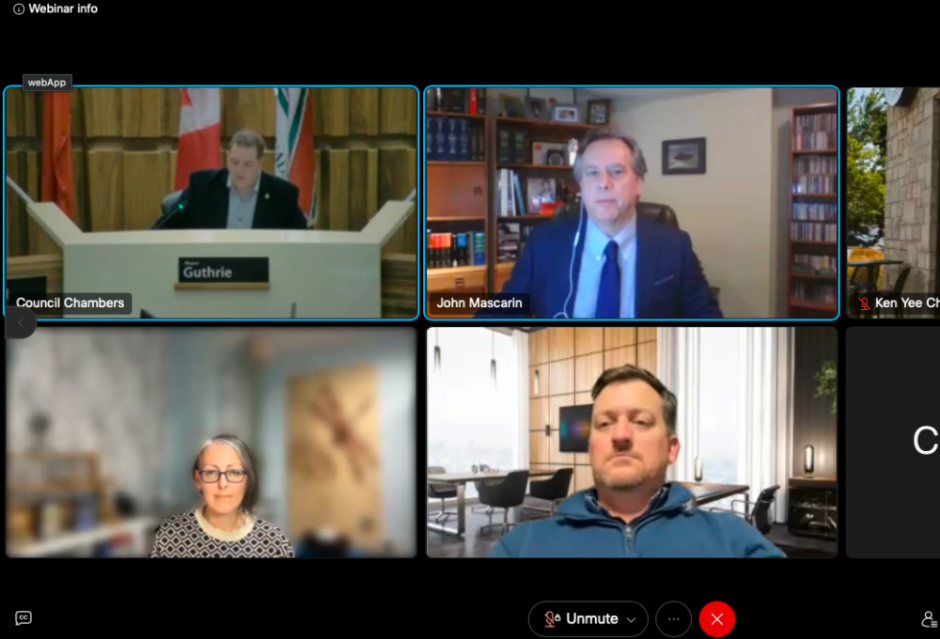
The motion to receive the report was approved, but not before the live-streaming system fritzed out. Unable to affect a short-term repair, anyone wanting to follow council business had to join the Webex meeting that the clerks use for anyone attending virtually. The problem persisted over the next two meetings.
Click here to see the complete recap of the meeting.
Regular Meeting of Council – November 26, 2024
There was a surprise in the amended agenda of the regular meeting: The mayor violated the Code of Conduct!
As you may know, Mayor Cam Guthrie is part of the Global Covenant of Mayors, an organization of cities from around the world that share information and co-ordinate action on climate change and climate change initiatives. Guthrie has been to several of these meetings and was planning to attend another one this month in Brazil when the Mayor of New Westminster, B.C. got dinged for contravening that council’s version of the code. Why? These trips, which are paid for in part by Mike Bloomberg Philanthropies, constituted a personal benefit to the mayor.
That decision prompted Guthrie to seek the advice from Guelph’s integrity commissioner John Mascarin, who reached the same conclusion as his New Westminster counterpart. Guthrie, travelling to these conferences on the dime of the Global Covenant of Mayors, accepted a personal benefit in contravention of the Code of Conduct in spite of his openness about attending the conference, securing funding for the City as part of those trips, and getting other benefits from participating in that organization that might have been returned to Guelph.
But while Mascarin said Guthrie had contravened the Code, he did so inadvertently and while acting in good faith. He also said that that Guthrie came to him for advice, got advice and followed that advice to the letter, so he wasn’t recommending any corrective actions, or what some people might call “a punishment.” Guthrie had also sought advice on this matter just a few days before a member of the public had filed a complaint about the mayor’s role with the Global Covenant of Mayors.
Coming out of the integrity commissioner’s report was a motion to amend the Code of Conduct to allow an exemption for food, lodging and transportation by third-party organizations for “attendance at events which are targeted to a municipal governance audience.” This would, hypothetically, allow Guthrie to continue in his role on the GCoM, but some councillors felt that the language was overly broad and could open the door to future abuses.
Councillor Dominque O’Rourke proposed some language that council would have to provide prior approval for the exemption and then carve out a specific exemption for the Global Covenant of Mayors, but she only found support from Councillors Leanne Caron, Erin Caton and Michele Richardson. The unedited motion ended up being approved.
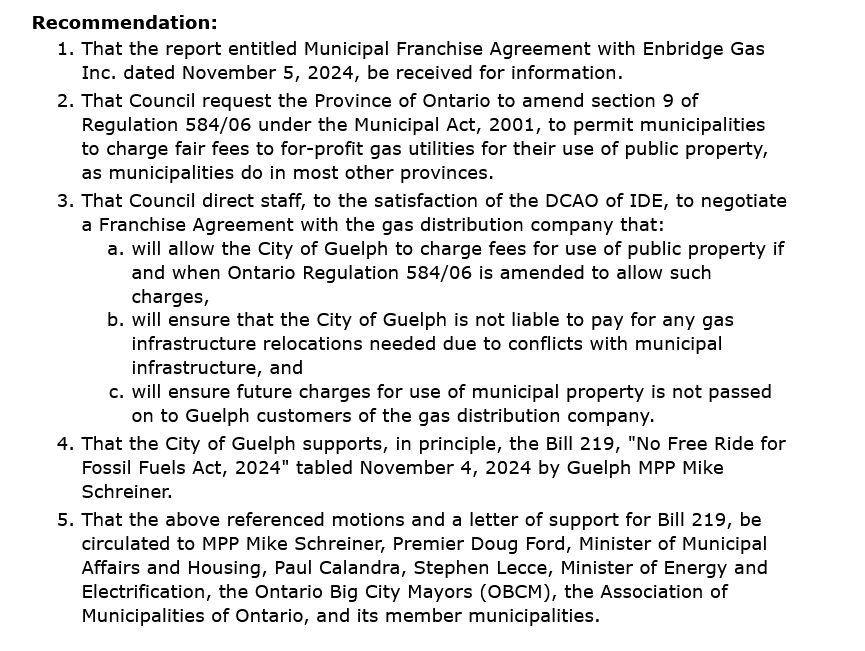
Council also had to ratify the motion they approved at Committee of the Whole for the Municipal Franchise Agreement with Enbridge Gas. The original staff recommendation to sign another 20-year contract with Enbridge with mostly the same conditions was rejected as council directed staff to seek a new contract that will allow the City to collect fees for the use of public property and to support changes at the Ontario Energy Board that would allow it.
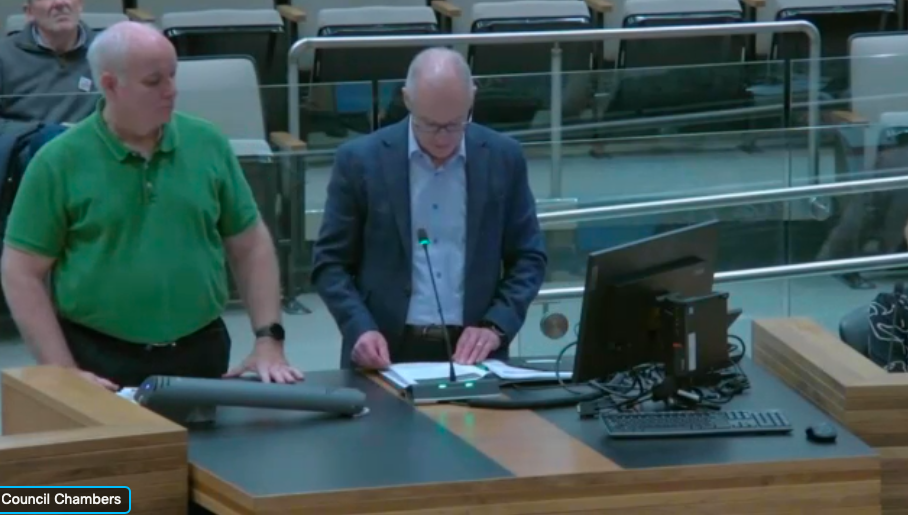 There were several delegates for this item, some returning for a second bout after committee, but the surprises guests were from Enbridge itself. Patrick McMahon and Murray Costello explained that Enbridge was an early adopter to renewables and noted that they’re working collaborative with the City to upgrade systems in advance of downtown revitalisation. They also said that the current franchise agreement is meant to create a level playing field between all Ontario municipalities so that one city isn’t funding work in another, and to stabilize rates between cities.
Council didn’t have much else to add, but Mayor Guthrie said that his opinion on this issue had been turned around, and that he now sees it as a way to nudge people into moving away from fossil fuels and see their full price. He compared the motion to the carbon tax, albeit somewhat more positively than Councillor Dan Gibson did. Gibson didn’t want to support the full recommendation because he was concerned that this would inflate energy prices like the federal government’s price on pollution. Ward 6 Councillor (and federal Liberal candidate) Dominique O’Rourke took exception to that saying there’s no evidence that increased energy costs are being driven by the measure.
Recommendation #1 and #5 were approved unanimously while #2 through #4 were approved 10-3 with Councillors Gibson, Christine Billings and Ken Yee Chew voting against.
Click here to see the complete recap of the meeting.
Budget Meeting of Council – November 27, 2024
Here was the big meeting of the week, the final passage of the amended 2025 budget. The day started with a 3.21 per cent tax levy increase for the City of Guelph, which is an increase of two-thirds of a per cent from the original mayor’s budget at the end of October. Guthrie opened by reviewing the amendments that had been provided by councillors, but the only one they could all agree on off the bat was to cover the cost of the Guelph General Hospital levy out Tax Rate Operating Contingency Reserve.
First change, council approved a transfer of $100,000 so that a community park on Beaumont Crescent can begin the planning phase in 2025. Along with that council approved the funding of building that park in 2026. In both cases, no projects were cut or sacrificed, this is just additional work that staff will be taking on.
Next, an increase to cover the cost of a Board and Committee Co-ordinator, a new staff position that will assist in the re-organization of Advisory Committees of Council after the report comes back in March, which is why the position didn’t originally make the cut in the original 2025 budget. City Clerk Dylan McMahon explained that without the position, it would take longer to initiate the changes, including the rollout of reimbursements for transit and daycare for committee members, which is theoretically meant to make the ACOCs more inclusive. Council approved that addition too.
 Next, Councillor Rodrigo Goller proposed increasing the transfer to the Affordable Housing Reserve by $400,000 in 2026 to demonstrate the City’s commitment to getting more affordable housing built. Councillor Dan Gibson said that council can do that by passing a motion saying that council endorses the $50 million in lost DCs and fees that provincial legislation has transferred to developers to build affordable housing while Councillor Dominique O’Rourke said that council should wait until there’s direction from the upcoming Affordable Housing Strategy update. Despite the concerns, the motion was passed unanimously.
This is where things started getting dicier. Goller brought a motion restoring 100 per cent Renewable Energy funding back into the multiyear budget, and some members of council wanted to at least take a spending holiday on these lines to get a better idea of the year-over-year impact. Guthrie said that he might be interested in restoring some funding, but nine councillors wanted the whole enchilada, so funding was restored to 2025 at the full amount by a vote of 9-4 and the other years unanimously.
A motion from Councillor Carly Klassen wanted to add money to the base budget to community grants and make a total of $500,000 available to fund community groups in 2025. With groups asking for almost twice as much money as there is available, Klassen said that the City has failed to keep up with need. Gibson invited people to call him “Scrooge” if they like, but he was starting to get uncomfortable with some of these additions, and regardless of the quality of work this money funds, it’s still putting an unfair burden on homeowners and businesses.
Gibson tried to push off an increase to the Community Grants budget till 2026, but that motion failed by a close 6-7 vote. In the end, enough councillors were persuaded by the argument that the work of groups funded though Community Grants had an impact on affordability in other ways, and the increased funding was approved 10-3. A subsequent motion to tie future annual increases on that line to the rate of inflation was also approved 10-3.
Next was a motion about adding $100,000 to the Public Art Reserve, which really tested the fiscal prudence of council. When that one failed, Klassen proposed a motion for up to $100,000 to develop information about how the City of Guelph can take advantage of future corporate sponsorship opportunities like naming rights. That one was a little more palpable to council, but the $100,000 was taken from the Tax Operating reserve as it was intended to be one-time funding.
Lastly, council approved $500,000 for bicentennial planning spread across 2026 and 2027 now that they’re sold on the potential economic benefits of such a celebration.
With all these amendments, the tax levy increase for 2025 was pushed up to 3.66 per cent, and with the expected 2.42 increase from local boards and shared services that brings the total increase for next year up to 6.08 per cent. It wasn’t the four per cent that he was aiming for, but Mayor Guthrie said it was enough for him to live with and thus remove any threat of a veto.
Only a few administrative motions were left over, plus directions to staff about reporting on the Culture Plan and 10-year capital budget plans respectively. Guthrie wrapped up by thanking staff, council and the community and saying, “I think we’ve landed in a good, balanced place.”
Click here to see the complete recap of the meeting.
 Guelph Politico