
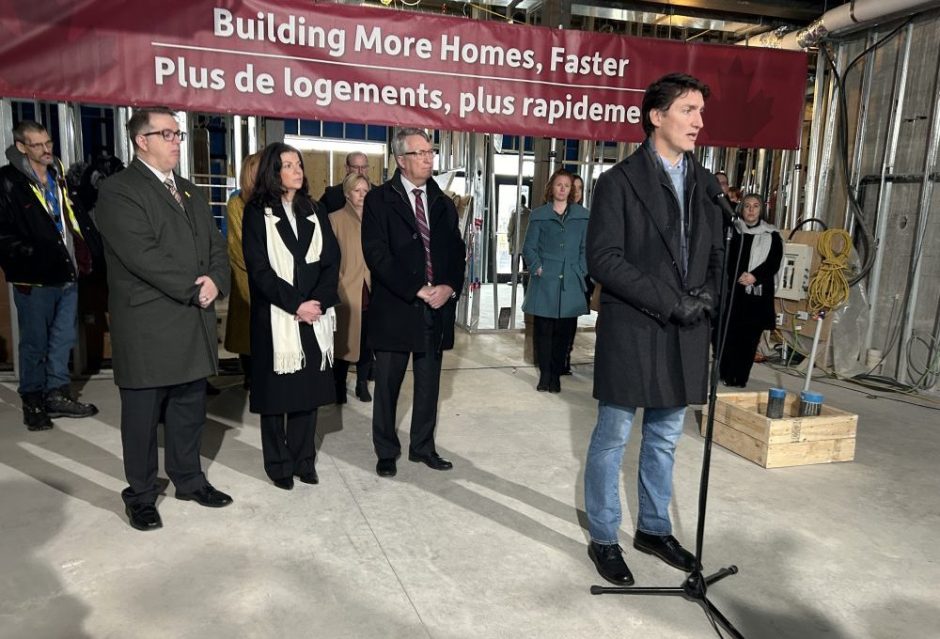
So Prime Minister Justin Trudeau came to Guelph on Friday. Not exactly the most popular guy in Canada right now, but long before his present levels of popularity there were a lot of people in the Royal City already disappointed with the PM. It all goes back to a promise made in 2015, the one where Trudeau said it would be the last election using first past the post (FPTP). We have since had two more elections with FPTP, so where does Trudeau stand now? We asked him.
At a media availability after a funding announcement at the Kindle Communities project on Shelldale, Guelph Politico asked Prime Minister Trudeau if the time had come to revisit his promise on electoral reform.
“I am deeply committed to the idea of electoral reform. I think citizens being able to rank their choices prevents them from having to vote against the ones they don’t want, and instead vote for us the ones they do, I’ve long believed in that,” Trudeau explained.
“In our first mandate, when we had a majority, I would have had the theoretical option of ramming through my preferred option for electoral reform and keeping the letter of that promise, but I also know that when it comes to changing our electoral system, it shouldn’t be any one party, even with the majority, that gets to decide how all future elections will bevunfolding,” he added.
Trudeau went on to say that he believes that the House of Commons needs to create consensus around an electoral reform option, but there’s been no clear path forward. Is that changing though?
“When I talk with folks in my community, they haven’t forgotten that promise from 2015. And maybe more importantly, there’s this overarching frustration with how politics has gotten in the way of improving our democracy and making sure that every vote counts,” Kitchener Centre MP Mike Morrice told Open Sources Guelph last November. He’s presently leading an effort to put electoral reform back on the frontburner.
Last year, Morrice and Elmwood-Transcona MP Daniel Blaikie table the private members’ bill M-86, which calls on the federal government to form a Canadian citizens’ assembly on electoral reform. Presently, 18 of their fellow MPs have signed on to second the bill including some high-profile Liberals including Carolyn Bennett, Bardish Chagger and Michael Coteau.
M-86 calls on the federal government to create a non-partisan Canadian citizens’ assembly on electoral reform to “determine if electoral reform is recommended for Canada, and, if so, recommend specific measures that would foster a healthier democracy.” The bill was debated in the House of Commons in November.
“We will have a vote in this Parliament and a debate on a citizens assembly on electoral reform. It’s the best way to take politics out of it and let regular people be informed by experts and make recommendations back to our Parliament on how to improve our democracy,” Morrice said.
“The only way we’re going to do it is if enough Canadians across the country put enough political pressure on their MPs, and it seems like every day I hear from another MP in the governing party who’s telling me they’re going to vote in support as a result of constituents telling them this matters to them.”
But Liberals are pretty good acknowledging the need for electoral reform on their own. As pointed out by Fair Vote Canada, Liberal Party members supported the call for a citizens assembly and passed a resolution to urge the Government of Canada to establish a non-partisan assembly to look at electoral reform.
Presently, 33 Liberal members of House have come out in support of an assembly, but right now Guelph MP Lloyd Longfield isn’t one of them. He has in the past brought Guelph efforts to support electoral reform to the attention of the House though.
In an interview with Open Sources during the 2019 federal election, Longfield said that failing to achieve anything on electoral reform was “one of my personal disappointments” from his first term in Parliament. “We spent $44 million trying to keep that promise, and unfortunately, we didn’t get to the goal line on it, so coming into the next tournament, I would love to see us get to a rank ballot. I think that’s something we could do, and that will give us some proportionality.”
As for the Prime Minister, he wants more agreement and less rancour before pursuing a new election method.
“Rather than risk Canadian democracy for the sake of ticking off a box in the electoral programme, I said, ‘We’re going to make sure we continue to work on building consensus,'” Trudeau said. “As I’ve said many times, including recently, if they’re [the other parties] willing to come to a consensus around improving our electoral system, I’m happy to revisit anytime, but it’s not something any government should do on its own.”
 Guelph Politico