
It was two months ago now when former Minister of Municipal Affairs and Housing Steve Clark resigned from the Ontario cabinet in the wake of the Auditor General’s report about the changes to the Greenbelt. It was a little over a month ago that Premier Doug Ford announced that the government would be restoring that land back to the Greenbelt, and it was just last week that Paul Calandra, Clark’s replacement, finally introduced that legislation. So what’s new this Monday?
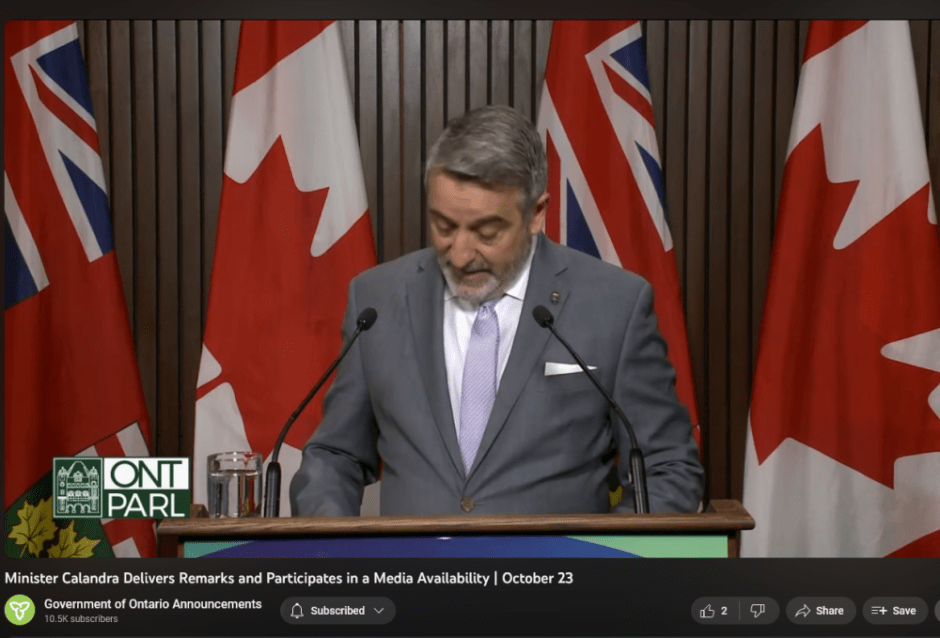
In a brief announcement on Monday morning, Calandra announced that the Ontario government will be hitting the rewind button on changes to Official Plans imposed on several municipalities around Ontario, including Guelph.
“Since becoming Minister of Municipal Affairs and Housing, I have made it a priority to review past decisions, including minister’s zoning orders and official plans, to ensure that they support our goal of building at least 1.5 million homes in a manner that maintains and reinforces public trust,” Calandra said in a statement. “In reviewing how decisions were made regarding official plans, it is now clear that they failed to meet this test.”
Calandra said that he will soon be introducing legislation to reserve the decisions of the ministry that rewrote the official plans of Barrie, Belleville, Guelph, Hamilton, Ottawa and the City of Peterborough, the Regional Municipalities of Halton, Niagara, Peel, Waterloo and York, and Wellington County. The legislation will undo the changes with the exception of any where that construction has begun as a result of that change or where doing so would contravene existing provincial legislation and regulation.
And yes, this would include changes to urban boundaries, which were a sticking point in Hamilton and a couple of townships in Wellington County.
“To ensure that the reset plans match our shared ambitions to build more homes, especially now that municipalities have made their housing pledges, we will be asking impacted municipalities to submit changes and updates to those plans to ministry staff within 45 days of today, including information on projects that are already underway,” Calandra said. “In recognition of the costs incurred by municipalities arising out of this decision, the province will work with impacted municipalities to assist with related planning and staffing costs.”
Provincial changes to the latest version of Guelph’s Official Plan, OPA80, was the source of much controversy earlier this year when council passed a multipart motion protesting the changes. There were 18 changes in all, but the most controversial were the allowance of 23-storey builds downtown, a reduction in employment lands in the Guelph Innovation District, and the re-designation of 41-45 George Street to high density after council pointedly made it low density.
Since all changes to the Official Plan are final and cannot be appealed, City of Guelph planning staff were forced to adapt and re-write policy to align with the changes, including the then recently approved Comprehensive Zoning Bylaw (which is still not in effect due to an appeal at the Ontario Land Tribunal).
Guelph’s representative at Queen’s Park was unimpressed with the announcement or the further chaos it will likely foster at city halls around Ontario.
“Today, we saw yet another flip-flop from a government that has wasted years lining speculators’ pockets instead of providing real solutions to the housing crisis,” said Green Party of Ontario leader Mike Schreiner. “This government is spiralling out of control. For months now, Ontarians have been bombarded with last-ditch reversals and half-hearted apologies that have more to do with protecting the government’s image than solving the housing crisis. As a result, we’re years behind where we should be. Ontarians have had enough.”
 Guelph Politico