
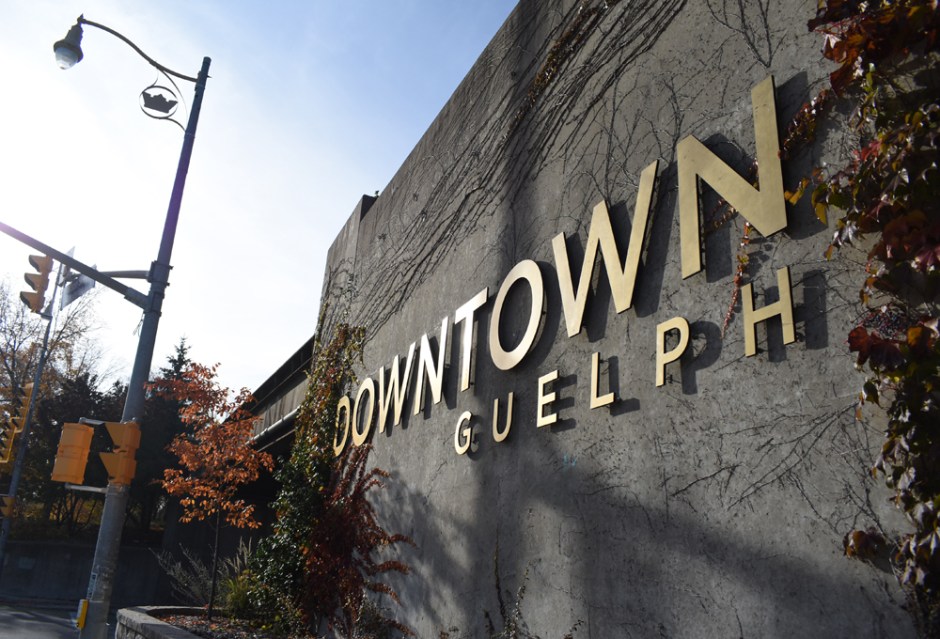
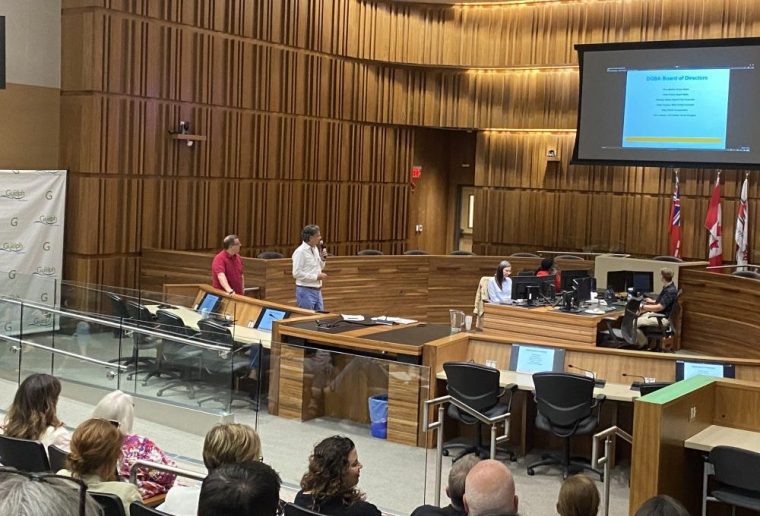
A town hall meeting for downtown businesses and building owners at Guelph City Hall on Monday was meant to highlight a rapid pace of change in the city’s centre since the new board of the Downtown Guelph Business Association took over last December. While that was informative, the members themselves still had a lot of concerns, from safety to the current status of the organization itself, and sometimes it got testy.
The Progress So Far…
Chuck Nash, the owner of Frank N Steins, is serving as the current chair of the DGBA, and led, what he called, the “State of the Union downtown”. The DGBA has been without an executive director since Marty Williams departed in January, and in his absence, the board itself has been setting the direction for the organization.
“The board has worked really, really hard. We’ve kind of upped the ante going from monthly board meetings and since January, we’ve been meeting bi-weekly” Nash said. “It’s been really intensive, and we had a lot to catch up on and do a lot of work, and the dedication from the board has been second to none.”
The results of that dedication include the ongoing replacement of the old purple parking signs with new green ones, the promise of money for facade improvement and the activation of second and third floor spaces from the City to be announced this fall. Although Mayor Cam Guthrie, several city councillors and the City’s executive team were all on-hand, no further details about the commitment from City Hall were given.
In terms of attractions, the Santa Claus Parade, and the Mayor’s Annual Tree Lighting will combined with a holiday market outside Old Quebec Street to create a single, day-long holiday event this year on December 2. Before that, there will be a dog promenade on September 23, which will feature all kinds of events and activities for pets and their humans. The focus in the meantime is expanding the the DGBA’s social media foot print in order to get more people downtown whether its for an event, or if its to run some errands.
In terms of the actual administration of the DGBA itself, Nash promised an updated website with improved functionality, new bylaws, improved transparency, and a new Strategic Plan to give this and future boards more direction should be finished by the end of summer. They’re also looking at office space as a matter of cost savings.
“We’re begging and pleading with the City to let us move into City Hall, so that we can give up our office space, which currently costs us about $55,000 a year or eight per cent of our budget,” Nash said. “The office, as many of you might know, is currently really underutilized and chewing up eight per cent of our budget for something that’s only used for monthly board meetings and for the staff who periodically come in there. So many of us work from home now so it’s very wasteful and we’re trying to find cost reduction there.”
What About an Executive Director?
The DGBA has been operating without an executive director since January, and that was a matter of concern for at least a couple of business owners at the town hall.
“In my experience reading about boards, it’s not the role of the board to do the work, it’s up to the executive director with a staff to execute upon those goals,” said Ian Conlon, who owns a personal training studio. “We need someone impartial to the board that we can trust or build a relationship with, so that it’s not ‘us versus them’, and currently it’s a lot of ‘us’ and a lot of ‘them’ and not enough ‘we’.”
“We’re not saying that we don’t need an executive director,” Nash began before Conlon interrupted noting a Guelph Today story with the headline, “Downtown Board not sure it needs new executive director.”
“Right now, this is a working board, there is no doubt about that, and it’s providing us an opportunity to learn what is needed as far as staff requirements,” Nash continued. “At the end of this year, or the beginning of next year, those discussions will come up via an organizational review, and via our strat plan after we’re done assessing what the actual staffing needs are of the DGBA.”
Sandy Clipsham with Ward One Studios shared similar concerns noting that the executive director and the membership co-orindator of the DGBA were the point of contact for concerns and questions about things happening downtown, and now there’s some measure of confusion about where to direct those queries. Nash said that any questions or concerns can be directed to the board.
“You’re doing all this work, and that’s great, but I think we expect a bit more,” another woman said. “I think I’m speaking on behalf of other business owners that we might not want to wait for another six or seven months. We need to know who we can contact about issues that we are supposed to have input on at any time, and we need to be aware of who those people are. There has to be more communication.”
She also made the point that the DGBA board is made up volunteers and expressed concerned that they seemed to be doing the work that was meant to be overseen by a paid staff. “When we voted for you guys, that wasn’t on the table. Nobody ever got up and said, ‘Oh, and by the way, if anyone does leave these positions – since everybody knew there were rumours in the air – we’re not going to replace them. That’s not what we voted for.”
“The board is putting in a tremendous amount of time and effort filling a lot of those gaps and bringing a lot of these items that you saw here today, but I think the board also recognizes that it’s not sustainable,” Nash said. “We’re learning as much as we can, as quickly as we can, but there will be staff hired. It’s just a matter of what and who and how many.”
Safety Concerns and Policing
Concerns about people downtown who are suffering from homelessness and/or mental health and addictions issues were also a point of concern, and Chief Gord Cobey, Deputy Chief Steve Gill, and Constable Connor Vaivods, who’s the main downtown patrol officer, were on hand to answer any questions.
Barb Minett, co-founder of the Bookshelf, was the first to speak and explained her frustration about people repeatedly trespassing at her store, even the ones who were banned. Minett says that those banned people are coming back to the store and telling her that the Bookshelf has no right to bar them from entry, and between confrontations like this, and incidents like a recent overdose on Bookshelf property, these issues putting undo stress on the staff.
“You may have heard other officers say this, but we’re not going to arrest our way out of that situation,” said Cobey. “One of the things that we have done is that we’re encouraged the people who are doing those extra [police] patrols to try and focus their attention more on Quebec Street because that seems to be where we’re getting a lot of feedback in terms of issues.”
Emma Duell, the owner of Woolwich Fine Yarns, expressed her own frustrations after being barely four months in business on Quebec Street. She said that there a few individuals on Quebec Street that are making things difficult, and that the regular appearance of ambulances and police cars near her front door are making it hard to get people inside.
“My customers are afraid to come in, and that’s the problem,” she said. “My customers are freaking out and I can’t be open late at night even though that’s a social thing for our community, to get together with artisans and craft. I can’t do that anymore.”
Along with the voices of concern, there were calls for understanding. Rachel, who works in three different downtown businesses and was once a substance user herself, said that she’s been able to dissuade people from stealing by approaching people with humanity and understanding, instead of looking at them like a problem to solve through policing.
“A lot of the people I know who do steal are literally about to die because of ongoing health issues because they can’t get help, and I’m not even talking about drug use, I’m talking about chronic life altering diseases and they can’t get help so they don’t give a fuck anymore,” Rachel said. “They’re going to do stuff like that because they don’t feel like they belong in this community, and because we’re constantly shaming them for what they’re doing, and I can tell you as someone who has been an addict, that shame is what causes you to keep going.”
Jessica Hirst, the founder of Modern Bride in the Petrie Building, echoed that sentiment. “Working at a bar for a million years, you learn to socialize and engage and communicate with people who are going to cause trouble, and I think that I think that there’s also that having that support,” she said.
“I think the idea of putting extra police or foot patrol downtown was to make people that aren’t comfortable with some of those social issues and being there, make them feel safe,” Nash countered. “Whether that’s a perceived feeling or a real feeling, we can debate that, but I think the idea was with a police presence, people will feel more safe in coming downtown.”
“We are one key stakeholder, and I guess the question I would ask is have we ever asked those folks who rely on the [Royal City] Mission what they need? I don’t know,” Cobey added. “These are the kinds of holistic community conversations we need, but are we including our most vulnerable and asking them these questions? I don’t know, and respectfully, I don’t think it’s my role* to do that. I think there’s other folks who are are professionally trained and equipped to do it.”
*Corrected on Wednesday June 28, 10:30 am.
 Guelph Politico