

It was a long afternoon and evening in June at Committee of the Whole. After a couple of months with some shorter agendas, it seemed like everything came home to roost this month with a massive agenda under the Governance service area including procedural updates, the Strategic Plan annual report and the last (?) you’ll hear from the Smart Cities Office. Also, there’s a lot of work coming soon in Downtown Guelph. Let’s recap!
Committee of the Whole Meeting – June 6
The open session of this month’s Committee of the Whole started 11 minutes late. Not great considering the lengthy agenda before council, but six-and-a-half hours later the agenda had been thoroughly vetted.
After the lengthy staff recognitions, committee dispatched the one thing on the consent agenda, the Declaration of Compliance for the Ontario Health Multi-Sectoral Accountability Agreement, and dug into the 2022 “Guelph. Future Ready” Progress Report.
CAO Scott Stewart explained that the information in the report didn’t offer a complete picture; some data is unavailable, and some data doesn’t come from the City itself, but he did assure committee that there’s more that enough data to understand how successful Guelph is at achieving their Strategic Planning goals. Members of the committee had praise for the clarity and transparency in the presentation and looked at how the this data might inform the next iteration of the Strategic Plan, which comes back to committee next month.
You can see the interactive Strategic Plan report for 2022 by clicking here.
After that, staff from the social services department in Wellington County answered city council’s invitation from last summer to basically explain itself to the horseshoe. Luisa Artuso, Social Services Administrator, led the committee through an overview of housing, childcare and Ontario Works including how their services are funded, the changes to those services that are pending, and what the challenges they’re facing are.
Questions concerned how the County manages their own funding of social housing projects, and how they decide on what amount to put aside for those efforts every year. Since the County’s treasurer wasn’t at the meeting Artuso had to promise to follow up with those answers and committee was reminded that the update to the affordable housing strategy is coming this fall. Other questions that committee had included gaps in housing, the total cost of answering that need, and accommodating larger families, and those will also be discussed in the updated strategy.
 The meeting then moved on to the 2023 Governance Review, the first of two governance reviews done every term. Most of these are routine like administrative changes, the fixing typos, or putting into writing the reflection of current practices, but committee got hung up on a couple of points.
The first was a concern about giving the clerks delegated authority to make administrative changes to motions, like language or grammar, so long as they don’t substantively change the intent of the motion. Councillor Leanne Caron produce a motions to amend the change to say that the clerk may *suggest* administrative edits noting a recent instance where the intention of a motion did not line up with what was said in the minutes. For clarity’s sake the amendment was approved.
Another motion from Governance Committee vice chair Linda Busuttil looked to enshrine the practice of asking the service area chair before putting an information item on the agenda. There was some concern from the other councillors about adding another layer of access to the agenda, or how it might affect the speed at which council could deal with a timely matter, but committee eventually agreed that the motion was in the best interest of agenda management and approved it.
Before passing the slate of recommendations and taking dinner, Councillor Dominique O’Rourke raised a concern about delegated authority to extend culture and recreation contacts to ten years from the present five. DCAO Colleen Clack-Bush said that it’s a matter of flexibility, especially when dealing with groups using City facilities for the long-term and providing them some sustainability, it’s not meant for every contract. This matter may come up again at the regular meeting at the end of the month.
After dinner, David Messer, executive director of the Smart Cities Office, presented the plan for winding down operations; the federal grant that started the office runs out at the end of the year. A summery report will be written and provided to council next year and there will be a celebration of their accomplishments this October, but for all intents and purposes this was Smart Cities last appearance at city council.
So what happens now? Innovation Guelph and 10C Shared Space are taking the lead on keeping COIL going, and there’s a grant in progress to get three years of funding to that end. Solid Waste Resources is continuing some of the work started at the Smart Cities office, Wellington Country will continue to support regenerative agriculture, and Public Health may take on the work done on food insecurity and access. Three delegates spoke to the successes of the Smart Cities office in terms of increasing access to nutritious food and reducing waste.
Councillor Caron’s motion to join the Municipality of Trent Lakes in asking for a change to the Oath of Office to include a prominent mention of First Nations, Inuit and Metis people was approved. She said if it was the perfect time for the motion given that this is National Indigenous History Month and the motion passed quickly without any further query or concern.
Since Community Engagement was the subject of a recent workshop, there were only a few process questions about the new framework.
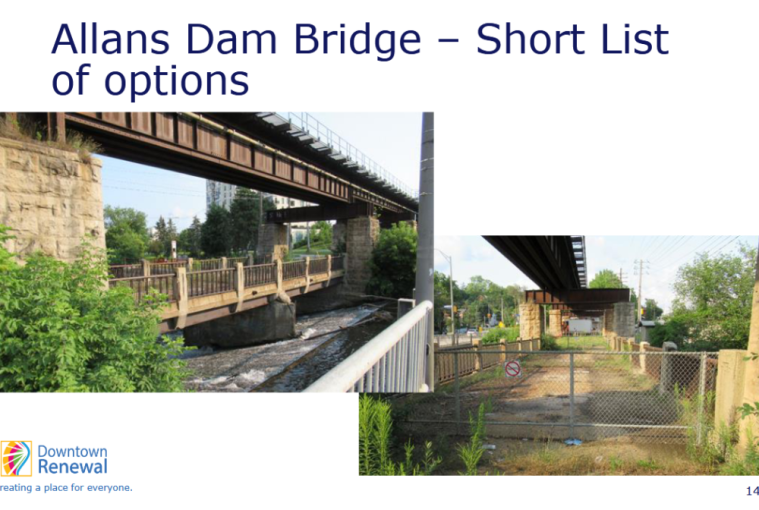 The last item was the Downtown Renewal Status Update report. No final decisions were meant to come out of this report, it was only for information and designed to make committee aware of the intricacies around two specific downtown renewal projects: environmental assessments for Upper Wyndham plus the Allan’s Dam and Macdonell Bridge area.
There’s presently no firm plan for what these areas might look like in the future. For example, the area around St. George’s Square and the northern portion of Wyndham could look very similar to how it looks now, or there could be a traffic circle and a complete street model. There are also a couple of different ways that the dam and the bridge might be improved, but they are both deteriorating and are in need of refurbishment at the very least.
Staff are planning a conventional public engagement on the EAs for both these projects this summer, and staff will also be on hand at community events like the Guelph and District Multicultural Festival this week and Art on the Street later this month to engage with people in-person. Councillor Carly Klassen has volunteered to be the downtown champion on council, which makes sense that this is her ward and she’s a downtown business owner. O’Rourke, acting as chair of Infrastructure, Development and Enterprise Services, noted that there are some massive transformations coming to Guelph by 2027, and it’s a very exciting time.
Click here to see the complete recap of the meeting.
The next meeting of city council is the planning meeting on Tuesday June 13. You can see the complete agenda on the City’s website here.
 Guelph Politico