
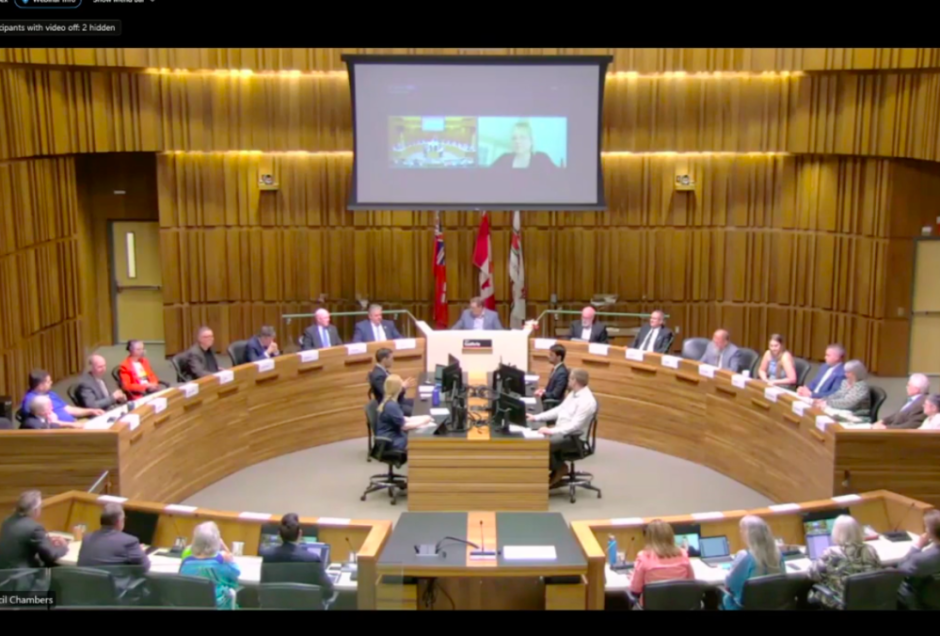
This week, there back-to-back council meetings, and one of them looked bigger than normal in terms of the number of people around the horseshoe, which was really more like a round table. A joint meeting of Guelph City Council and Wellington County Council was held to talk about the issues facing paramedics, while Guelph council on it’s own had to deal with a matter of funding more police downtown.
Regular Meeting of City Council – May 31
It took a little over 30 minutes to dispatch the end of the month business at city council, and maybe the most consequential bit happened in closed session: Mayor Cam Guthrie announced that direction was given to staff to finalize a new agreement between the City of Guelph and the Ontario Public Service Employees’ Union Local 231.
In the open meeting, council passed much of the consent agenda from Committee of the Whole swiftly including the allocation of the positive variances for the operating budget and the new e-scooter recommendation. The Capital Budget Monitoring report was pulled so that Councillor Cathy Downer could attach an additional motion to approve $500,000 from the Growth Reserve Fund to cover the cost of the Ward West Cultural Heritage Study.
Downer’s argument was that getting heritage districts done was good way to preserve more heritage faster as the City counts down to January 2025 when anything listed, but not designated, on the heritage registry is deleted. She also made the point that since consultants are hired to do the heavy lifting to study these districts, it gives heritage staff more time to work on those individual designations. Presently, there are two heritage district studies underway for the OR Lands and Downtown Guelph; the Ward West project was paused a few years ago to put the OR Lands on the frontburner.
Downer’s motion was passed unanimously.
Last, but not least, council had to ratify a request from the Guelph Police Services Board to spend $260,000 from the Police Operating Contingency Reserve for a pilot project to have more dedicated downtown patrol officers. The project has been running since April, and Councillor Rodrigo Goller took the initiative to make the motion saying that businesses and constituents downtown were looking for the added support and assistance.
Councillor Erin Caton asked about balancing equity with safety for residents who don’t necessarily feel safer at the sight of more uniformed police officers and was referred to the chair of the police board and Chief Gord Cobey to discuss those more process-based concerns. Other councillors wanted to be heard that the decision to have more police patrols downtown was not a statement on the apparent lack of safety downtown, nor was it a message that council see people suffering from mental illness and homelessness as a police problem to solve. Guthrie noted that the police are also collecting data about their interactions downtown, which will go to informing new safety strategies in the core including solutions through social services.
Ultimately, the motion was approved unanimously. The meeting also saw Ajay Sharma as a new community member appointment to the Guelph Police Services Board.
Click here to see the complete recap of the meeting.
Workshop Meeting of City Council – June 1
If council seemed to have doubled in size from the Wednesday meeting, it’s because Guelph City Council was joined by the Wellington County Council for a special joint workshop on the Guelph Wellington Paramedic Service. The service is jointly shared by the City and the County, Guelph manages while the County helps cover the cost.
DCAO of Public Services Colleen Clack-Bush and Paramedic Chief Stephen Dewar lead the joint council through a brief history of the service, how it’s managed, who pays for it, and how much they pay for. They also talked about the consultant’s report from 2016 that correctly predicted that the call volumes would increase 46 per cent by 2026, and despite the pandemic’s challenges the service has been able to keep pace with incremental staffing increases.
That report also had a recommendation to build new pandemic stations across the region, but when the current provincial government came to power in 2018 they started talking about changing land ambulance service in the province. Then COVID-19 happened, but the City finally got word a couple of months ago that any proposed changes to the structure of the system are off the table; the Province will instead focus on improving the technology that paramedics have access to.
On the front burner right now though are offload delays at Guelph General Hospital, which is in the top 10 per cent of hospitals combating delays in Ontario. The Guelph Hospital was awarded funding for a staff member to assist with those delays, but the funding expired before someone could be found to fill the position. The Hospital’s new CEO, Mark Walton, was also on hand for the meeting and he explained that while the problem with offload delays are systemic, finding solutions is his number one priority.
What are the staffing issues at the Hospital these days? Walton explained that GGH has a 15 per cent vacancy rate versus five to six per cent pre-COVID. While many staff members weathered that first year of the pandemic, years two and three started to show the wear with the retirement and attrition of many doctors, nurses and senior managers. Staffing up is difficult because of how in-demand medical professionals are at the moment, and Walton had a warning to anyone that might feel that additional hospital facilities might solve the offload. He worked in Oakville when the area hospital moved to a new building three-times the size of the old one, and it was full in side of a week.
“If you build it, they will come,” Walton said.
As the presentation continued, the issues with the 10 paramedic facilities in Guelph and Wellington were discussed, following up on an information report to council last month. With the exception of the Clair Road Emergency Station, none of the facilities are purpose built, and all but three of the buildings are leased. Issues with the facilities very from case-to-case, but some common concerns include a lack of space for showers or personal needs, not enough office space, and it seems that the paramedics are not immune from rent increases either.
This last point raised some interesting discussion because while the 50 per cent funding for paramedics from the Ministry of Health can be used to pay rent, it cannot be used for capital construction. One of things that the City and County could do is that the County could pay for the construction of a building in Guelph that the City could then lease for a paramedic facility. Potential financial options for facilities will be part of the 2024-27 multiyear budget this fall.
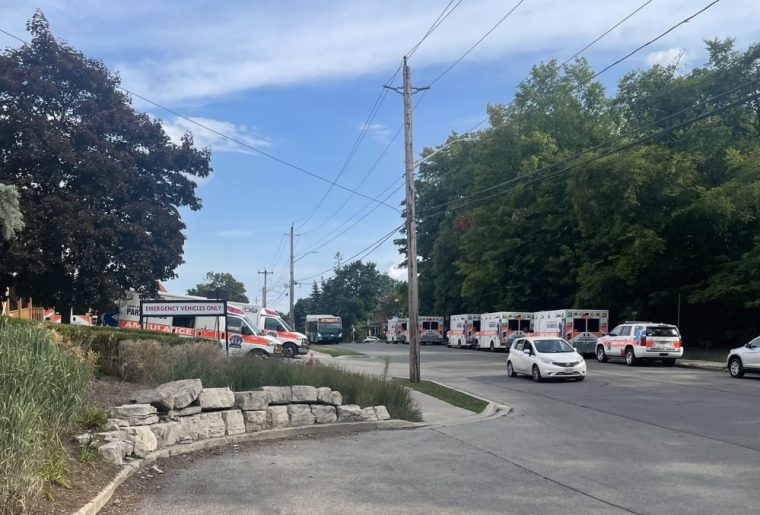
Clack-Bush was asking whether hiring more paramedics might be a solution to the offload delay crisis, and she said that adding bodies don’t solve the systemic issues and could actually just result in even more ambulances being line up on Delhi Street. Also, ambulances are dispatched province-wide, so the end result is that hiring more GWPS staff could see GWPS staff sent to calls in Waterloo, Halton and even Peel, which borders Wellington County on the eastern end.
On staffing, Walton added that alternative models of care, finding additional duties that staff can cover, finding efficiencies in the hospital, and finding efficiencies in transfer of patients will yield results better that adding more paramedics. Dewar also said rather offhandedly that there can never be enough paramedics on duty during surge periods.
Guelph CAO Scott Stewart said that the councils need to keep in mind that there’s a role for the Ministry of Health as well, and they must play it. They need to proceed from the idea that offload delays are unacceptable and take action, which is what the councils can do to help… Advocacy. A letter has been sent to Minister Sylvia Jones, staff are looking to meetings at the Association of Municipalities of Ontario conference later this summer, and the area MPPs need to be drafted into the effort. Stewart said that both councils need to re-endorse the master plan and present a united front.
Guthrie concluded the meeting by thanking paramedics on behalf of the City, the County and the people living in Guelph and Wellington. He added that he hopes that the message gets out that they deserve better and that he was thrilled to hear the positive comments about moving forward. Guthrie said that the councils need to move quick, be bold, recognise the urgency, and, obviously, continue to work together.
Click here to see the complete recap of the meeting.
 Guelph Politico