
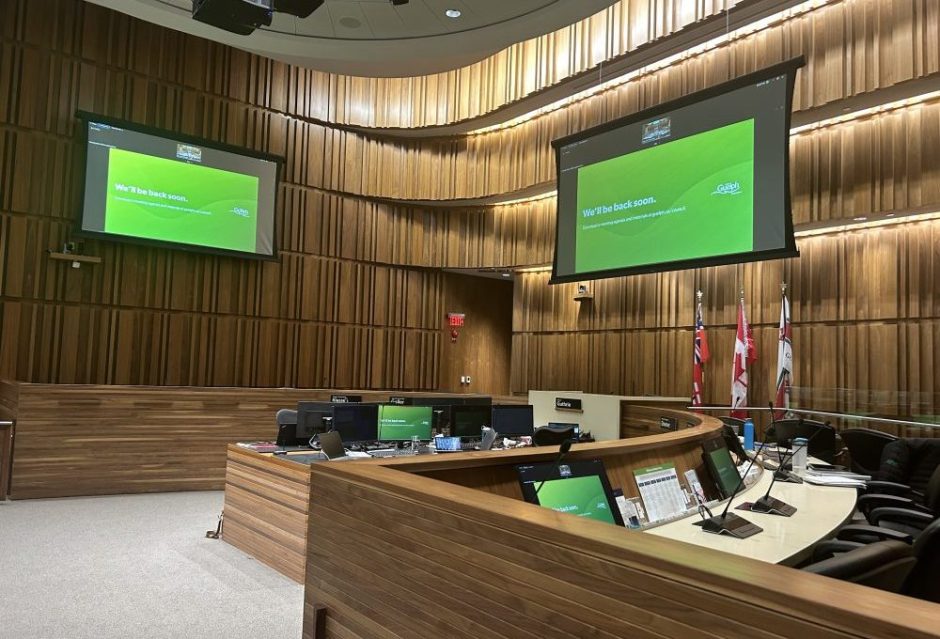
A packed agenda about taxes and recreation on this Committee of the Whole agenda! You can click here for the amended agenda from City Hall, and you can click here for the Politico preview. For the complete blow-by-blow of today’s council meeting, you can follow along with the thread below, or you can watch the whole meeting for yourself by watching it on the City’s website here.
BEGINNING OF THREAD:
Councillor Cathy Downer calls the meeting to order. Mayor Guthrie is absent today.
First order of business, a closed meeting agenda:
Guelph Storm Hockey Club Operating Agreement: Section 239(2) (f) and (k) of the Municipal Act, regarding advice that is subject to solicitor-client privilege, including communications necessary for that purpose and a position, plan, procedure, criteria or instruction to be applied to any negotiations carried on or to be carried on by or on behalf of the municipality or local board.
Corporate Cybersecurity Briefing 2026: Section 239(2) (a) of the Municipal Act, regarding the security of the property of the municipality or local board.
About 45 minutes later, committee emerges from the closed meeting, and now Councillor Goller is leading the meeting. On the two items, Goller says they gave direction to staff on both. He notes that they have regrets today from Mayor Guthrie and Councillor Gibson.
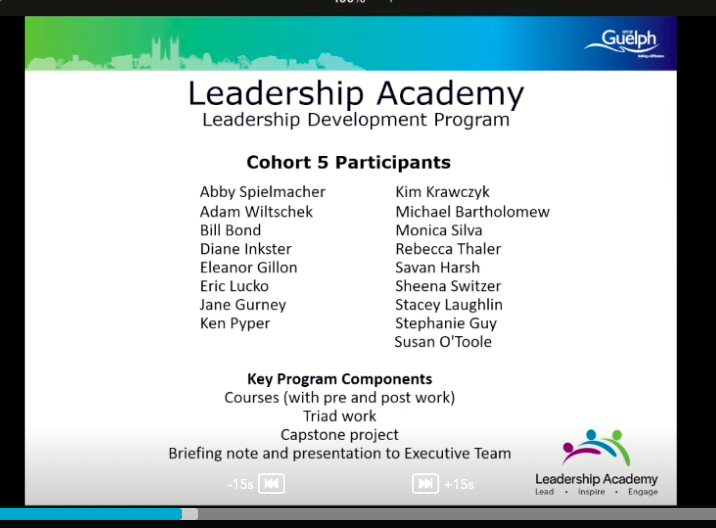
This month’s staff recognitions:

Next, under Governance, Lobbyist Registry One Year Review. Chair Busuttil notes that this is a consent item and Caron/Richardson move the recommendation: That the Lobbyist Registry One Year Review report, dated March 4, 2026, be received. It’s approved.
Now, on to Corporate Services with Chair Caron starting with 2026 Administrative Development Charge By-law Update. Shanna O’Dwyer, General Manager of Finance & City Treasurer plus Justin Wei, Manager of Financial Strategy and Reporting & Deputy Treasurer will present.
Wei notes that there over the last 20 months there have been three major pieces of provincial legislation that have affected the Development Charges Act. As a result, there were some changes that need to be affected since the last update was approved in the fall of 2024.
Key Changes…
-Bill 185: Rate freeze provision adjusted from 24 months to 18 months
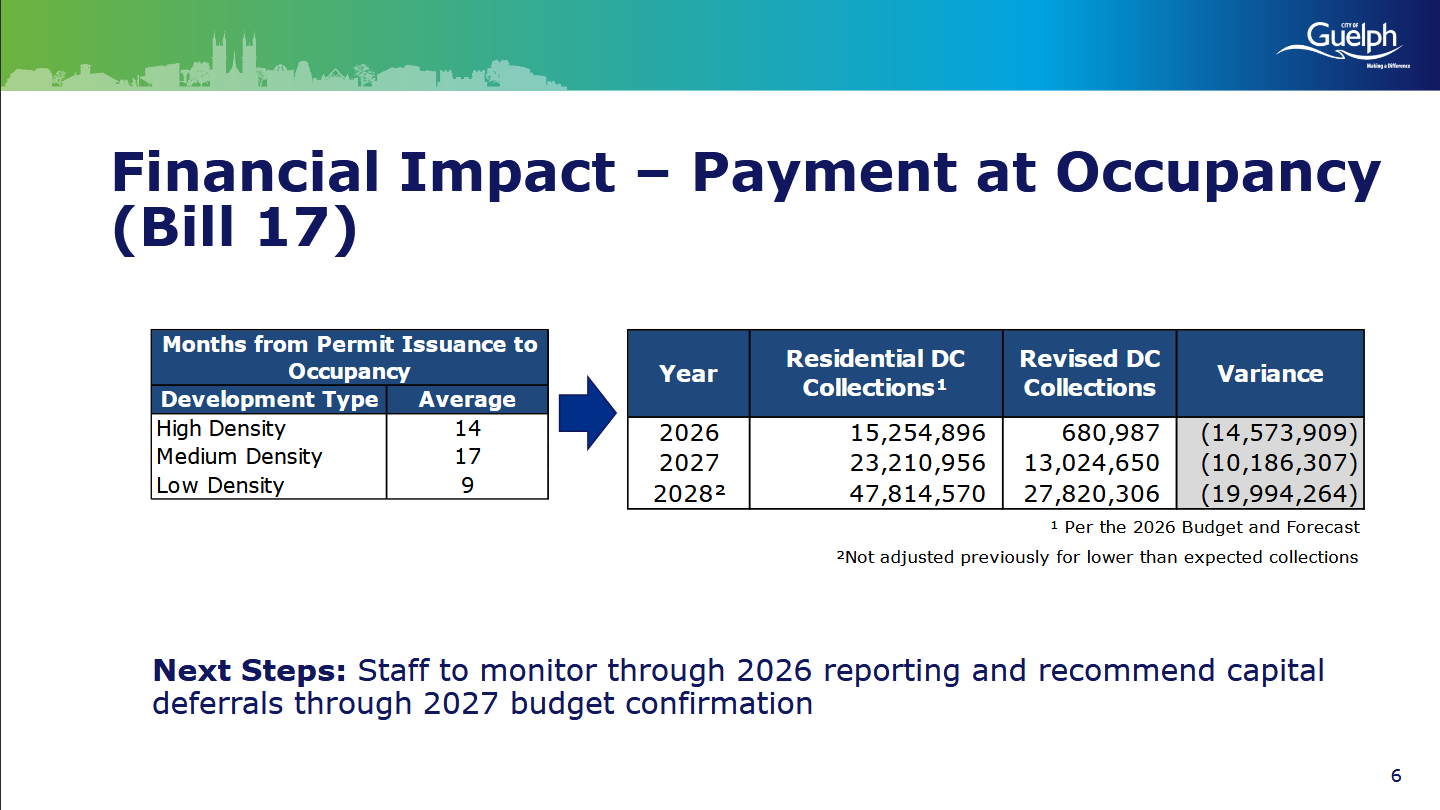
-Bill 17: Payments of residential DC’s now at occupancy, and Interest no longer collected on deferred payments
-Minor technical/housekeeping updates
The delay in collecting DCs will have an impact on the City including cash flow pressures, less liquidity, and more uncertainty about the receipt of DC payments. The below chart notes an impact of between $10 and $20 million over the next 10 years, but staff will continue to monitor and its likely that future capital deferrals will be required.
Bill 60 changes reporting and oversight measures, including a measure that will allow the minister to pull DC bylaws and background studies anytime. Staff are unconcerned because they’re already producing the required docs within the new timelines.
The other part of this report concerns staff’s evaluation about what other municipalities are doing with DCs. O’Dwyer explains that Mississauga has expanded grant-in-lieu programs for targeted rental housing, London has a temporary Community Improvement Plan (CIP) for first time home buyers, and Burlington is looking at time-limited but broad exemptions.
O’Dwyer notes that cutting DCs doesn’t make infrastructure any cheaper, it just means having fewer financial resources to pay for it, and municipalities have very few options to fund itself already. Guelph has ambitious capital plan put prioritizing growth means delaying things like asset management and replacement. There are also a number of new exemptions to DCs, and the development community has become very good at seeking, and receiving, new opportunities.
On Guelph Vs Burlington, O’Dwyer notes that Guelph has a single tier municipality carries an awful lot of the load on its own, while Burlington’s costs are partially covered by Halton Region. If Guelph implemented a blanket exemption similar to what Burlington was contemplating that would mean a $46 million shortfall would have to be made up somewhere, like a tax levy increase of 8.85 per cent.
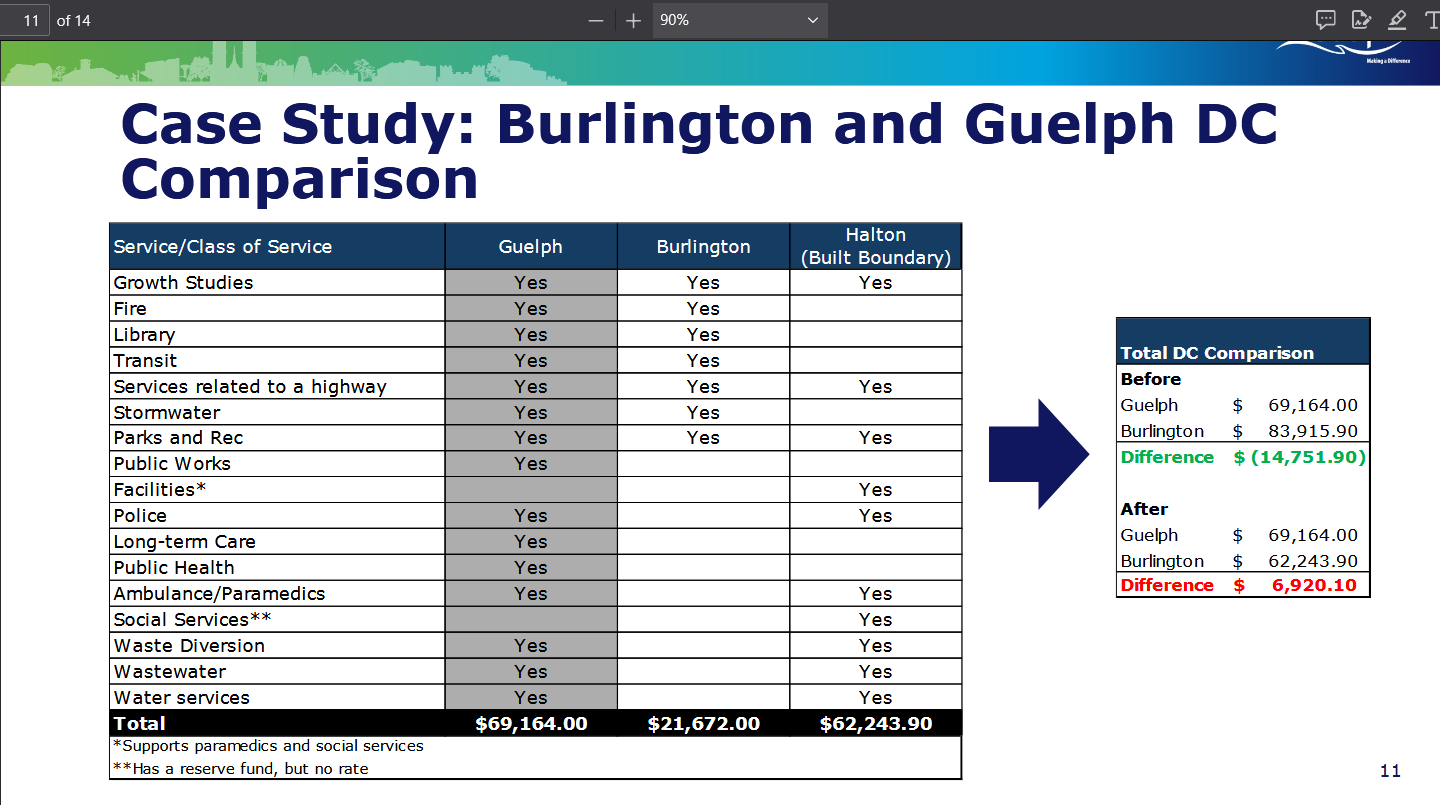
Reminder: Guelph’s DCs are in the middle of the pack in Ontario, and are actually closer to the cheaper side of the grid.
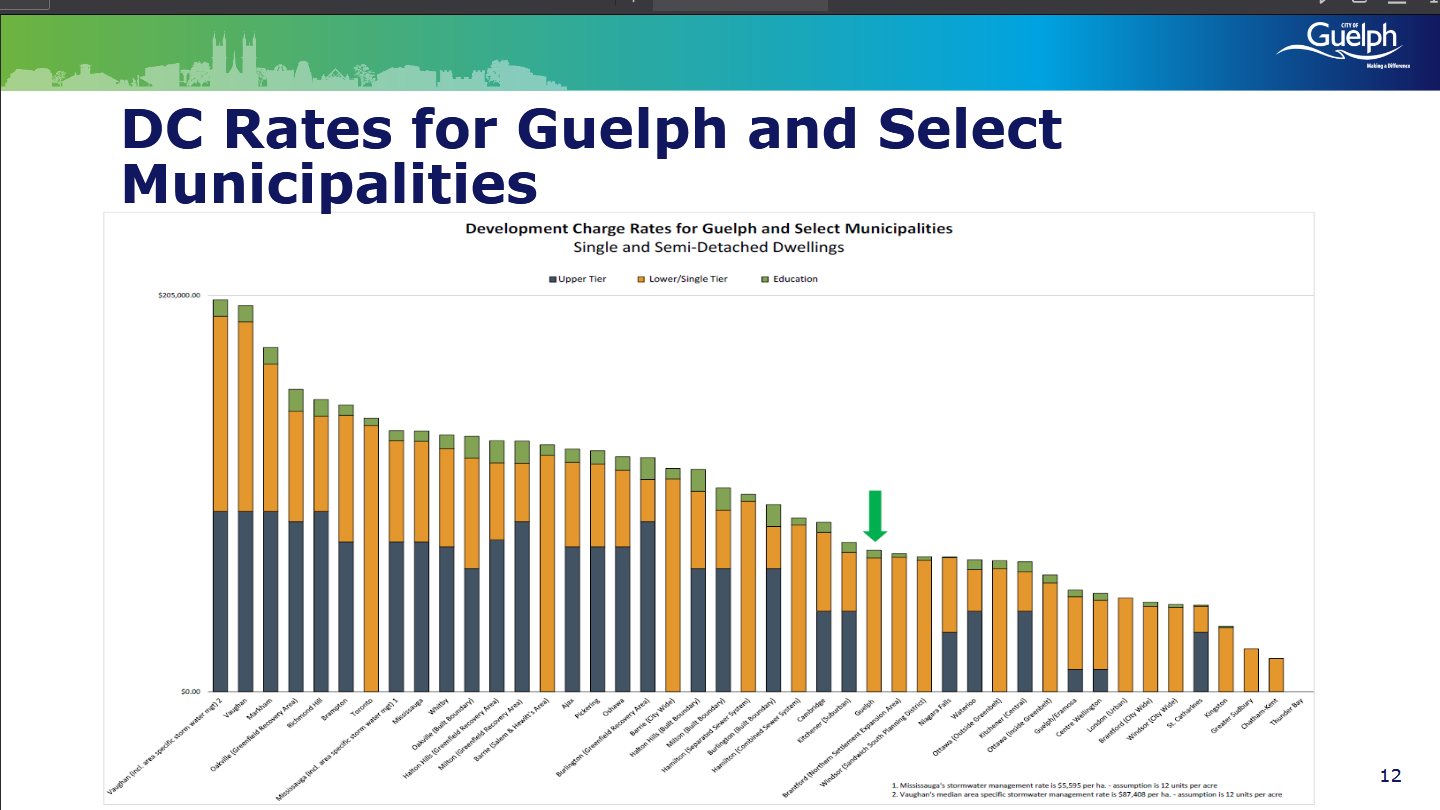
O’Dwyer notes that an untenable situation is developing and that the City needs new, stable and predictable funding for growth infrastructure from upper levels of government. Any announcement about DCs effectively freezes development and the constant churn of change is not having the desired effect on building more housing.
Caron notes that this is technically a public meeting and invites anyone in chambers or watching online to step up and delegate if they wish…
…After a brief break, we begin committee questions. Cllr Allt notes that this is the most explicitly political report he’s seen in council, and he means that as a compliment. He asks what kind of capital deferrals the City might have to address? O’Dwyer says the level of deferrals in future budget cycles will depend on how the projected delays bear out in reality. They will have to stay on top of it and make changes diligently by relying on the capital projects framework.
Allt asks if the promise of 3 million new homes is “dust in the wind”? O’Dwyer says that they need to build enabling infrastructure to make housing happen, but there will come a time when high priority items will have to start being deferred; they’ve already delayed all the medium ones. CAO Baker adds that they were prioritize projects that would support city-wide growth over site specific, but that might change.
Allt: This is not about libraries and rec centres, right?
O’Dwyer: This is about all the infrastructure that supports growth: water, wastewater and other things that would constrain growth if they’re not completed.
Cllr Busuttil asks if this is a new centralize report into the province. Wei says yes, and while they don’t have any firm guidelines yet, they already do this work, so there’s no real change to staff work plan.
Goller/Hauser move the recommendation:
- That the 2026 Development Charges Update Study dated January 30, 2026, included as Attachment-1 to report 2026-76 – 2026 Administrative Development Charge By-law Update, be approved.
- That the Administrative By-law revisions set out in Chapter 3 of the 2026 Development Charges Update Study dated January 30, 2026, be approved.
- That, in accordance with the Development Charges Act, 1997, as amended, Council determine that no further public meeting is required in respect of the proposed 2026 Amending Development Charges By-law.
- That By-law Number (2026) – 21203 included as Attachment-2 to report 2026-76 – 2026 Administrative Development Charge By-law Update dated March 31, 2026, be approved.
- That the updated Development Charge Interest Policy included as Attachment-3 of report 2026-76 – 2026 Administrative Development Charge By-law Update, be approved.
- That Council direct staff to update the City’s Local Service Policy by May 27, 2027, as described in report 2026-76 – 2026 Administrative Development Charge By-law Update.
Cllr Goller asks if they decided to lower or eliminate DCs, how many years would it take for the tax collected from that building to make up the loss? O’Dwyer says that’s complicated, because that’s assessment growth revenue, and growth comes with new expenses. It’s not a net new impact, plus assessment growth is also mean to renew infrastructure as it ages, which is why they had a separate stream for growth (new) infrastructure.
Cllr Hauser asks if these conversations are helping or hurting? O’Dwyer says hurting. Any hint of a change of policy at upper levels of government has a freezing effect, especially if the expected result is a positive for the developer.
Caron asks if there’s any condition that can be applied to pass on any savings to the home buyer. O’Dwyer says there is not. Caron asks if it would be helpful to for council to endorse a letter to the ONgov to stop any further changes to fees until we see how the fee cuts so far have panned out. O’Dwyer says staff is cool with that.
Recommendations approved.
Next, 2026 Property Tax Policy. James Krauter, Manager, Revenue and Treasury & Deputy Treasurer will present. Like every March, committee has to approve the new tax policy, which is basically how the tax levy increase passed at budget time is turned into what you see on your tax bill starting in June.
Krauter notes that council approved the new affordable rental housing subclass last fall, a 35 per cent reduction to qualifying affordable rental units. The Municipal Property Assessment Corporation is still gathering data and assessment notices will be issued later this year to any property that qualifies.
In terms of funding the City, this how we “slice the pie”. Note our reliance on the residential tax base.
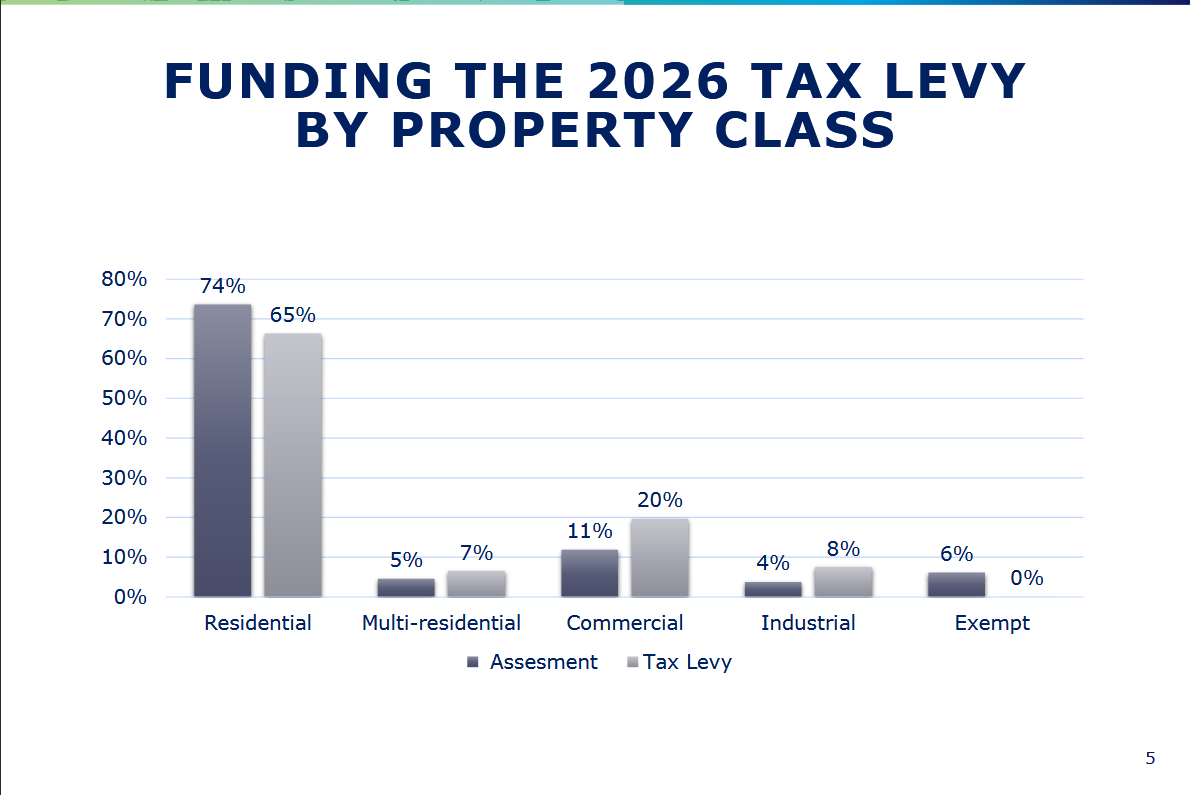
There are some other considerations. In 1998, Guelph was one of the only municipalities to adopt a New Multi-Residential (NT) class. Buildings can stay in that class for 35 years, then revert automatically to Multi-Residential, and those first generation of units will start to convert to 2033, but the majority of the affected units will flip around 2050. The impact will be a $1,000 jump, so the City will need to look at options. Staff are recommending to wait for reassessment before coming up with a strategic plan.
Goller asks about the proportion of multi-residential versus low density. Krauter notes that there are 29k single family homes in Guelph, 11k+ residential condos, and 184 apartment buildings (not sure of total number of units). Goller says it makes sense to wait for the provincial government to make a decision before council proceeds with any changes.
Caron notes that the Residential Tenancies Act, landlords must reduced rent if there’s a significant enough reduction in their taxes, how does the City monitor that? Krauter says they look at the changes on an annual basis, and if there is such a reduction the City must notify the landlord, and notify all the units affected, which they have to do according to legislation. If the landlord does make a move, then it goes up to the Ontario Land Tribunal.
The recommendation is approved:
- That, with the continued extension by the province of the 2017-2020 assessment cycle, tax ratios for all tax classes including the Multi-Residential ratio will remain consistent until a province wide reassessment occurs or provincial legislation forces such change.
- That the 2026 City of Guelph property tax ratios and corresponding tax rates, as set out in Attachment-1 to the report titled 2026 Property Tax Policy dated March 4, 2026, be approved.
Next, Chair Downer takes over for Public Services.
We start with a Service Profile of Culture and Recreation. Danna Evans, General Manager of Culture and Recreation will represent.
Evans says that they provide opportunities of participation in order to attract more people to facilities while promoting community and healthy living. There are 10 main facilities along recreation, museums, Sleeman Centre and the River Run. There are 90 FT staff members, 640 PT/casual and 500 active volunteers. About half the FT staff members have worked for the City for 10 years or more.
Evans: Culture and recreation assures that public spaces are open to everyone, and they’re trying to respond to community need and fill gaps in the community. They’re trying to develop new programs and partners on a regular basis, but its working pretty good with over 106k tickets sold at the River Run annually, over 23k visits to the museum galleries and events, and over 170k in rec program participation.
In 2026, they’ve got the South End Community Centre to look forward to, the Culture Plan, the Parks and Rec Master Plan, and Guelph’s Bicentennial planning.
Core service objectives include managing these facilities:
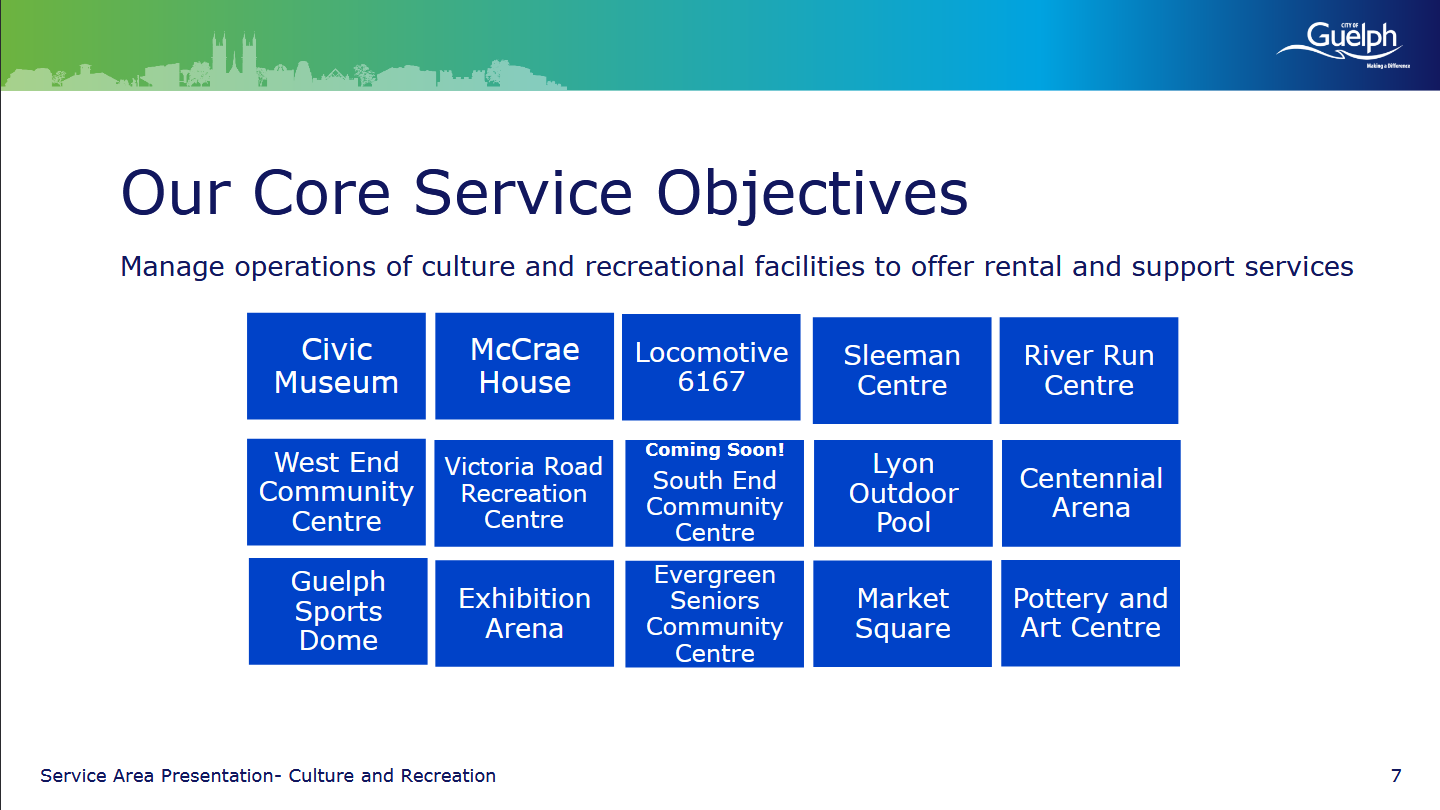
Also, they design and deliver culture and rec programs, from swim lessons to River Run event. They also support event planning and place making, including public art. They also sell takeout meals at Evergreen Senior’s Centre five days per week, do the lightings and flag raisings in Market Square, and more.
Challenges? Reliance on part time staff, Funding for growth, Aging infrastructure, Access barriers, Pressures for elite facilities, Prime time Rental demands, and Legacy Rental times.
Opportunities? Grants / Sponsorships, Expanded programs, Tourism Growth, Facility Allocation update, Guelph 200 Legacy, and Innovations in technology.
Budget breakdown, operating and capital:
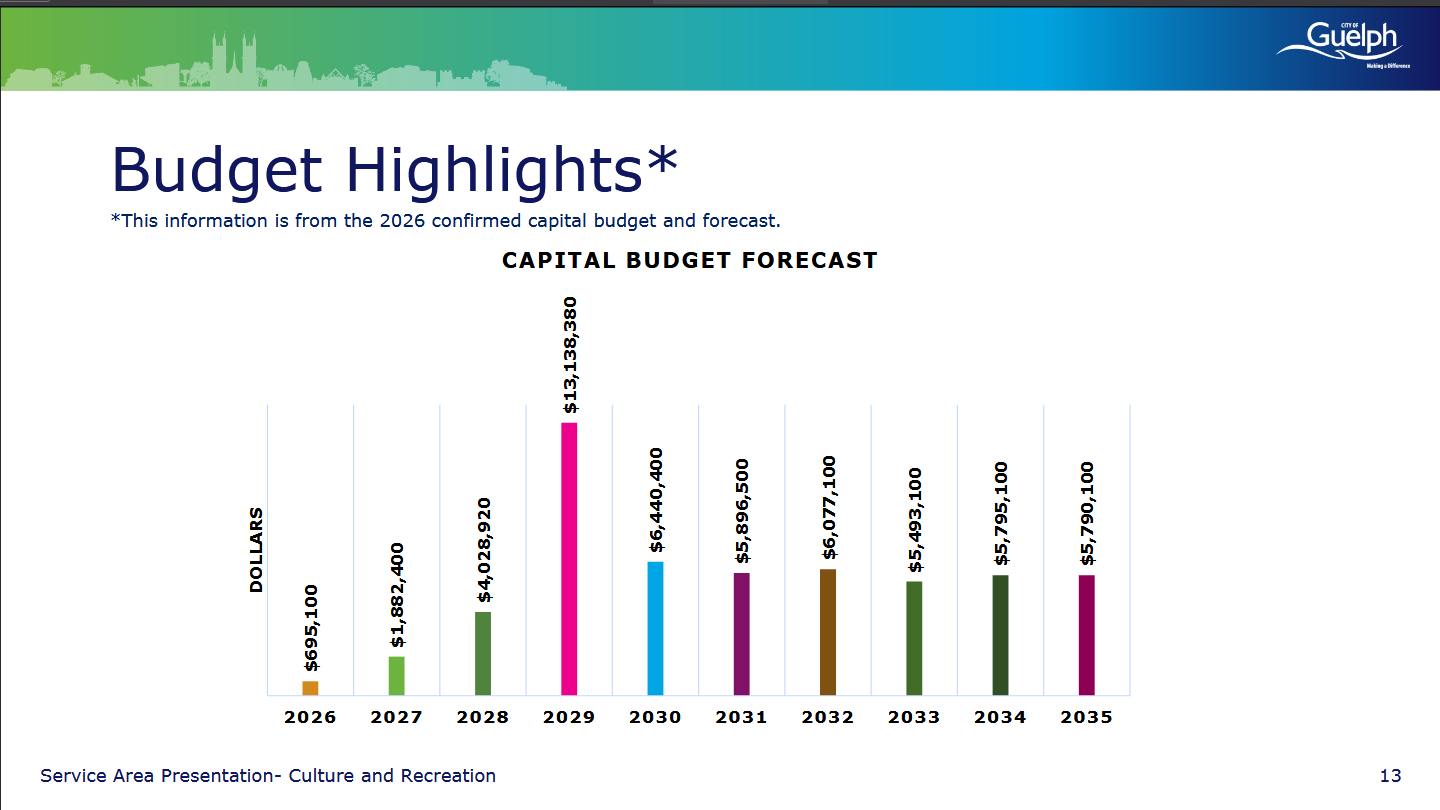
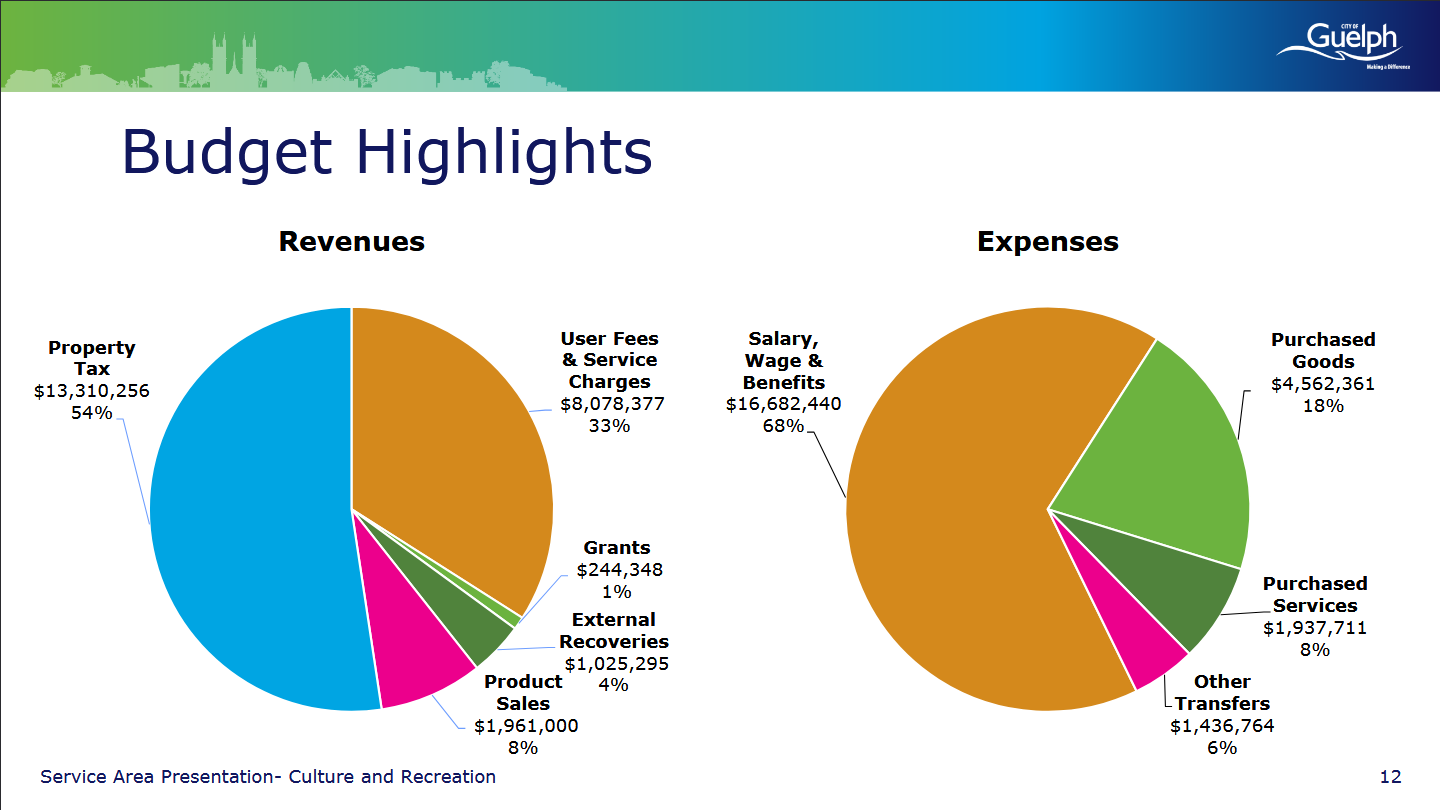
The spike in 2029 is a result of facility renewal projects being pushed forward to relieve some budget pressure. Staff are presently looking at the ways they can sand down that spike and spread out the funding needs.
Questions? Nope.
Next, an item on consent: Recreation Facilities Allocation Process Update. Downer asks for comments from Evans, who seems to jump right into the Sleeman Centre Operating Model presentation. She’s discussing the opportunities for the City to book events and undo the reliance on supporting the centre through the taxbase. There will be changes to how the community to rent ice time at Sleeman once the two new pads at the South End Community Centre open, that’s not the end of those opportunities, but it will change how long and how far in advance groups can book that ice time.
Evans says that they know there’s a need for more ice time in Guelph from the needs assessment completed in prep for the SECC; the City needs one more ice pad by 2033. The needs assessments did not take into account Sleeman and the U of G though and once the SECC opens, they will do community engagement to further study community needs.
As for Sleeman, this year staff will create an event plan, develop a marketing strategy and come up with allocation and booking guidelines. There will be some new costs with marketing and artist fees, but there will also be new revenue. More information about that will come forward with the 2027 budget confirmation in the new year.
Evans says the motions will allow staff to negotiate rates and fees where they will hopefully recover all costs. They’ve proposed to add a $2-$3 service charge per ticket to fund a capital reserve for centre infrastructure, and to remove the youth facility discount for (only) the Sleeman Centre.
Downer asks to go back to the Allocation Process Update, any questions?
Caron says they’ve been hearing from the community about allocation, and many are going outside the city for ice time. There’s a perception of preference for certain sports too. So on engagement, what is that going to look like and what are the timelines? Evans says they’ve done robust communication with community users, which caused someone to burst out laughing in the gallery. Downer asks for decorum.
Evans continues, there’s been engagement with users, not with the whole community. Patty Pizziola, Recreation Supervisor, Bookings, Events and Promotions said they did surveys and outreach through consultants with active user groups and their was a Have Your Say page.
Caron: Was it every single user group?
Evans: We used list of contacts, and they more one-on-one with boards and chairs through the consultant about how easy or cumbersome the process is. They were looking at process, not policy.
Caron: What will you be looking at after the SECC opens?
Evans: They’re looking at optimization, how much new time they found beyond growth, and are there adjustments that can be made so that they don’t lose time. Can people be moved to a different facility that might be a better fit, any orgs working across two facilities that can be combined into one?
Caron asks about emerging sports. Evans says she imagines there are a lot, like a mash-up between soccer and ping pong. More locally, there’s interest in more accessible sports like wheelchair basketball and sledge hockey.
Busuttil stresses that there needs to be a focus on arts and music, and not just sports and acknowledges staff’s work on that.
Busuttil/Goller move the recommendation: That the Recreation Facilities Allocation Process be approved, and it is approved!
We now move on exclusively to Sleeman Centre Operating Model and questions.
Cllr Klassen asks about the transition, given that orgs plan ice time for September through March. Evans says there’s no loss, and the just approved allocation will make some assurance of that and they will also look to find efficiencies with those orgs if they want to move their ice time from two pads to one.
DCAO Colleen Clack-Bush says that they are aiming to open the South End Community Centre on September 1, so they need to start allocating the new ice time now. Everyone currently accommodated at Sleeman will continue to be accommodated in the system. They need the approval this month so that they don’t leave groups hanging.
Klassen asks when they might see the goal of increased revenue by $1.8 million? Evans says that’s a big part of the budget work they’re doing, but there will still be some transition due to a lack of flexibility. She says Sleeman Centre manager Ryan Giles has had to turn down some opportunities in the last eight months because of the existing contracts, including a film, some trade show, and a cheerleading event.
Goller asks for clarity: youth groups can still book the facility, but they just have to pay the full rate? Evans says that’s right. Ice rentals right now is about $300,000, so this might mean another $150,000 per year considering all the current ice time rentals at Sleeman. Clack-Bush adds that they don’t offer the youth rental discount at the River Run Centre either as a matter of policy.
Goller asks about cancelling leagues if a bigger event becomes available. Evans says they do some of that now, moving teams to other pads where they can while recognizing that there’s a need to have a consistent schedule for youth leagues.
Goller asks if council doesn’t support recommendation #3, that’s a $150k impact? Clack-Bush says they can come back to council with an exact number, but the re-allocation of the groups is the most important part. Goller says he wants to look at a policy where they can just cancel if something comes up. Clack-Bush says they don’t want to do that because the time to guarantee bookings is now before the SECC comes online. It makes staff’s efforts to get other things in Sleeman harder.
Goller says groups can still book September to March just paying the full fee? Evans says that’s not the intent, they’re thinking more like one-offs or limited time bookings.
Goller tries again: Can we still let leagues book ice time at the discount if they consent to the possibility that they will get bumped? Clack-Bush says they can look at that, but they don’t recommend it, and they don’t think it would be beneficial to the groups as they look to try make more money off the Sleeman Centre. The time is now with the SECC’s twin pads coming online.
Goller asks to separate recommendations #1 and #2 from #3 when it comes time to vote.
Cllr Caron asks if we can defer the third clause since leagues area already planning their 2026/2026 season? Clack-Bush says there will be no impact on the rates if we move them out of Sleeman to other facilities.
Caron asks to defer #3 to the end of the month. Clerk McMahon says whether they pass it or defer it, it still comes back at the end of the month.
Cllr Hauser asks how quickly the new available ice time will get eaten up considering the groups that are going outside of the city to get ice time? Evans says she’s not sure, but they will be following up with different orgs about their needs once the SECC opens.
Cllr Chew says he thinks they all agree that the shortfall is unsustainable, and they all agree that it can be used much better, but the issue is the transition. Is there a way they can look at doing this in a phased way to monitor. Evans says the concerns council has received is about ice capacity, and they’re relying on the needs assessment done with the SECC. Has that changed? That’s why they will be doing follow up once the SECC has opened.
Chew asks how the City leases with various groups? Evans says they will be relying on the new facility allocation policy. They will focus on Guelph and youth first, but they also won’t be cherry picking and going with the largest group because it’s the largest group.
Cllr Caton says staff did exactly what council asked them to do. They’re trying to make a responsible decision that increases value to all families. Busuttil says ditto, and she’s looking at the economic opportunities because those are also lost when people look for ice time outside of town, or can’t access Sleeman because of hockey practice.
Goller says he supports the booking changes, but he’s still going to vote to defer recommendation #3.
Downer asks Clack-Bush if she has anything further to add. The DCAO says they will develop a memo that outlines who many events will be affected by the move to other ice pads versus the more one-off events, and staff are open to talking to any user groups that want to talk. Also, Guelph is not the only municipality that’s struggling with not having enough ice; Centre Wellington up the road has the same issues. She doesn’t want to lose track though that they’re adding ice, even while recognizing it doesn’t solve the problem.
Caron asks if there’s an new ice pads in the 10-year capital plan. Clack-Bush says no, and more likely money’s going to go to keeping the ones that are aging.
Downer says when Sleeman opened it was intended to be an event venue and that’s why it was built. We haven’t been able to exploit it as an entertainment venue and for years councils have been looking for ways to better utilize it; this is the first time they’ve seen a plan and a lot of that has to do with delays over the SECC. Delays cost in many ways she says. She hopes that they can work out issues with the groups.
Recommendation moved by Hauser/Richardson:
- That the Deputy Chief Administrative Officer of Public Services, or designate, have the authority to negotiate all Sleeman Centre rates and fees when revenue can be recovered through rental profit share or ticket sales.
- That Sleeman Centre capital reserve fund ticket service charge increase to between $2.00 and $3.00 starting September 1, 2026.
No opposition to those motions.
Busuttil/Billings move:
3. That the Youth Facility Discount no longer be applicable for rentals at Sleeman Centre, as of September 1, 2026.
Goller/Caron move referral. It fails 5-6.
Vote to approve #3 passes 7-4 with Hauser, Chew, Caron and Goller voting against.
That’s a wrap!
END OF THREAD!
 Guelph Politico