
Let’s workshop about water! You can click here for the amended agenda from City Hall, and you can click here for the Politico preview. For the complete blow-by-blow of this council meeting in the thread below, and you can also watch the City’s own live-stream of the meeting here.
BEGINNING OF THREAD:
Mayor Guthrie calls the meeting to order.
Nectar Tampacopoulos, General Manager of Environmental Services begins with key focuses and takeaways: supporting new housing, aligning approvals and service capacity defining the current service and capacity (aka: the runway), and sharing policy work with new authorities under Bill 185.
Wayne Galliher, Division Manager, Water takes over with the background: Guelph has relied on groundwater since 1879, with focusing on the needs primarily of firefighting. The system is comprised of 25 production well, 560 km of watermains. 21 wells are in continuous operation and four are offline. Current firm capacity is 69.7 m3/day with a system capacity of 79.4.
Existing Offline Wells:
• Clythe Well – water quality upgrades (in progress)
• Smallfield/Sacco Wells – water quality upgrades, contaminated sites
• Edinburgh Wells – well interference, potential water quality upgrades
Existing Test Wells:
• Ironwood/Steffler Wells Dolime interference
• Guelph South Well – test program, surface water impacts
• Logan Well – test program, well interference
Tim Robertson, Division Manager, Wastewater, overviews the wastewater: Guelph constructed a separate sanitary and storm sewer in the early 1900s. The focus today is on waste as a resource according to this acronym: Water Resource Recovery Centre.
Most wastewater flows with gravity, but there are five pumping stations;
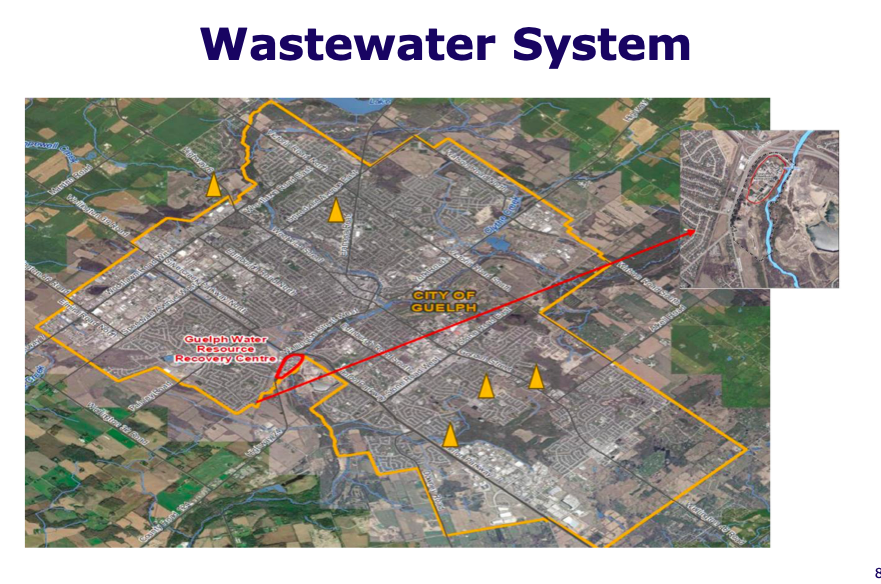
2% of the flow comes from Rockwood, fyi. Average daily flow is 64k m3/ dat. The treatment process generates residuals that have nutrient and energy value, both of which are recovered by current practices including biogas for energy and fertiliser.
Robertson says all infrastructure is optimised to its full potential before any new projects are considered.
Galliher returns to talk master plans, which was last update in 2022 and meant to support water supply development to get Guelph to 2051. The MP will be re-opened in 2028 to account for new field work and will inform the City’s linear servicing MP.
What is the master plan? It looks at meeting current and future demands of water service (basically). It also means understanding what is driving peak demand and assessing the adequacy of supply in the instances like drought or unplanned maintenance. The 2022 MP recommended a 15% buffer in the case of these potential interruptions.
Galliher points out that while Guelph has been growing fast, our water demand has been not been growing as fast. They’ve reclaimed that through conservation and efficiency.
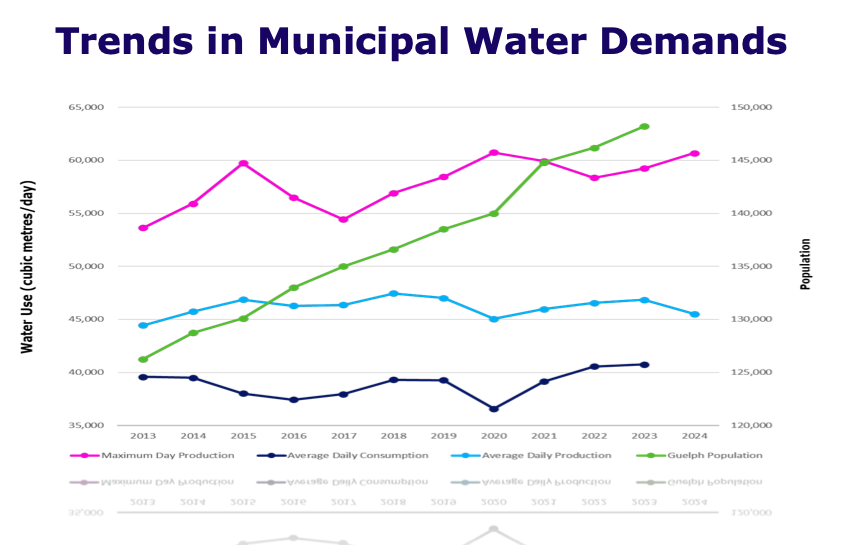
Peak water demand was 56k in 2024, which will give the City more time to onboard new, time sensitive projects. However, there is a concern about time getting away from Water Services if they need to start developing projects faster, like a sudden increase in the amount of development.
Timeline for new projects:
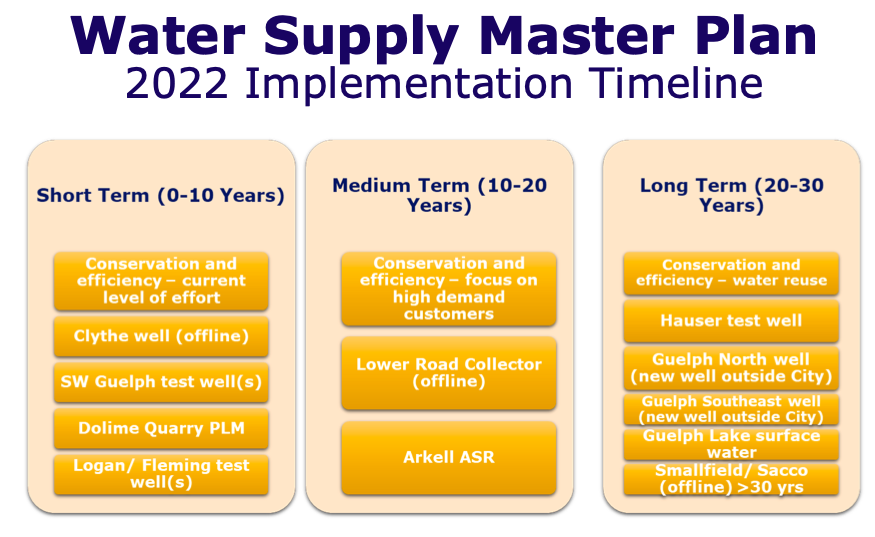
Key projects underway include Clythe Well treatment plant. The well is presently offline, but the project is in a design phase now and will go to tender in Q1 2026. Then there’s the South Guelph Water Supply EA, with potential for 4.5 million litres per day following pump test in 2019. A new test will be done this summer. Also, the Logan Test Well EA in Guelph/Eramosa Township and it’s shown suitable taking of 6.4 million litres per day. The testing for this EA was just finished.
Next, Robertson will go over the Wastewater Treatment & Biosolids Management Master Plan. It was done in 2022. Currently the WRRC is at 85 per cent capacity so the time is right to look at expansion. The plan is to get to 79.2 megalitres per day from the current 64 by 2038 (that’s phase 2). Getting there will require $140 million investment phase 1 and $50 million in phase 2. Also, this is outside the current 10-year capital plan window.
So what work is coming up? There are four key projects: The new disc filter and UV disinfection project, which will go out to tender at the end of this year; biosolids expansion in Q3 2026 which will support growth and increase efficiency; plant #2 that will expand two additional clarifiers and associated equipment; and preliminary treatment expansion which will begin in 2026 and be awarded in 2027.
Gallihers notes that there’s years concurrent work taking a master plan and turning it into all the various construction projects. EAs can become contentious too as all water issues are and neighbours feel like their own water resources are threatened.
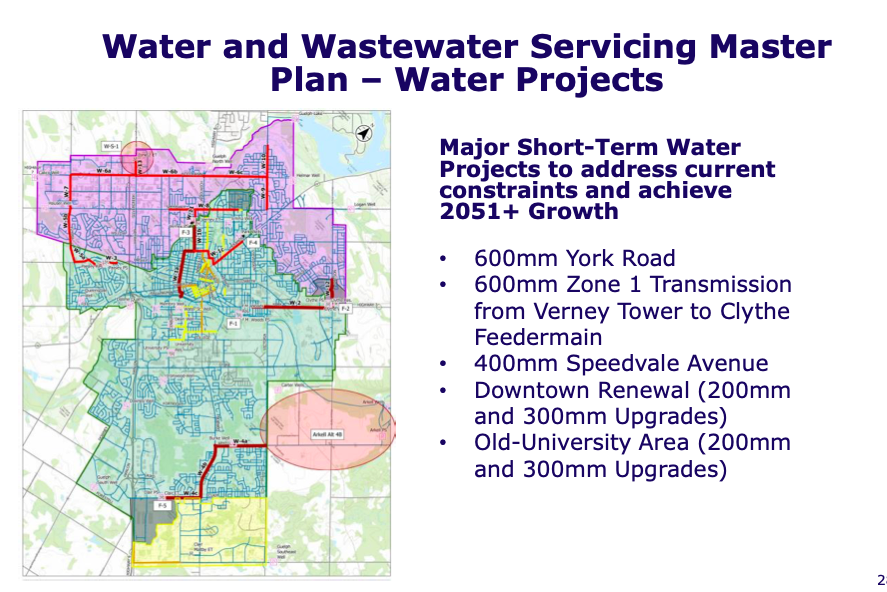
The Water and Wastewater Linear Servicing Master Plan focuses on taking the two master plans and working out the chronology of when projects need to be initiated. Water projects in the short-term:
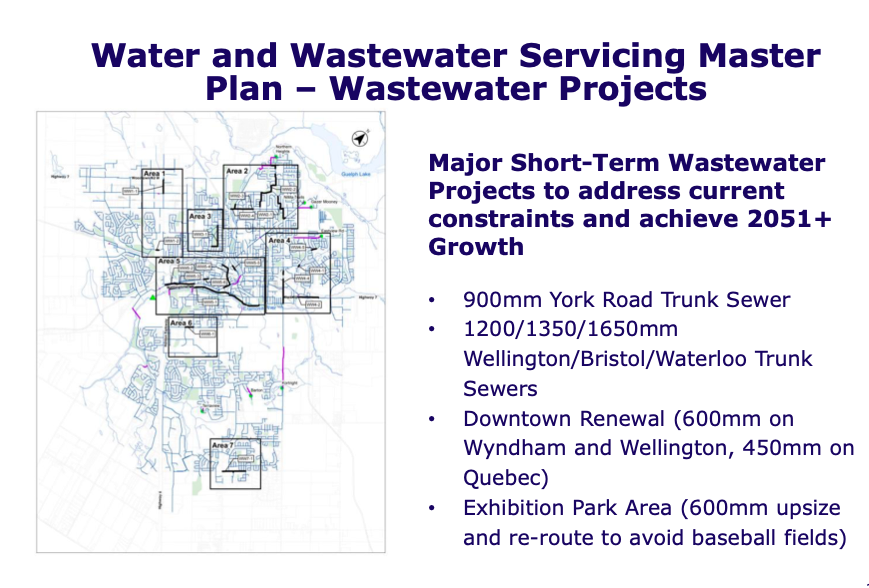
As for wastewater projects:
The City also receives requests for servicing outside the city. The official plan seeks to encourage development along the fringe, but there’s also a concern that the City does not have extra capacity to get to our 2051 needs. There presently two exemptions with the Grazer Mooney subdivision in GET and Rockwood wastewater servicing. A service extension agreement will be coming to council by the end of the year.
Presently (or at least by the end of 2024) there’s an unallocated serving capacity of about 3,758 m2/day or 17,844 people. That’s how many people that can be accommodated with the present service capacity.
So how to allocate capacity? First one, first served at the time of a development agreement and building permit. Servicing needs identified in pre-consultation and the City investigates is the site can meet the need. The process is the same for residential, industry, commercial or institution.
Challenges? Legacy approval continue even without a time line to begin construction, land use type feeds the assumptions so if the land use changes there’s an impact, there’s also the question of zoning density versus proposed allocation.
Impact of Bill 185? Municipalities can define allocation by revoking it if construction doesn’t get going in a timely way. Staff will be launching a new project this month to form a new servicing allocation policy, which includes this “use it or lose it” provision. Look for the launch of formal engagement about this bylaw coming later this month.
That’s a wrap for the presentation so it’s on to council questions…
Cllr Gibson asks if this is all benefit from conservation efforts. Staff says if you look at the WSMP it speaks to the benefit of deferral and timing, and the community has done a lot of work that we’re seeing the benefit of. There will a report about more opportunity for conservation later this year.
Cllr Downer asks about “use it or lose it”, we can’t make it retroactive, can we? GM of Building Krista Walkey says that they can. They will have transition policies to make sure that its fair, and they will make sure that those who are ready to go have the support. Downer says kudos about water conservation numbers because Guelph was doing that before it was cool.
Downer asks if the City is compromised in anyway financially due to DC decisions at ONgov? Staff says there were some changes that were added back, so no issues with impact from DC changes with these plans.
Cllr Busuttil asks if staff is seeing a “mismatch”; like if more people are using a unit than it might have been built for. She’s thinking about the six people living in a one-bedroom apartment. Staffs they will be implementing that check as part of the allocation work, looking at consumption breakdown by build forms.
Gibson suggests looking at potential future industrial uses because an opportunity may arise that the City might have to capitalise on quickly. We will need to have that information handy.
Cllr Goller asks about the amount of capacity is being held back by units not built yet. Staff says that it also part of the allocation study they’re working on. They can get back to council with a written report in late-June. Goller asks other municipalities doing “use it or lose it” policy. Staff says they’re engaging the neighbouring municipalities to work through it.
Cllr Chew asks if there will be any merit based evaluation on different types of development. Staff says they need to take that one back to understand where the policy stands. Chew says he wants to make sure that it doesn’t become convoluted so that people can understand how projects will be evaluated.
Cllr Billings asks about the existing capacity with loss of supply on page 12, is that leakage? Staff says no, that’s an infrastructure failure at the largest pump failure. Billings asks how much we’re leaking. Staff says we have an industry best position in terms of “unavoidable loss”; Guelph is at 1.3 which is down from 3 in the mid-2000s. Industry best is 1.
Billings asks if the replacement of pipes helps. Staff says yes, and they will be very interested to see the impact when the very old downtown pipes get replaced in a few years.
Billings asks about quality of the new water, is it just as good? Staff says some of the test wells highlighted there is a “naturally occurred aesthetic issue” in some, but the others are showing good results. They’re also looking to work with the ONgov on cleaning up some of the challenging wells that have been contaminated and need remediation, but that help may be 10 years in coming.
Mayor Guthrie asks if taxpayers are responsible for cleaning up contaminated wells. Staff says they’ve engaged ONgov and are having ongoing meetings to get money and capacity, whether that’s just motivating a landowner.
Short-term vs long-term infrastructure, Guthrie asks if there’s a business case that they look at when deciding how to proceed. DCAO Holmes says that they’re looking to prioritise growth, but that changes all the time with new legislation or new development. What they look at with the capital forecast is where the biggest bang for buck is because money and time are both factors.
Guthrie says with this “use it or lose it” he feels like it’s going to be a big determination for the budget. Can they make sure they have deals with developers before approving the budget? Holmes says they do that informally now, but this tool will let them formalise that and get some agreement about timing, but things change with economic circumstances too.
Guthrie says that he remembers trying to get his head around conservation as a councillor and credits the previous administration with that effort. He says the data has showed that its paying off and that’s an important takeaway for the budget: education and conservation work! He also says that he’s been impressed with everyone in water (not that he’s picking favourites on staff).
Motion to receive the workshop presentation approved!
That’s a wrap!
 Guelph Politico