
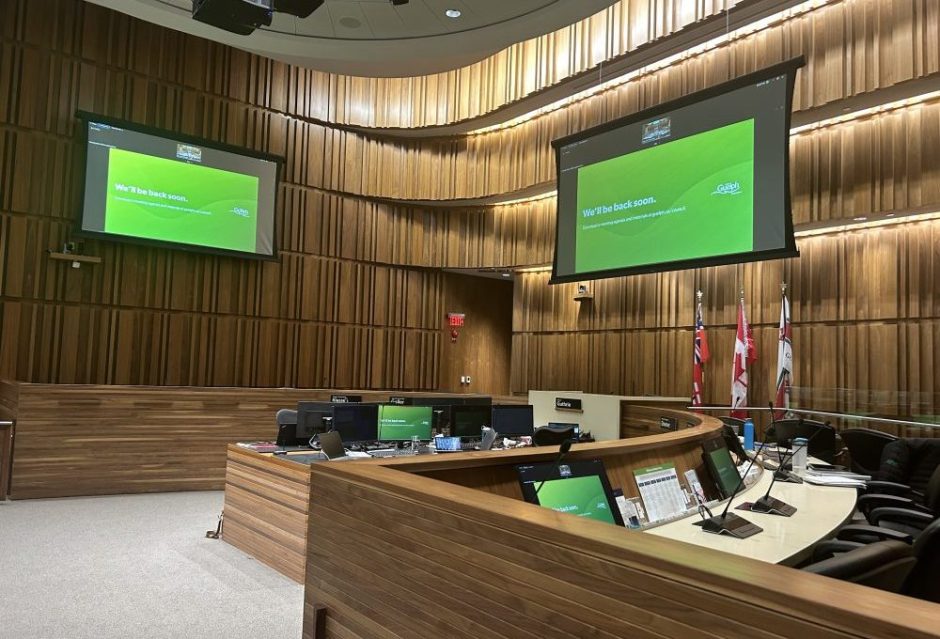
It’s the last budget meeting of the year! Or the first. Depends on how you look at it! You can click here for the amended agenda from City Hall, and you can click here for the Politico preview. For the complete blow-by-blow of this month’s Committee of the Whole meeting, follow the breakdown posted below, and you can also watch the City’s own live-stream of the meeting here.
***
Mayor Guthrie calls the meeting to order.
No Disclosure of Pecuniary Interest and General Nature Thereof.
Regrets from Cllr Klassen and Richardson.
Shanna O’Dwyer, Acting General Manage of Finance and City Treasurer begins. She notes that this is the first time that the LBSS budgets have been considered separate and apart from the main City of Guelph budget, which make up, typically, about 1/3 of the City’s total budget levy.
This meeting completes the 2025 budget confirmation process.
To recap, the LBSS are: Guelph Police Service, Guelph Public Library, County of Wellington Social Services, The Elliott Community, Wellington-Dufferin-Guelph Public Health, Grand River Conservation Authority and the Downtown Guelph Business Association. Funding for all comes from the tax rate except for the GRCA, which comes from the water fees.
Budgets at a glance (except the GRCA):
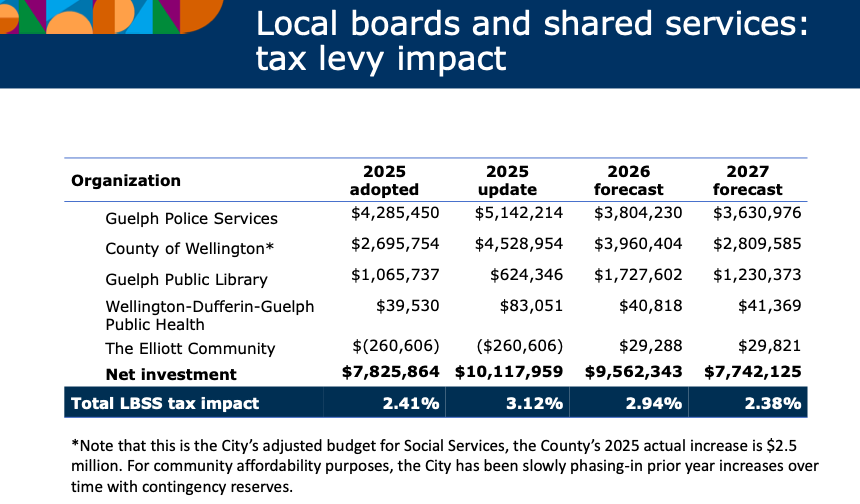 There’s a difference in the County increase for Social Services budget of $4.5 million in total. This is due to the phase of the 2024 increase, and an allocation of assessment growth increase.
Downtown! $721k or 3% increase over 2024. The increase in expenses is funded by grants and other revenue.
No changes to the GRCA budget from what was adopted last year. Note: The GRCA budget is still draft and will be approved by their board in February.
Questions about what we’ve heard so far?
Cllr O’Rourke asks about GRCA budget, they have revenues from hydro generation, any chance to build up budget that way? Sonia Radoja, manager of corporate services at the GRCA, says there’s no plan for expansion at this time. They were looking at Parkhill Dam, but there’s been no uptake on that idea.
Guthrie says GRCA, DGBA, and WDGPH are donezo!
We start with The Elliott on page 72 of the presentation!
There are now 114 residents who call The Elliott home thanks to 29-bed expansion. They also exceed four direct hours of care per resident per day as established by the ONgov. Theresa Moisan, Chief of Finance and Operational Services of The Elliott Community, says she’d be happy to give anyone on council a tour of the new space.
Moisan says they’ve stayed with in the 4% threshold for 2025 and have net decrease for this year. They’ve reduced the cost per bed this year too from $24k to $18k. They’re also leveraging grants from government and non-profits, including $263k in HVAC upgrades from COVID-19 funding.
No questions about The Elliott.
Next, the Library with new CEO Dan Atkins.
Budget goals: Continue to deliver equitable service, Build capacity for the new Central Library, Balance fiscal responsibility, and Align with the City’s strategic direction. Atkins says this budget will aim to build capacity and balance those goals with fiscal responsibility. A “thoughtful but strategic investment”.
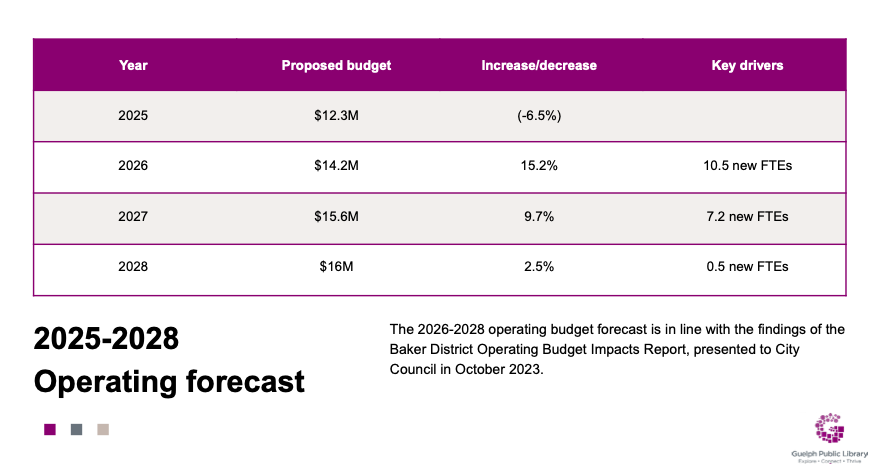
The GPL Board has approved a budget of $12,349,767, which is a 6.5% reduction from the 2024 budget. That’s thanks to an “administrative” adjustment, otherwise it would have meant a 4.7% *increase*.
Drivers: Inflation, utilities, book prices, software and building maintenance. Employee compensation is about 68%, which is consistent with national average. Capital reserve is heading down, and it should be obvious why given what’s happening on Baker Street.
The budget includes 6.3 Full-Time Equivalent (FTE) positions phased in for 2026 that will help build programming and service capacity for the new Central Library. Also, staff training and development will continue so they’re ready for that opening day planned for next year. Atkins notes that library workers are now also I.T., social workers, ECEs and more!
The Public Library Operating Grant is expected to remain steady at $167,700, but staff are always looking at new grants. Losing revenue from room rentals as library space is at a premium from growing demand, they need it for their own programming and services.
We will be getting back to increases though next year:
 On capital, there will be investments RFID to support material management, IT upgrades, maintenance at the main library, and branch upgrades. There will be an accessibility audit in 2025 that will also be supported by these funds.
Sure, books and computers, but the library also does: Facilitating language learning, technological support, and job searching and education, Delivering programming to the community, at vulnerable points in their lives, Connecting vulnerable people to social supports, and Inspiring creativity and community.
Questions? Cllr Gibson asks about synergies between maintenance with City and the Library. Atkins says the “maintenance” is about keeping the building itself going, they’ve got to stay in that building for another 18 months. DCAO Trevor Lee says that staff will be delivering a report in Q2 about the co-ordination of back end support for City and shared services.
Atkins adds that they do not have any paid maintenance staff, it’s contractors for trades and custodial.
O’Rourke asks if 2.5% annual increase is the expectation after the new library opens. Atkins says yes. O’Rourke asks if a new collection was included in the budget for the new library. Atkins says that’s the number that was in the KMPG business case, and that’s DC funded too.
O’Rourke: Will any funds from the capital campaign offset the costs of the new building?
Atkins: Yes.
Next: Wellington County with Luisa Artuso, Social Services Administrator for the County of Wellington. She reviews the services they provide: Housing, Childcare and Ontario Works. She notes that the budget will be presented to County council later this month for final approval.
The launch of $10/day childcare program has now made childcare the largest budget item in the social services portfolio, and the licensed system is federal funded. In Guelph, there are 2,467
spaces supported through CWELCC funding.
Ontario Works, which interestingly is not required to provide derives under a certain cap. That’s because it’s paid for from the ONgov, and the municipality only takes care of some admin cost. Artuso says they would like to have some more influence over this program though given the restrictions.
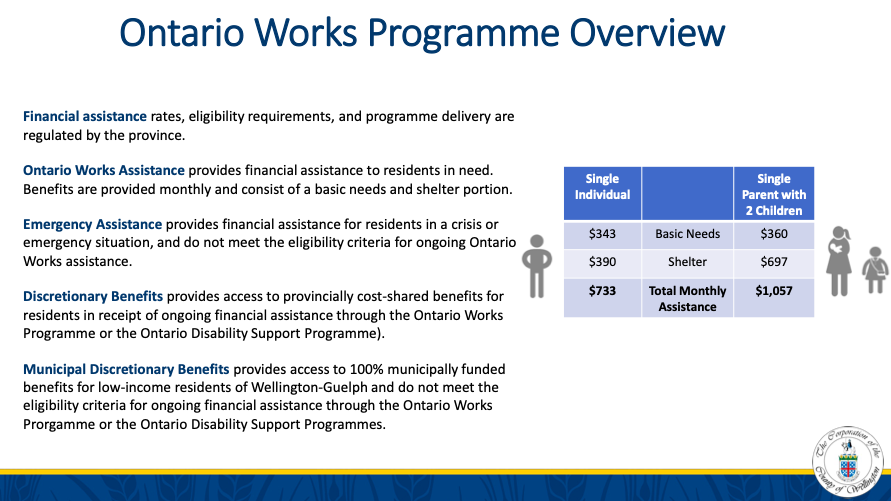 Over 3,500 people are reliant on Ontario Works, and 4/5 are in Guelph. Over 34% of all people reliant on Ontario Works are under 18 years. 7/10 OW recipients are single adults.
Housing! This covers prevention programs like rental or utility arrears, which have seen more municipal funding as the housing crisis has accelerated. It also includes emergency response to homelessness like find housing placements, or ways to get around barriers to housing. Emergency shelters at Stepping Stone are funded here, as is the winter response program.
The cost of emergency responses to homelessness is about $10.7 million now, with nearly $7 million being on municipal tab. Progress is pretty static:
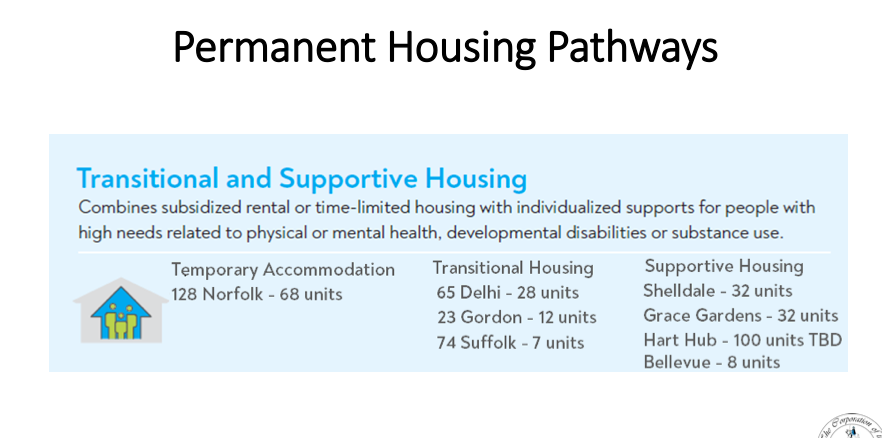
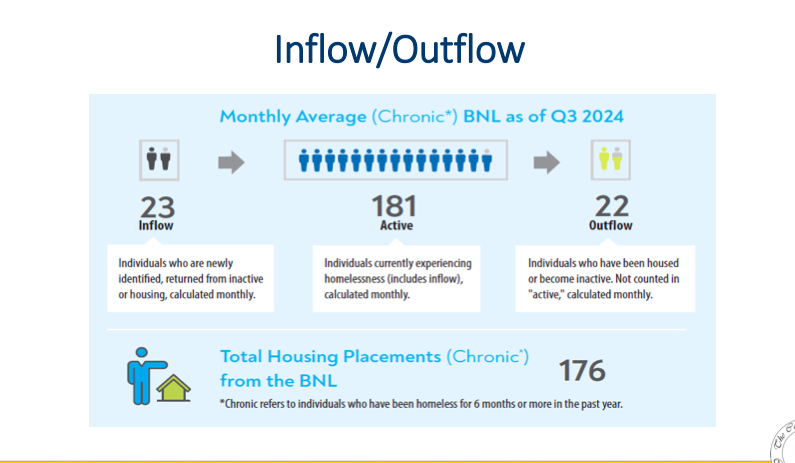 County also manages the transitional and supportive housing. Artuso says that the HART Hub funding will add about 100 different beds to this file:
 Social housing. Artuso notes that municipalities, in total, are providing about 65% of all funding this way. In Wellington, we spend $22.5 million out of $34.3 million from all sources of government.
Now to the hard numbers! Shauna Calder, Manager of Finance for County takes over. This budget was presented to the JSSLAC earlier this month and there’s $182.7 million budget for all social services, 30.5 per cent over 2024. This is mostly in childcare and again that funds come from the feds.
Increase on the Guelph side is 7.3 per cent, or $2.5 million. (0.3% for the County, FYI.) Housing is 15.4% increase alone being driven by loss of one-time funding, funding for temp. accommodation at Norfolk Street, new operations at Delhi, plus the winter shelter response. County is adding a new position for maintenance to help manage stock.
Childcare. City share is decreasing 26.8 per cent or $1.3 million thank to the new funding formula. For Ontario Works, there’s a projected 3.1 per cent increase for the City (4% for the County), and includes a six per cent increase in case load. Doesn’t impact levy though because this is provincially funded. Also, there’s an admin funding increase for the first time since 2018.
In summation: 4.1 per cent higher versus projection in 2024.
Questions? Cllr Busuttil asks the community advisory board, what do they do? Artuso says that’s for the Reaching Home funding, and while the funding is managed by the County how they’re used is directed by the board.
Busuttil asks about capital for permanent public housing, where does that fit in the budget? Calder says the capital here is maintenance. In terms of new builds, there’s no plan for new social housing but the County has it’s own budget for capital affordable housing, and allocates $1.2 million per year to reserves for that purpose.
Busuttil: So does the City have to have a separate convo about land purchase?
Calder: Would depend on type of housing your looking to build? If there was other funding and a shovel ready project ready to go, okay, but if there’s a more long-term plan that would be a separate conversation.
Guthrie asks if the County’s $2.1 million only builds housing in the County. Calder says County.
Cllr Allt asks if 106 beds are enough for everyone unsheltered right now. Artuso says it does at this time, and they get reports from Stepping Stone three times per week, and they have had vacancies and never had to turn anyone away *unless* they have a restriction.
Allt: So there are 106 people or fewer on the streets.
Artuso: That’s a tricky question. There are various reasons why people feel like they can’t live in the shelter system and we’re trying to meet that demand and understand those needs.
Allt asks about projected financial needs in the next two years. Artuso says the planned budget accommodates their project need, and supportive housing unit increase will also have a barring because the more of that they have the less they will need to rely on emergency response.
Cllr Caton asks if there are any numbers for people on OW that should be on ODSP. Artuso says that there are explorations along those lines, especially for people who have been on OW for more than 5 years. They did a delegation to the ministry to petition for an increase to ODSP so that people can be better accommodated and given a pathway to being financially independent.
Caton asks if there are 100 new units from the HART Hub funding or is it just a reorganisation? Artuso says people are staying in their units, it becomes a supportive unit in name when people are getting the health help they need. They’re moving from one portfolio to another.
Cllr Downer says that when she thinks about supportive housing, the support are on site. Artuso says there is that, but they’ve always had sites that were “scattered”, but the key is having individuals connected and regularly interacting with health support.
O’Rourke repeats a questions he asked at this month’s JSSLAC: Is there a plan for the County to research social housing needs for Guelph? Artuso says they’re working on it, and it’s important to understand the market-based rental system can affect families in all types of circumstances, there are a lot of outside influence. They’re using 2021 census data to inform that work. Also using by-name list data, but that’s not a firm number.
O’Rourke asks if there will be any targets for people experiencing IPV and/or special consideration for people with developmental disabilities? Artuso says they’re working on IPV and accessible units a through the system, can’t do it by municipality. Presently, there are no units earmarked for people experiencing IPV, but that is a specific stressor and they’re looking at that with Women in Crisis.
O’Rourke asks why home care isn’t covering services that will be covered thru HART Hub. Artuso says that’s a good question, but health and housing services locally teamed up for the application to develop the plan. Because it’s for Guelph and Wellington, they had to look at hub and spoke model for service delivery.
Gibson asks if the County is forecasting about impact on OW with economic improvements. Artuso says they’re projecting increase in OW. Gibson says job growth needs to come first before we can see impact on housing.
Guthrie calls for a break before hearing the police budget.
We now dig into the Guelph Police Services Budget with Chief Gordon Cobey!
Cobey thanks council for their commitment to battling Intimate Partner Violence and says that he wants to make sure Guelph Police rises to the challenge. He says that the want to set an example for fighting IPV and human trafficking, but also set an example helping survivors.
Cobey notes again that the number of officers versus the rising Guelph population is now plateauing and that the number of calls for services has been increasing since 2020. He says that when there’s investment in Guelph Police, the community gets favourable results back and while they’re getting positive feedback, they can’t get complacent.
There was decrease in medical absences in 2023, which is first for a while. Cobey also says a point of pride is Guelph’s recovery on the crime severity index; Guelph is now back in the top 10 and the goal is to get to number one.
The theme of this year’s budget is fighting IPV, human trafficking, internet child exploitation, and online fraud targeting vulnerable people, especially seniors.
Cobey throws it to Melanie Clark, Staff Sergeant Investigative Services, who is working on these issues. GPS has combined enforcement of IPV and trafficking into a single unit, which may be a first. There is overlap between the two areas, especially where people are being grooming for trafficking, which is in many cases a instance of IPV.
On Guelph: Clark says the 401 is the backbone of trafficking, victims can be moved quickly and efficiently and that means more $$. The top urban communities are 1) Toronto and 5) London, and Guelph is right in the middle. She says they have a huge responsibility to the community. 34% of victims were trafficked by an intimate partner, btw.
There have been 40 calls that involve human trafficking in Guelph in 2024, and six of those involved victims under 18. Clack says that’s the “tip of the iceberg” and the numbers are reactive. Cobey says one theme they have to remember is that it’s not a “developing issue”, it’s becoming more understood.
Hugh Currie, who is the Team Leader of the Internet Child Exploitation Unit with Guelph Police is introduced. He says they don’t have the resources to deal with this issue and he knows there are people in Guelph exploiting kids. He says he’s personally seen over 50 million images of kids being tortured. “This is real,” he says.
Cobey says we have no idea the trauma endured by Currie and the people who do that work. In 2024, GPS had 92 tips from a national centre like Crime Stoppers, and of those 2/3 of the tips they don’t have the capacity to tackle. Cobey says if we don’t talk about it, we don’t recognise it, react to it, or support the victims.
Next, fraud! GPS had approximately 250 frauds under $25,000 and 38 cases over $25k worth about $7.2 million in loses. Three staffers work on that file.
On the budget, Cobey says that the goal is to have the KPMG recommendations enacted by 2027 in order to align with the City’s concerns around affordability.
Guthrie thanks Cobey and the GPS for everything they do, especially in these areas.
Gibson asks Currie about collaboration with other police services. Currie says they’re part of the provincial strategy group with 86 other services that are doing this work, but they are also under-resourced. Their first mandate is to help victims, not just the ones in Guelph but around the world.
Gibson asks about raising awareness with young people. Currie says he does a lot of presentations with the community, and works with Crime Stoppers, but parents have to parent, and they sometimes use social media as a babysitter. “There are ways people will find our kids, and they do.”
Gibson asks if there are cases where the evidence is strong enough so that the victim doesn’t have to testify. Clark says that can be a kind of revictimization, she had a victim who said that the court process was more traumatising than being trafficked. It is possible, but sadly the best evidence is that person telling the story.
Gibson: Would more officers help getting the bad guy?
Clark: 100 per cent.
Guthrie seems to have interceded to get Gibson back on a budget-related track.
Allt asks about dealing with costs of officers experiencing trauma from the work. Cobey says affordability considerations are leading to overtime; they’re constantly trying to threat the needle. He says he doubts he will ever come to council with a zero growth budget.
Allt asks what do we police for in terms of population, is it the actual number of is with the post-secondary population too? Cobey says they should account for 25,000 more than the base population, and points to the Heads in Beds Levy as a need to addressed.
Allt asks how well staffed we are to deal with fraud against old people. Cobey says not well, but hopes to have a couple of extra resources and a lot of this is about proactive education in the community. If someone is a victim of cyber fraud, we may never recover those funds especially if the suspect is overseas. Prevention is everything.
O’Rourke asks about the proportion on prevention. Cobey says one of themes here is to bring the community together and act as one. If they’re not just trying to keep their heads above water, then can better focus on proactive measures and education.
O’Rourke asks for assurances about dedicating funds to comms. Cobey says 100 per cent.
O’Rourke asks about the collaboration with Women-in-Crisis, Victims Services, et al. Clark says there is collaboration, but resources are limited, and mostly generated through grants. They’re doing it, but they can do it so much better.
O’Rourke asks if there’s a division between IPV and human trafficking work in the unit, or is there crossover. Clark says the goal is to have every officer in the unit cross-trained.
Cllr Caron notes that there may be some people watching who may have been triggered by those stories, especially since there was no warning it was coming. Where can people get help? Victim Services is a good place to start.
Caron asks about the allocation of resources, are all police along the 401 working together on this? Police staff says they’re making people as aware as possible, they’re targeting communications at ONRoutes, and trucking associations are raising awareness too. Cobey adds that other police services are putting more in this areas and thinks Guelph is at or below 50 percentile this year.
Downer asks what percentage of the $5 million is going to these priorities? Cobey says two FTEs are going to fraud, one to exploitation, one to tech crime to analyse devices and six to IPV and trafficking. The 2025 budget will establish these units, and they will measure the future needs can’t say for sure what they’ll need in 2026 and 2027 for these specific units.
Guthrie notes that there’s an extra $850k on top of the original allocation for 2025 with the purpose of going to these areas. Cobey says yes, but the fraud and tech support was already budgeted in.
Guthrie asks for a motion for the two recommendations. Goller/Caron make the motion:
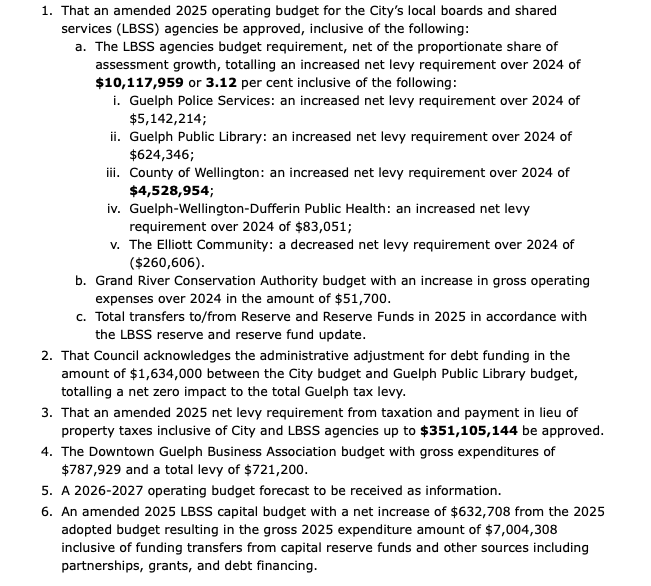

Council votes unanimously for the motions!
Bylaw of the Week: “A by-law to confirm the proceedings of a meeting of Guelph City Council held January 22, 2025” is approved.
Total tax levy increase for 2025 is 6.78 per cent! Guthrie notes that 2025 was originally going to be 9.5 per cent but with the extra board spending it would have went to 10.51. Guthrie thanks staff, inside and out, for co-ordinating all that.
Meeting adjourned.
END OF RECAP!
 Guelph Politico