
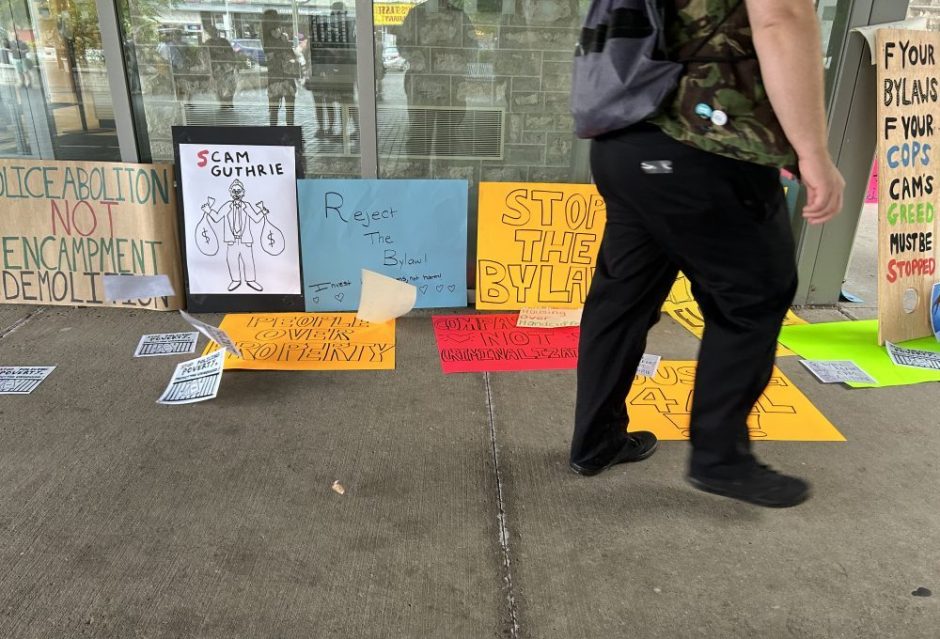
It was business as unusual this past week because city council should have one last week off before the start of September. Instead, there were a couple of extra meetings, one short and one pretty long. At the first meeting, council had a decision to make about the hiring of a new CAO, and in the other there was an even tougher decision regarding a matter so deeply controversial it packed the gallery. Here’s the recap…
Special Meeting of City Council – August 22
Council met to make a decision on the hiring of a new Chief Administrative Officer for the City of Guelph, but it was not revealed at the end of that meeting. After talking about it in closed session for a little over an hour, council emerged to announced that they had given direction to staff and the executive headhunters at Boyden Canada to begin final negotiations with the selected candidate. Mayor Guthrie said that they hoped to have a formal announcement soon, and it was announced this Tuesday that Tara Baker is the new CAO.
Click here to see the complete recap of the meeting.
Special Meeting of City Council – August 28
As people were still protesting and chanting outside the council chambers at 4 pm, Mayor Cam Guthrie called the meeting to order at 4 pm sharp. He explained that council would be immediately going in-camera in order to get solicitor advice about the legal issues around the Public Space Use Bylaw, and that should only be gone for 30 minutes. They returned just before 5 pm.
So that you don’t have to scroll in order to find out how they decided, council voted to approve the bylaw by a count of 10-3 with Councillors Phil Allt, Linda Busuttil and Erin Caton dissenting. The bylaw was amended to make St. George’s Square and Market Squared both “Sensitive Public Areas” under Schedule A, and that was thanks to Ward 2 Councillors Rodrigo Goller and Carly Klassen.
The bylaw will come back to council for final ratification at the September 10 meeting and then go into effect on October 1.
There were two supplementary motions, the first from Councillor Dominique O’Rourke, which requested that up to $450,000 be provided to the County of Wellington from the Tax Rate Operating Contingency Reserve to provide for the basic needs of people experiencing homelessness in Guelph through the Wellington-Guelph Health and Housing Community Planning Table. There was also some wording about reducing that funding if money from the either the provincial or federal governments came through, but no one seemed bullish on that possibility.
What this motion was in reference to seemed to be a point of confusion. There was some back and forth between the councillors and Deputy CAO of Public Services Colleen Clack-Bush about who’s on this panel, and what work they’ve done so far to draw up a list of what basic needs unhoused people require. O’Rourke said that this work was in progress after a meeting early this month, and that there wasn’t time to pull together a formal ask with a report in time for this meeting. Not wanting to wait for the budget process and needing an appropriate report to staple this request to, it was either this rush job or no job at all.
Despite some concerns about the formal administration of the funds and how the City might continue funding these efforts beyond the one-time investment, many councillors said that they had to send a message that they wanted to change the game and take action on the homelessness crisis, especially after the bylaw vote. The motion was approved unanimously.
Another motion, this one from Caton, asked City staff to work with the Planning Table to identify needs and develop a plan, including a budget and funding sources, to provide and maintain portable washrooms, waste bins and sharps disposal to encampments and to bring that report back by Q1 2025. This motion was along similar lines as the other one but looking at more longer-term infrastructure needs. It was also approved unanimously.
Council rose after over seven hours after the start of the meeting, and the few activists that remained yelled “Shame!” and “See you in court!” to the departing councillors and staff. This was in repeated reference to the likelihood that the City of Guelph will be taken to court if the bylaw goes into effect.
Stephanie Clendenning from Legal Clinic of Guelph and Wellington County was one of the over 40 delegates and she explained that this bylaw “will be challenged in court, it will be expensive, and it will fail,” before reciting briefly the string of legal precedent from the 2008 case in Victoria, B.C., which laid the legal groundwork in this area.
Clendenning said that the Public Space Use Bylaw is not as permissive as City staff believed it was, and a challenge to Hamilton’s anti-encampment bylaw going to court again next month will once again reassert the Charter rights of the homeless. If Guelph is found in violation of the Charter of Rights and Freedoms there can be monetary penalties, they could be forced to pay off the legal fees of all parties, and there would some reputational damage to the municipality, she added.
The argument wasn’t persuasive in the end, and neither were the half of the delegation slate that came out to try and convince council to vote against the bylaw. Even people who supported the Public Space Use Bylaw acknowledged that this was not the cure-all that many people were hoping it will be. Many of those in favour were downtown business owners, who said they were sympathetic to people living rough, but something had to be done to break the gridlock on this issue.
Council did have their concerns including the back and forth about whether there were enough shelter beds in Guelph for everyone who needs one, which staff said was tough to confirm because of the difficulty in getting hard data about the homeless. There were also some concerns about a map that the City had developed to show where encampments can be located, whether it will be available before the October 1 implementation of the bylaw, and whether unhoused people will know how to access the map in order to know where they can go. It was also noted that there’ll be more pressure on social services as clients will be more spread out around the city.
In the end, Guthrie said it was important that council be responsive to this community concern, and he was emphatic that this was not going to criminalized people experiencing homelessness in Guelph. He called this a “comprised bylaw” and once passed we will see where it goes from here.
Click here to see the complete recap of the meeting.
The next meet of city council is the Committee of the Whole meeting on Wednesday September 4. You can see the Politico preview here.
 Guelph Politico