
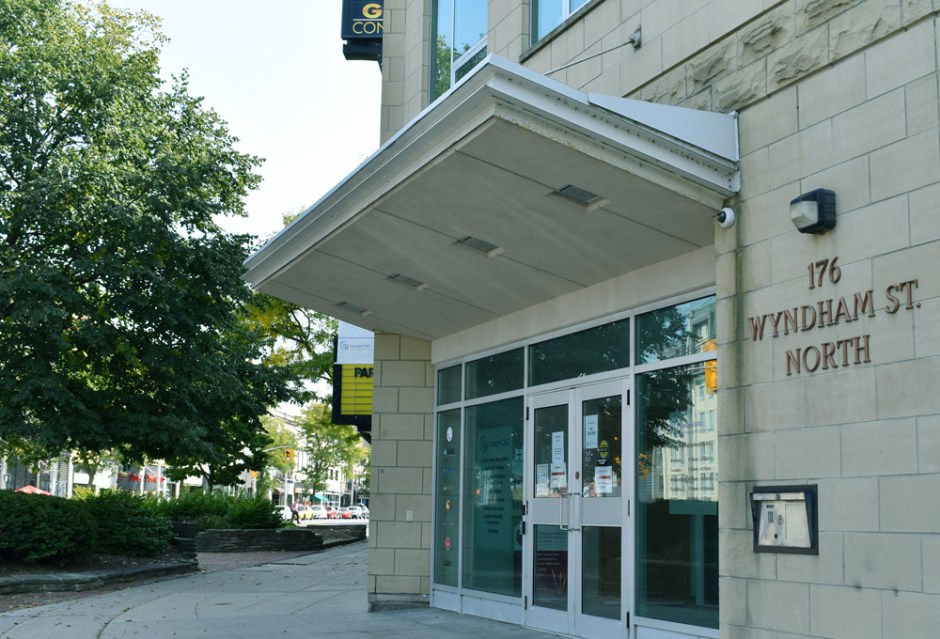
The Consumption and Treatment Site (CTS) at Guelph Community Health Centre will have to close by the end of March. This decree comes from the annual Association of Municipalities of Ontario conference today where Minister of Health Sylvia Jones announced that the provincial government is banning supervised drug consumption sites within 200 metres of schools and child care centres.
“Communities, parents and families across Ontario have made it clear that the presence of consumption sites near schools and daycares is leading to serious safety problems,” said Jones in a media release. “We need to do more to protect public safety, especially for young school children, while helping people get the treatment they need, which is why we’re taking the next step to expand access to a broad range of treatment and recovery services, while keeping kids and communities safe.”
According to the Government of Ontario’s release, the cause for this new direction is that crime in areas around CTSes is higher than in neighbourhoods where there are none. The source of the statistics mentioned in the release is not mentioned, and some studies have shown difficulty attaching a rise in crime to the presence of a CTS in the area.
What’s far more certain is that consumption and treatment sites save lives. Last year, Statistics Canada noted that there were around 49,000 overdoses and drug-related medical emergencies between 2017 and June 2023 at sites across Canada and there were no reported fatalities on-site. The Lancet reported that in Toronto between May 2017 and December 2019 overdose mortality rate decreased significantly in neighbourhoods that were home to a CTS compared to other areas of the city.
And yet concern about community safety has persisted in many quarters, including the Officer of the Mayor of the City of Guelph.
“Injection sites in sensitive areas or downtown cores aren’t working in my personal opinion. Kids near them, open drug use around them, challenging (and in some cases very scary) behavioural issues for our small and medium sized businesses and more… Something’s gotta change,” Guthrie said on social media last week.
Guthrie was one of five Ontario mayors quoted in the Ontario government media release Tuesday supporting the move to close nine CTS locations in the province by March 31, 2025, including the one in Guelph.
“I commend the provincial government for moving forward with a detailed plan to save lives, restore families and improve communities struggling with the stranglehold of addictions,” Guthrie said. “I am confident that the new HART Hub model, focused on recovery, will show the positive results cities have been desperately requesting for our most vulnerable citizens, not just in Guelph, but across Ontario.”
HART stands for Homelessness and Addiction Recovery Treatment (HART) Hub, and the Ontario government is ponying up $378 million to create 19 of them. According to the media release, the HART Hubs will provide primary care, mental health services, addiction care and support, and supplies like naloxone, onsite showers and food. HART Hubs will also apparently add up to 375 highly supportive housing units, in addition to addiction recovery and treatment beds.
How and when these beds and resources will be assigned is apparently to be determined. The nine closing sites will be “encouraged to submit proposals to transition to HART Hubs and will be prioritized by the province during the review process.” The government’s media release also said that these sites could be eligible for up to four times the provincial funding they’re receiving now on average.
In a further statement on social media, Guthrie said that his energy will “now be focused on doing whatever it takes to review the criteria on an application to obtain part of the $378 million funding for a HART HUB in our community.”
Guthrie also said, “I also want to commend the staff that have been working at this [CTS] location over several years that have been on the frontlines trying their very best. I hope that you too can join me in advancing the opportunity for a HART HUB for potentially many of the same clients you’re already seeing. You have my commitment to start on this immediately.”
Guelph Community Health Centre, which operates the Guelph CTS at their Wyndham Street North office, is still absorbing the decision announced today.
“This information is new to us and we need some time to understand the full details and its impact on our community before we can comment,” said Melissa Kwiatkowski, CEO of Community Health in a statement on social media. “We are concerned about the human rights impacts of removing this life-saving service from the community, without providing a comparable alternative.”
“As a next step, we plan to meet with the Ministry to understand our options, and to develop a transition plan to ensure continued access to low barrier mental health and addiction support,” Kwiatkowski added. “Services we have already been offering in our health hub are well aligned with the Ministry’s plan and we feel we are well positioned to submit an application for the hub model with our health partners.”
It’s also worth nothing that this news comes as activists and health professionals in the region are preparing to mark Drug Poisoning Awareness Day. There will be a gathering at King and Main in Mount Forest at noon on Thursday and at noon in St. George’s Square on Thursday August 29.
“Consumption and Treatment Service are health services that offer low barrier, life-saving care. This includes supervised injection services, harm reduction supplies, education and referrals to addiction treatment and primary care. Most importantly, they prevent deaths,” said the Wellington Guelph Drug Strategy in their own social media post.
“We are concerned about the impacts of this decision. Closures of life-saving services will lead to increasing fatalities and further public substance use. As drug poisonings continue to intensify in Guelph and Wellington, we need every tool possible.”
 Guelph Politico