
This week, council came back to do the council’s business with an agenda that included Indigenous relations, but the Downtown Parking Master Plan that was the source of the most controversy. How much should maximums be minimized was the primary source of friction, but that might still have to be worked out at the end of the month. Meanwhile, there was a lengthy closed session we know nothing about. Here’s the recap…
Special Meeting of City Council – September 6
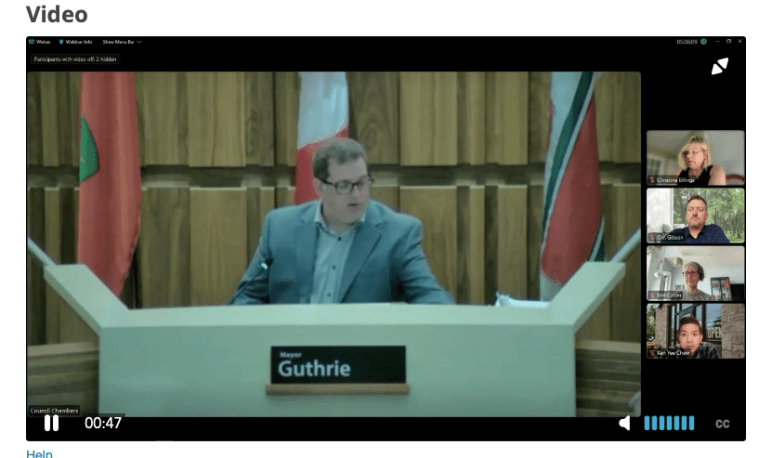
It was back to business as usual this week as your regularly scheduled Committee of the Whole meeting was held on Wednesday due to the long weekend. Although it was a year late, careful council observers at home noted that the upgrades to the council chambers were complete; when you’re watching a meeting from home, you no longer have to stare at the back of staffs’ heads from the other side of the room for hours.
As for committee business, things started off smoothly with a couple of staff recognitions and the immediate passage of changes stemming from Strong Mayor Powers including the investigation to create a municipal lobbying registry. Despite the generation of some controversy back in June, council had nothing to add about the mostly administrative changes, nor did they have any notes about the council and committee schedule for the next four years.
Next, a team including the Curator of Guelph Museums, the City’s Manager of Policy and Intergovernmental Relations, and the Senior Advisor for Equity, Anti-Racism and Indigenous Initiatives introduced the new territorial acknowledgement. They explained that the original acknowledgement introduced in 2016 was always intended to be a first step, and feedback from various local Indigenous groups pointed to a need to correct some pronunciation and history, while giving the acknowledgement a little more context and emotion. They also didn’t want the acknowledgement to sound like Indigenous people exist only in the past tense.
This is what they came up with:
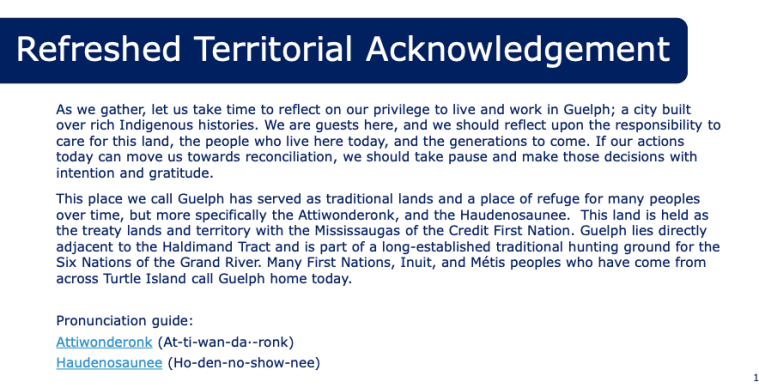
Committee had almost universal praise for the changes, but one councillor was concerned about the use of the phrase “We are guests here” as it sounds kind of exclusive. Sara Sayyed explained that each word in the new acknowledgement has a specific intent, and that the wording in this case goes back to Indigenous ideas about ownership and environmental stewardship. We’re all guests on this land, and we should it treat it that way. Council will get further lessons about Indigenous thinking and reconciliation at a workshop on September 20.
Then it was time for the big item of the meeting, the Downtown Parking Master Plan. Terry Gayman, GM of Engineering and Transportation Services, said that the goal is to use parking as tool for economic renewal and to help accelerate the creation of housing to meet the 18,000 new homes goal. The most notable parts of the plan are the future introduction of a cash-in-lieu program for parking and a reduction in minimum parking requirements to 0.85 spaces per unit. Technically, that last part is a zoning bylaw change so this item was also a statutory planning meeting in the name of efficiency.
The master plan also covered the areas of climate resiliency, modal shift, accessibility and making parking options safe and easy to use with new technologies. Any plans to re-introduce parking metres for on-street spots will have to wait until after the new underground parking structure on Baker Street is open in 2026 and the downtown infrastructure updates are completed in 2028. The opening of Conestoga College’s Downtown Guelph campus was also a consideration.
There were three delegates on the plan, and there was mostly praise from Downtown Guelph Business Association treasurer Richard Overland and Guelph Coalition for Active Transportation chair Adrian Salvatore. Victor Labreche, a representative of Woodhouse Investments who own several properties downtown including the old Canada Trust building at Cork and Wyndham, explained that the 0.85 spots per unit mark won’t go far enough if the goal is to take underutilized real estate in the core and turn them into new house. He recommended that Guelph follow other municipalities like London and Kitchener and have no parking minimums downtown at all.
To have minimums, or not to have minimums, was the crux of the committee debate. Staff insisted that keeping the 0.85 spot per unit number would give them more flexibility when working with developers and it would help ensure that downtown doesn’t head for a parking apocalypse by approving so many units without parking requirements that no one with a car has a place to put it in a couple of years.
Mayor Cam Guthrie and Councillor Rodrigo Goller took point, and took turns, bouncing ideas off staff for ways to get to zero parking minimums. Goller pointed out that many Conestoga students coming to Guelph will be international students and that they won’t be bringing their cars with them; Guthrie meanwhile tried different policy proposals like having a zero minimum for social housing projects only, or having zero minimums until the cash-in-lieu program is approved in February. In other matters, Infrastructure, Development and Enterprise Chair Dominique O’Rourke expressed concern about accommodating GO Transit users and Metrolinx’s insistence that they only need about 70 more spaces.
Guthrie then asked for leave to move into closed session because he had a question about acquiring land, and since it was close to dinner time anyway, committee took about 45 minutes off before coming back into open session to finish the file. Committee pushed to get for options for zero minimums (or near zero minimums) by the end of the month, while others expressed their faith that the plan strikes the right balance between all the various parking pressures in the core. Guthrie was not one of those people and voted against the staff recommendations after calling for a “parking revolution.”
The last item was really the first item. Committee went into closed session before the start of the meeting and were 15 minutes late starting the open session because the discussion about “Downtown Riverfront Park Acquisition Plan” was running overtime. Eighty minutes after the end of the open meeting, committee emerged from in-camera to say that direction was given to staff on this matter. That’s all.
Click here to see the complete recap of the meeting.
 Guelph Politico