
We’re back! Well, technically we were back a few weeks ago, but now city council is officially back, returning from summer vacation and returning to the council chambers. The agenda for this first Committee of the Whole meeting of the (nearly) fall has some straightforward stuff, but it also will have some controversy including the presentation of the Downtown Parking Master Plan and everyone’s three favourite words: “Strong Mayor Powers.”
NOTE #1: Delegates will be able to appear at this meeting in-person or via tele-presense but you do have to register with the clerks office before 10 am on Friday September 1. You can also submit written delegations and correspondences for agenda items.
NOTE #2: In addition to meeting in-person, this meeting will also be live-streamed on the City of Guelph’s website here.
NOTE #3: This takes place on the special meeting day of Wednesday due to the Labour Day holiday long weekend.
CLOSED MEETING:
Downtown Riverfront Park Acquisition Plan – Because this has to do with the possible purchase and acquisition in property, in this case the strip mall between Gordon and Wellington, this matter has to be discussed in-camera under Section 239(2) (c) of the Municipal Act.
STAFF RECOGNITIONS:
1) Phil McIntyre, a Supervisor in Lab Services and Environmental Compliance for Wastewater Service, is now a Certified Engineering Technologist (C.E.T.) Designation from OACETT.
2) Babawale Oke, Engineering Records Technician in Design and Construction for Engineering and Transportation Services now has a PMP Designation.
Updates Resulting from the Extension of Strong Mayor Powers – When we last talked about the impact of Strong Mayor Powers their implementation for Guelph ended up affecting the discussion about changes to the Procedural Bylaw that had already been approved at June’s Committee of the Whole. Long story short, it was too late for staff to analyze the full impact for that June council meeting, so we had to wait for the September committee meeting instead.
Many of the changes to the bylaw are essentially about accommodating the new powers, and yes, Mayor Guthrie did delegate authority back to council and staff on several of those matters, but they still have to be enshrined in the bylaw because that was only the current mayor’s choice. Another change will see a couple of extra steps at the end of the budget process as the mayor will be able to veto budget amendments and council will have an opportunity to override the veto. Staff also want to explore the possibility of establishing a municipal lobbyist registry and bring a report back in the first quarter of next year.
So is this the last we’ll hear about changes extending from Strong Mayor Powers? This line from the report seems insightful, “As staff continue to understand the impacts of this legislation, future updates to by-laws and governing documents may be necessary and would come forward for Council discussion as part of the twice-per-term governance reviews conducted by the City Clerk’s Office, or as needed.”
2024 – 2027 City Council and Committee Meeting Schedule – So normally at this time of year staff bring forward next year’s council calendar, but to align better with the Strategic Plan and the Budget, which are now renewed every four years, staff are recommending a four-year council calendar.
Because of the very different responses about availability from council and members of the public, meeting start times will be staggered: Committee of the Whole will continue at 2 pm, planning and regular meetings will start at 6 pm, special meetings will also begin at 6 pm, Council Orientation and Education Workshops will start at 10 am, and the annual (non-delegation) Budget meetings will start at 9 am. The meeting days will continue to be on Tuesday, and occasionally on Wednesdays as needed.
An interesting note in this report, and you should bookmark it for later, is a matrix of notable dates for 2024, which you can find here.
Refreshed Territorial Acknowledgement – By now, you’re probably familiar with the Territorial Acknowledgement, which was launched in 2016 and is read at council meetings and most City of Guelph events and activities. Well, that was version 1.0 of the acknowledgement, City staff have been working on a new version that will fix historical inaccuracies and give the acknowledgement some more emotion and more of a connection to the cause of reconciliation.
Here’s the current Territorial Acknowledgement:
As we gather, we are reminded that Guelph is situated on treaty land that is steeped in rich Indigenous history and home to many First Nations, Inuit and Métis people today.
As a city we have a responsibility for the stewardship of the land on which we live and work.
Today we acknowledge the Mississaugas of the Credit First Nation of the Anishinaabek Peoples on whose traditional territory we are meeting.
And here’s the new version:
As we gather, let us take time to reflect on our privilege to live and work in Guelph; a city built over rich Indigenous histories. We are guests here, and we should reflect upon the responsibility to care for this land, the people who live here today, and the generations to come. If our actions today can move us towards reconciliation, we should take pause and make those decisions with intention and gratitude.
This place we call Guelph has served as traditional lands and a place of refuge for many peoples over time, but more specifically the Attiwonderonk, and the Haudenosaunee. This land is held as the treaty lands and territory with the Mississaugas of the Credit First Nation. Guelph lies directly adjacent to the Haldimand Tract and is part of a long-established traditional hunting ground for the Six Nations of the Grand River. Many First Nations, Inuit, and Métis peoples who have come from across Turtle Island call Guelph home today.
Pronunciation guide:
Attiwonderonk (At-ti-wan-da·-ronk)
Haudenosaunee (Ho-den-no-show-nee)
This revised acknowledgement was developed through collaborations with the Mississaugas of the Credit First Nation, Six Nations of the Grand River Executive Council, a Sharing Circle with local Indigenous community, and the U of G’s assistant VP of Indigenous Initiatives Dr. Cara Wehkamp.
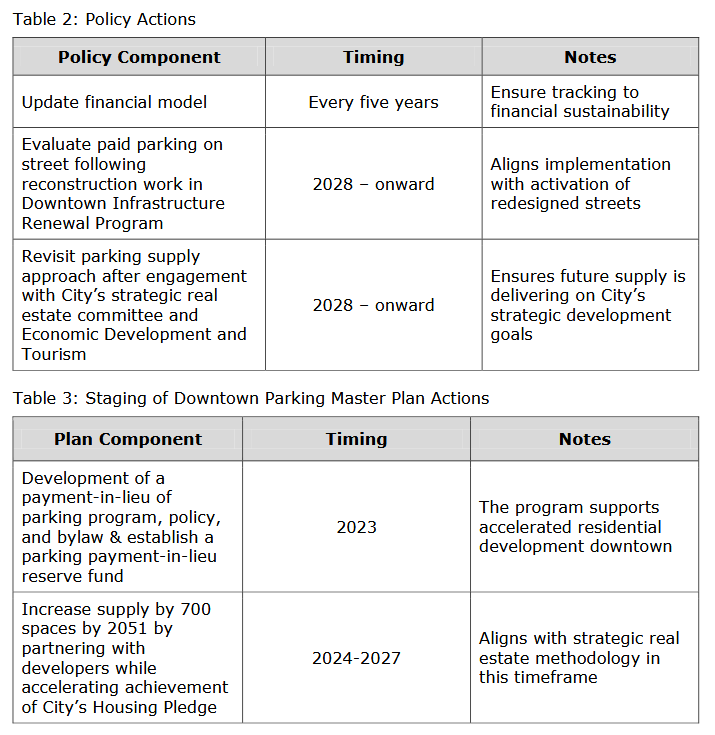
Downtown Parking Master Plan – According to the staff report, this plan is based on the key financial themes around the establishment of a payment-in-lieu parking program that will hopefully accelerate affordable housing and the return of parking metres for on-street parking spaces after downtown is reconstructed at the end of the decade.
That second part is pretty straightforward, as for the first part it’s kind of how it sounds: Like the payment-in-lieu for parkland, developers will be allowed to pay money to the City instead of building a project with all the required parking spaces. According to staff, the program will bring in around $600,000 every year while adding to housing stock and protecting cultural heritage in the core.
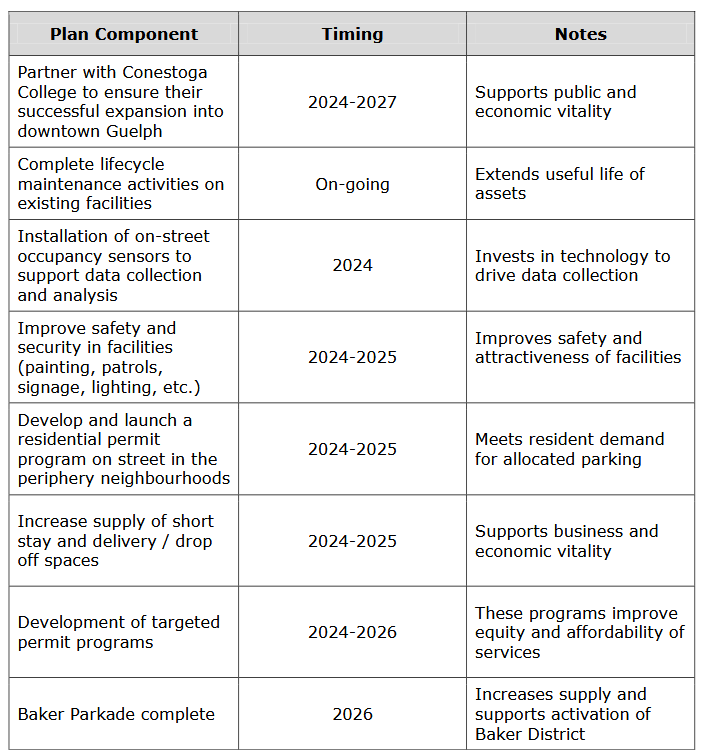
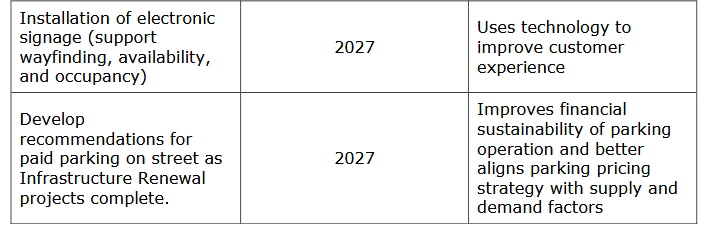
This is the list of policies and projects coming out of the master plan, which will now be reviewed every years:
NOTE: Because The Downtown Parking Master Plan includes components related to proposed Zoning By-law Amendments to amend residential parking regulations in the Downtown Zones this item is technically a Statutory Planning Meeting, so delegations of up to a maximum of 10 minutes will be permitted for this item only.
 Guelph Politico