
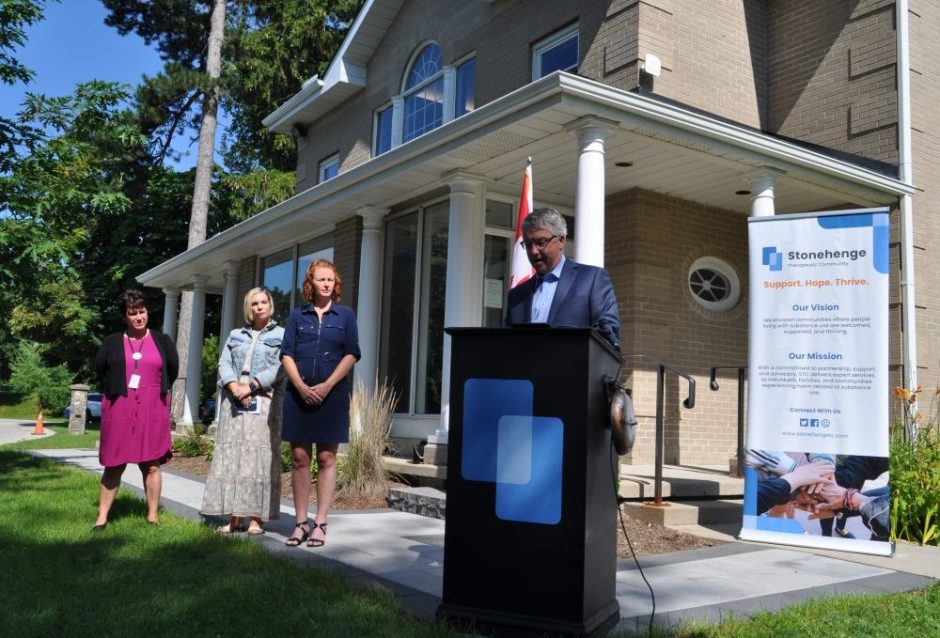
As local addiction agencies mark Drug Poisoning Awareness Day in the next week, a special delivery came from from the federal government on Tuesday. Guelph MP Lloyd Longfield announced additional funds through Health Canada’s Substance Use and Addictions Program (SUAP); $1.8 million that will go to three programs that will ensure support and treatment for people in the Guelph area who are addicted to substances.
“The opioid crisis is widespread, it’s pervasive, it’s devastating families and devastating communities, large and small. It used to be a downtown problem, but now it’s a problem that every community in Canada is looking at,” Longfield said in his remarks outside the Stonehenge Therapeutic Community on Westwood Road.
“With stakes this high, we need to do everything in our power to protect those at risk, and it starts with preventing overdoses but it doesn’t stop there,” he added. “We’ve embraced a comprehensive approach, and it’s one that includes improving access to health and social supports, as well as treatment programs.”
The additional funding announced today will go to the Guelph Community Health Centre so that they can increase the capacity of its current safer supply program and provide supports for participants like prescription access, access to primary and specialty care services like income, housing, and nutrition.
“Safer supply is but one more harm reduction tool that allows medical professionals to prescribe opioids and to reduce or eliminate a client’s reliance, or an individual’s reliance, on the illicit street supply,” explained Lindsey Sodtke, the harm reduction manager from Guelph CHC.
“This program is saving lives in our community, and this continuing funding will ensure that we are able to continue to do this important, meaningful, life changing work in our community. Safer supply is but one more tool in our toolbox for managing the fatal overdose epidemic that is ravaging our community.”
The funding will also support Stonehenge’s Peer2Peer overdose response program, which connects individuals affected by drug or alcohol poisoning with someone with relevant lived experience. These Peer Recovery Coaches provide emotional support, prevention education, information about local services and support, and access to naloxone kits.
“Stonehenge highly values the role of peers and the voice of lived experience across all of our programs, as they help to reduce stigma and the harms related to substance use,” said Kristin Kerr, the CEO of Stonehenge.
“This funding from the Government of Canada highlights the importance of continuing to enhance the capacity of community mental health and addiction services, which means bringing care closer to the people who, where and when they need it, and also helping to ease the burden of emergency room visits,” Kerr added. “The Peer2Peer program ensures that individuals who experience a drug poisoning and their loved ones, have the support they need, in the moment that they need it, to feel supported and to navigate the health system and figure out next steps.”
The rest of the funds will go to Wyndham House to help provide youth access to multiple supports in Guelph, Wellington and Dufferin counties, and those include housing, education, and financial supports.
“Specifically for Wyndham House, we see firsthand how devastating substance use is on the individual, their loved ones, friends, and our community,” said Rita Isley, board president of Wyndham House who was also on hand at the announcement. “Since receiving the SUAP funding, Wyndham House has provided service to over 300 unique individuals in this community, and the additional funding will help allow us to serve even more youth and keep our hub open until March of 2024.”
“The hub has allowed Wyndham House to complete over 100 assessments and provide ongoing psychiatric appointments, there have been over 100 concurrent treatment appointments provided by the different clinicians, we’ve been able to reduce hospital visits by way of providing access to nurses and physicians, and that’s been approximately 150 appointments, and over 50 per cent of the individuals who access shelter at Wyndham House in the past year have been referred to the concurrent hub and started care within two weeks of that referral,” Isley explained.
In addition to coming in advance of Drug Poisoning Awareness Day, this announcement comes a little over a week since the Wellington Guelph Drug Strategy posted an alert about 17 drug poisoning in a two week period that included four suspected drug-related deaths. Issues around toxic supply increased during lockdowns and border closures throughout the pandemic, but despite now being in a post-pandemic world, the problem of toxic supply is still one with no easy solution.
“What we continue to see is that the toxic drug supply is ever evolving, so we don’t know [the source] and that’s why we’re here today,” Sodtke said. “We know that we need to do everything we can in order to provide alternatives that are going to be harm reduction focused for our community members.”
“We (the federal government) have invested in the borders to try and stop the supply from China and the United States and other countries. We’ve put money into the guns and gangs program to try and stop the internal movement of drugs within communities,” Longfield added. “We look for indicators that these programs are working, and I would hope that fewer alerts would be an indicator.”
Community agencies serving Guelph and Wellington County have previously received $3.6 million in SUAP funding, and that’s part of over $500 million in funding across 380 projects in all parts of Canada since 2017. It begs the question, is it enough? Is it enough to finally put a real dent in the addiction crisis and turn things around.
“Enough would be measured by results. We know that there’s still a great need out there, and we know it’s a complex need,” Longfield said. “So this isn’t all the money that needs to go into fighting it, and it’s not the only program that needs to be used to fight the opioid crisis, but it has been quite effective in our community, and that’s why it’s being continued.”
If you, or someone you know, is in crisis or in need of support, and you’re not sure where to begin, you can call 1-844-HERE247 (1-844-437-3247) and get access any time to 11 different agencies across Waterloo and Wellington.
 Guelph Politico