
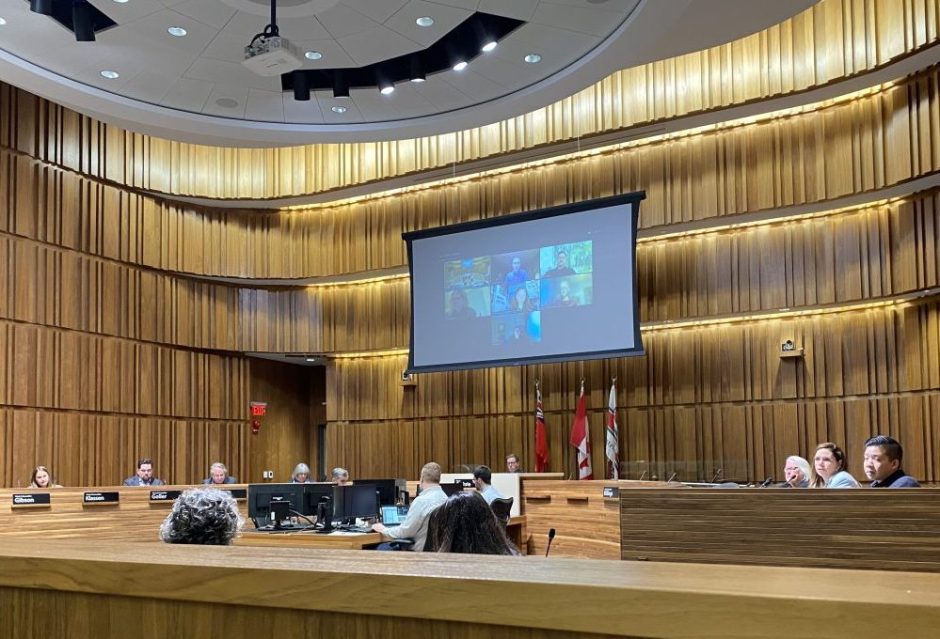
It was supposed to be the last council meeting before the usual August break, but the events of this week’s regular meeting of council did something unusual: It ended with a cliffhanger. The door was opened to a potential August meeting for a matter involving supportive housing and the raising the money to cover it. It terms of the business settled at the meeting itself, but there were also a few complications there too. Here’s the recap…
Regular Meeting of City Council – July 25
There was a lot of last-minute business as council tried to wrap things up before the August vacation, but first, there was a moment of celebration! Marc Richardson and Jennifer Allen, two members of Canada’s Special Olympics World Games in Berlin last month were honoured for being outstanding athletes from Guelph. Richardson took a gold and a bronze medal in 10 pin bowling, while Allen was part of the silver medal winning basketball team.

In terms of political matters, council discussion began with the permanent version of the Seasonal Patio Program. Councillor Dominique O’Rourke offered an amendment to the recommendation approved at Committee of the Whole, that the program be run as revenue neutral with any additional funding coming from the general operating tax levy and not the Municipal Accommodation Tax. Some staffing changes essentially make the program cheaper by running it with a part-time staff member who will manage everything between the beginning of the season and the end.
Bryan Steele of La Reina was the one delegate and he said that if the fees remain at $10 per square metre per month then he’s unlikely to have a patio next year, and neither will some of his fellow bar owners downtown including Frank N Stein’s, Jimmy Jazz/Royal Electric and Partytown. He tried to make the point that the City of Guelph was valuing its streets at a higher cost than the City of Toronto does at $49 per square metre.
Council though seemed mostly beyond the debate about fees. Mayor Cam Guthrie said that we all knew that this day was coming and that there would be some additional cost to making the program permanent. The amended recommendation was approved unanimously, and so was a follow-up motion to review the program on an annual basis.
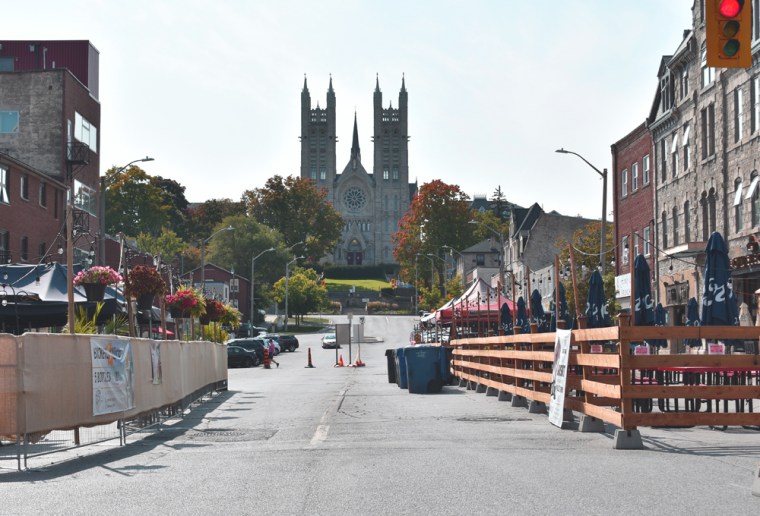
Next, the Bylaw Review motions. Like at Committee of the Whole, council took the recommendations one at a time, but the wording of the motions themselves was updated from the July 5 meeting. The first recommendation, which directed staff to appraise the bylaw review work plan and recommend to council any changes at an October meeting was passed rather swiftly.
The next motion concerned the noise bylaw and a review of the use of noise cameras. Enter Donna Jennison of No More Noise Guelph who has been at the vanguard for this issue with previous delegations at the Police Board and Committee of the Whole. She asked again that council be proactive on the issue.
Council itself was sympathetic, but many noted that noise cameras are presently not allowed in Ontario, so it seems a bit counter-intuitive to dedicate staff time to something that’s not an option. Councillor Rodrigo Goller said that Guelph needs to be an advocate for change at the provincial level, and seize opportunities like the upcoming AMO meeting, but CAO Scott Stewart warned that there are already numerous priorities for Guelph when it comes to any meeting with the Minister of Transportation.
Eventually, council approved an amended motion that read that staff will bring back to council further consideration about noise cameras once they’re legal and that the mayor and staff will advocate to the Ontario government to legislate the technology. That was satisfying for everyone on council, except Councillor Goller, and the motion passed 11-1.
The next recommendation about reviewing recreational outdoor fires was more easily resolved. DCAO Colleen Clack-Bush explained that her conversations with Guelph Fire staff, including the incoming fire chief, did not express any desire to review that bylaw right now. Most of council agreed and the motion was defeated 3-9.
The final recommendation about considering a review of the bylaw that governs the use, display and sale of fireworks passed unanimously.
The new e-scooter bylaw was also swiftly passed so you can now lawfully use your e-scooter on any City of Guelph road, multiuse path or cycling track.
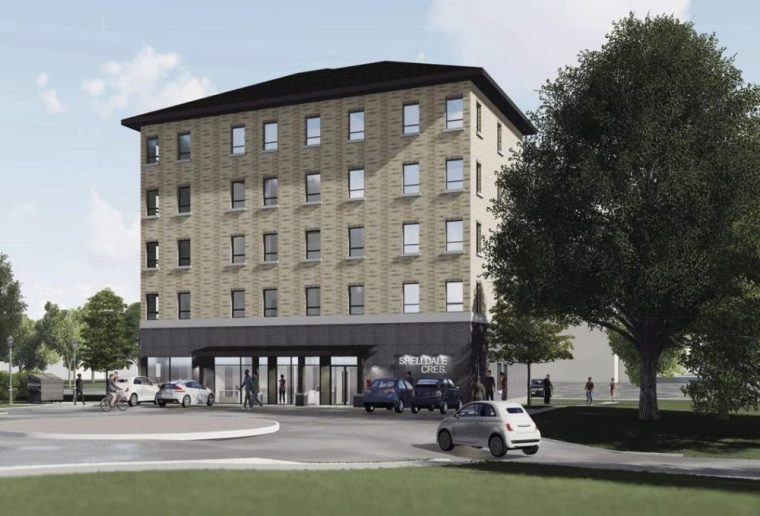
With a matter about the Municipal Elections Act pulled, that left a new item that emerged on the amended agenda last Friday. A motion from Guthrie (though technically put on the floor by Councillor Goller and his wardmate Carly Klassen) requesting that staff partner with the Home for Good campaign to leverage up to $500,000 from the City’s Affordable Housing Reserve for matching funds. That money will be allocated to the completion of the Kindle Communities supportive housing project on Shelldale.
From the mayor’s tone, he seemed to think that the matter was a slamdunk. He said that the Home For Good campaign was a proven track record for turning $500,000 into $1 million, and that the money’s “just sitting there” in the City’s account anyway. Council gave consent for three guests to take part in the discussion: United Way executive director Glenna Banda and Guelph Community Foundation executive director Chris Willard, who are both co-chairs of Home For Good, and Family & Children’s Services executive director Daria Allan-Ebron.
Councillor Linda Busuttil began probing the ask by reviewing the money spent so far on supportive housing and how it’s been allocated. Her point was that the City has established a Request for Proposals process for how money from the Affordable Housing Reserve is spent, which includes insight from the City’s housing provider Wellington County. Councillor Michelle Richardson echoed Busuttil’s concerns saying that she also didn’t like the rapid way that this request came forward.
Not helping the cause was some matter of confusion; Allan-Ebron said that the Kindle project is on time and on budget, but the issue is that there are numerous pieces of funding raised by Home For Good which are contingent on reaching certain targets. “Unfortunately, funds raised, although in alignment with the original campaign timelines, have not kept pace with the quick timelines required to bring three projects on board in 2023,” said their letter to council, which was received on Thursday July 20.
To put a number on it, Home For Good needs to get to $770,500 by August 15. That’s $495,250 for the August 15 target plus $275,250 from a missed target on June 15.
While some councillors said that the motion was a net positive despite whatever discomforts they might have about process, it seemed that “Team Process” had the momentum. Councillor Cathy Downer said that this was the second year in a row that council has gotten this kind of request with this kind of short notice. O’Rourke, who was a board member for both the United Way and the Community Foundation, noted that everyone at the council table wanted this project to succeed, but was concerned about the lack of documentation (except for the letter), and the lack of a staff recommendation.
O’Rourke asked about why the City shouldn’t give Kindle the money directly. Evidentially, there are a number of contribution agreements in place from several funders, including a big piece of funding from the Canadian Mortgage and Housing Corporation, which became “unlocked” when Home For Good set $2 million as the goal of their campaign. What would happen to that funding, especially the piece from CMHC, if the August 15 target is missed, was a question no one could answer.
Home For Good, Banda explained, was born of a need to have co-ordination to raise money for all the supportive housing projects including Grace Gardens and the Bellevue expansion at Wyndham House, so that partnering agencies could focus on service delivery and construction. Willard also noted that Home for Good was a five-year campaign that had to be completed in 15 months. For the record, Kindle is expected to open sometime this fall.
Stewart eventually chimed in to say that staff have been largely quiet in this exchange because they have no information to work with, so if council was waiting on staff advice, they had none to offer. He then suggested that staff could sit down with Banda, Willard and Allan-Ebron, and possibly invite the County in for good measure, so that they can get all information on the table and come back to council with a fully informed recommendation.
O’Rourke and Busuttil moved a referral of the recommendation to an emergency meeting of council that will be held in advance of August 15; Stewart said that it’s his intention that staff will “operate with a sense of urgency.” Guthrie noted that this wasn’t council saying no, it was council saying, “We’ll see”, and the motion to refer passed unanimously.
Click here to see the complete recap of the meeting.
 Guelph Politico