

It’s been a couple of months since we’ve had something really juicy at a planning meeting to chew on, and boy was there ever something juicy at this planning meeting. Everyone’s favourite proposed student development was back at council again for the planning meeting, and after that, there was a council workshop that promised to be the first of many steps that will help council get their heads around the housing crisis.
Planning Meeting of City Council – July 11
July’s planning meeting heard a couple of new applications. Well, one new one and one that’s sort of a sequel. Before that though, council swiftly approved the demolition permit for a garage with no heritage value inside the College and Brooklyn Hill heritage conservation district.
The first application was for 25 Alice Street where the owners want to tear down the current detached house and build a new semi-detached house. While the property is zoned RL.2 under the new Comprehensive Zoning Bylaw, that bylaw is not yet in effect because it’s being appealed hence why the application had to come to a full statutory planning meeting. The only delegate was the agent for the owner, but council had no concerns and approved receipt of the application.
And then there was the application for 716 Gordon Street, which has long been gestating as a future student residence building, private-owned but being explicitly marketed to University of Guelph students (which is right across the street). The former-Ontario Municipal Board ruled in 2013 that the development could go ahead with four towers with a maximum height of 11 storeys that includes 1,325 bedrooms and 280 parking spaces; the new proposal is more of less the same but with 1,149 bedrooms and 303 parking spaces.
Controversy came early when the two people speaking on behalf of the project were asked about what type of units these will be: condos or rentals? Marc Villemaire of Aventus Developments did not close the door on the possibility that many of those 500-some units could be condos, but he added that those considerations are being worked out by the marketing department. When asked point blank if their projects in London and Waterloo offered affordable units, Villemaire confessed that they are not.
Other council concerns included the fate of mature trees on the property, the inclusion of just 15 visitor parking spaces, and how quickly the project might begin construction once approved. There were also questions about how closely the development will stick to the idea of being for students, like can families live in this building? According to Villemaire, over half the units will be one- or two-bedroom units, and the people renting them will likely lease those units for one or two years. He also explained that it’s not unusual in their other developments for recent grads to stay in the building for a year or two after graduating.

Area residents delegating then added their concerns, primary among them is the inclusion of terraces in the project; one delegate in particular noted that the OMB decision explicitly said that balconies are incompatible with this project. Setbacks, the loss of trees and the potential impact of increased traffic in this busy intersection were also discussed.
Council had a tonne of notes for staff including the examination of the differences between this project and previous private student residence projects on Chancellors Way and the Holiday Inn site. Of particular concern was whether or not that this project, given that it’s a student residence, will have to pay municipal taxes given that residences on university property do not. Councillors also expressed some concern about the terraces, and whether or not these units will count towards the housing pledge.
The application was received unanimously by council.
The last item of the planning meeting was the Delegation of Authority Update to include Minor Zoning By-law Amendments. Under this delegated authority, staff can oversee the removal of a holding provision, the approval of temporary use, and minor changes like grammatical errors or mistakes in mapping. Much of the council discussion was about the process, primarily about notice when one of these changes arise. Also, it’s worth noting that these changes have no impact on Committee of Adjustment business.
The minor amendment delegation of authority was approved unanimously, but Tuesday night at council was not over yet…!
Click here to see the complete recap of the meeting.
Workshop Meeting of City Council – July 11
Everything you ever wanted to know about housing but were afraid to ask? Just about.
Mayor Cam Guthrie set the scene by explaining that the workshop was for the benefit of council and the community so that they were all working from the same set of information. This was also the first step, which will be followed by subsequent steps in the next several weeks including next week’s meetings about development charges, the August release of the system analysis around homelessness and mental health conducted by Collective Results, and the September 12 council meeting that will include the Affordable Housing Strategy update and a report from Wellington County.
The presentation was over 70 minutes long and included the involvement of nearly a dozen different senior staff members. There were too many details to cover in a simple recap, but the presentation touched on the housing continuum, City of Guelph investment beyond what’s mandated, historical trends, the City’s recent work around all plans from Official to master, improvements to the application process, and challenges like legislative changes at Queen’s Park and the inordinate amount of time being spent at the Ontario Land Tribunal.
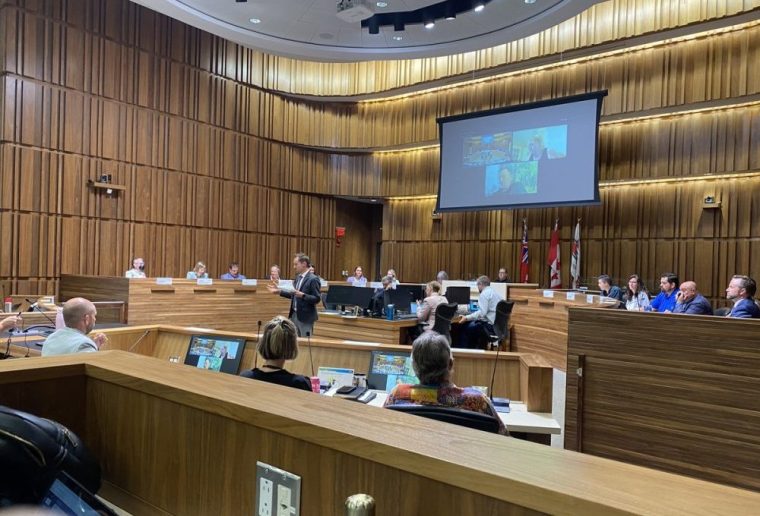
CAO Scott Stewart noted that the rapid pace of regulatory change has been a drain on staff, but they have persevered. He explained that the last several years of work on Clair-Maltby, Dolime, the Guelph Innovation District, various master plans, and other reviews meant that Guelph was set up well to now capitalize on that work and start activating housing. He said that the process feels slow because it’s deeply detailed work on a grand scale, plus, he noted, Guelph has nearly 6,000 units approved just waiting for the shovel in the ground. Stewart also noted that the Government of Ontario has to come through to make municipalities whole thanks to changes in fee collection.
Strategic Communications Advisor Shelly Reed then introduced council to the interactive story map that lays out much of the information shared in the meeting and includes a map showing where units have been approved, how many and when. You can check out the site for yourself here.
When it was finally council’s turn to ask questions, they inquired about the capacity of staff to handle the workload and what resources they need, what levers the City can pull to incentivize affordable housing construction, and how well the City works with partners in for-profit and non-profit housing. Staff confessed that there are some difficulties in staying on top of staffing because all planning departments in Ontario are trying to staff up, and that their workload right now is about trying to balance the needs of asset management while doing infrastructure that can activate new housing.
In one last exercise, staff and council broke up into small groups to brainstorm answer to this question: What do you want to say that council accomplished to generate housing by the end of the current term? These were some of the answers…
- Review compensation for planning staff in order to recruit and retain the best
- Double or triple basement and accessory apartments
- Get shovels in the ground for GID and IMICo lands
- Get other levels of government back to the table for social housing
- Sunset clauses for developments
- Increase the amount of purpose built rentals
- Create different housing options like co-ops
- Create complete communities within existing neighbourhoods
- Have zero active OLT files
- Accelerated on-campus housing for U of G and Conestoga
- Create better digitized services
- Create affordable housing that matches the needs of all family types
- Ask the Province to revisit bonusing
- Look at new school development and build housing around it
- Recognize that affordability is also about utilities, and encourage the building of net-zero homes
Guthrie wraps up by saying that this was the best council workshop he had ever been to and thanked staff for the opportunity. He also said that he wants the community to know that there’s more to come as the City puts the proverbial puzzle pieces together, and people need to know that staff and council are united and open to hearing new ideas on how to get housing done.
Click here to see the complete recap of the meeting.
 Guelph Politico