

The 2026 budget confirmation process finally begins with the presentation from City of Guelph senior staff! You can click here for the amended agenda from City Hall, and you can click here for the Politico preview. For the complete blow-by-blow of today’s council meeting, you can follow along with the thread below, or you can watch the whole meeting for yourself by watching it on the City’s website here.
BEGINNING OF THREAD:
Mayor Guthrie has called the meeting to order.
From the closed meeting…
Mayor’s Draft 2026 Budget Update – There was no direction.
Organizational Structure Review: A Phased Approach – Council just received info, and no direction was given.
No Disclosure of Pecuniary Interest and General Nature Thereof.
As Guthrie notes today is budget presentation day. In terms of opening remarks, he says that he gave direction to staff earlier this year to have three options: 1) a 2.5 per cent budget, a 3.5 per cent budget, and 3) the original recommendation. He thanks staff for all the heavy lifting.
Guthrie says option #1 would have hurt the community and created financial risk. “They would not have been good,” he says. He landed on current budget 3.17 per cent, and that does not include the last payment for the hospital levy. There have been changes since then, three items added back: $300,000 for the bicentennial, $60,000 for termite control, and $40,000 to add another free ride day for seniors.
Lastly, he says that everything here is under the direct control of council, 35 per cent it from the seven shared services that the City finances in-part or on whole, but are controlled through a separate board. He says he would not be surprised if at the end, the community is looking at a six per cent increase. He wants council to take a hard look at affordability, but balancing that with value. Hopes that this is a model for the outside boards.
The list of those boards:
- Guelph Police Services
- Guelph Public Library
- County of Wellington (Social Services)
- The Elliott Community (Long-term Care)
- Wellington-Dufferin-Guelph Public Health
- Grand River Conservation Authority
- Downtown Guelph Business Association
Also, Guthrie says he hopes to sign off on the budget by November 10.
CAO Tara Baker begins the presentation. She offers thanks to all the staff members on hand for the team effort in putting the budget together. She also notes that this is the second confirmation in the 2024-2027 multiyear budget cycle, and that there are more details on the options not taken on the City’s budget site.
She notes that there was significantly more change than what might be expected in a typical budget confirmation year. Inflationary pressures were considered, all operating impacts from capital were measured, they looked at growth impacts too, and updated DC collection assumptions and debt strategy.
Ontario municipalities are navigating increasingly complex environments, Baker says, from tariffs, to housing, to social issues. We need a modern fiscal framework, but for now City resources are being strained. The City budget is still catching up from inflation pressures between 2021-24, so getting to affordability means tough decisions. The City is committed to meeting community need while safeguarding sustainability.
While the primary focus is affordability, there are meaningful new investments in this budget, Baker says. It also responds to slower growth, which has a pervasive impact on the budget via lower DCs and building permit fees. Plus, there are compensation adjustments and changes to WSIB legislation. We’re also outsourcing more fleet servicing work than before due to capacity.
Jodie Sales, General Manager, Strategic Initiatives and Intergovernmental Services takes over noting there’s less capacity to absorb impacts, low contingency reserve balances (and no surpluses to rebuild), uncertainty about timing to recover development fees, too much legislative change, and global uncertainty. On the other hand, there are opportunities with grant management, advocating to upper levels of government and capital prioritization.
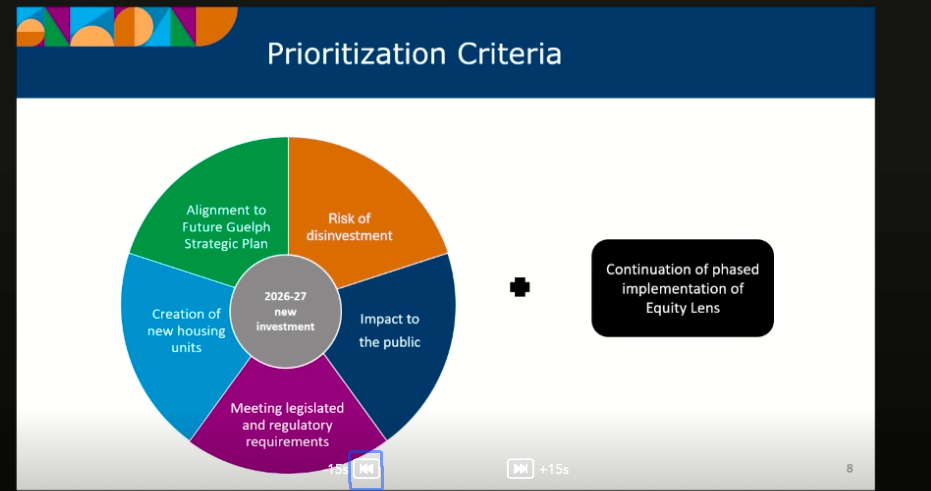
The prioritization criteria for 2026 are the same as 2025.
On City Building, there are investments that support housing infrastructure, an increase to affordable housing reserve and reconstruction of Wyndham Street North. The implementation of trails as been slowed, but the G2G is still proceeding, and transit investments have been prioritized over active transportation.
Environment includes the electrification of the fleet, and other capital projects. Stormwater management improvements and new work in the Exhibition Park area included.
On People and the Economy, we’re talking about new investments in emergency services, and progress on infrastructural renewal downtown. There’s also the renewed and expanded community benefit agreements.
On Foundations there’s new investments in occupational health and safety for City of Guelph staff as well as I.T. renewal and improved cyber security, though there have been delays on that work too. There is a warning about more disruptions as asset management suffers.
Shanna O’Dwyer, General Manager of Finance and City Treasurer takes over to talk about the operating budget in detail. She says staff strongly recommend against taking the hospital levy from the reserves. She also notes that the City is close to its 2026 assessment growth target of 1.15 per cent, which is good news, but they won’t know for sure till mid-November. Missing the target would also impact 2027 budget update, and even making the 2026 target is not a sure thing. May need to reassess those targets for 2027 anyway.
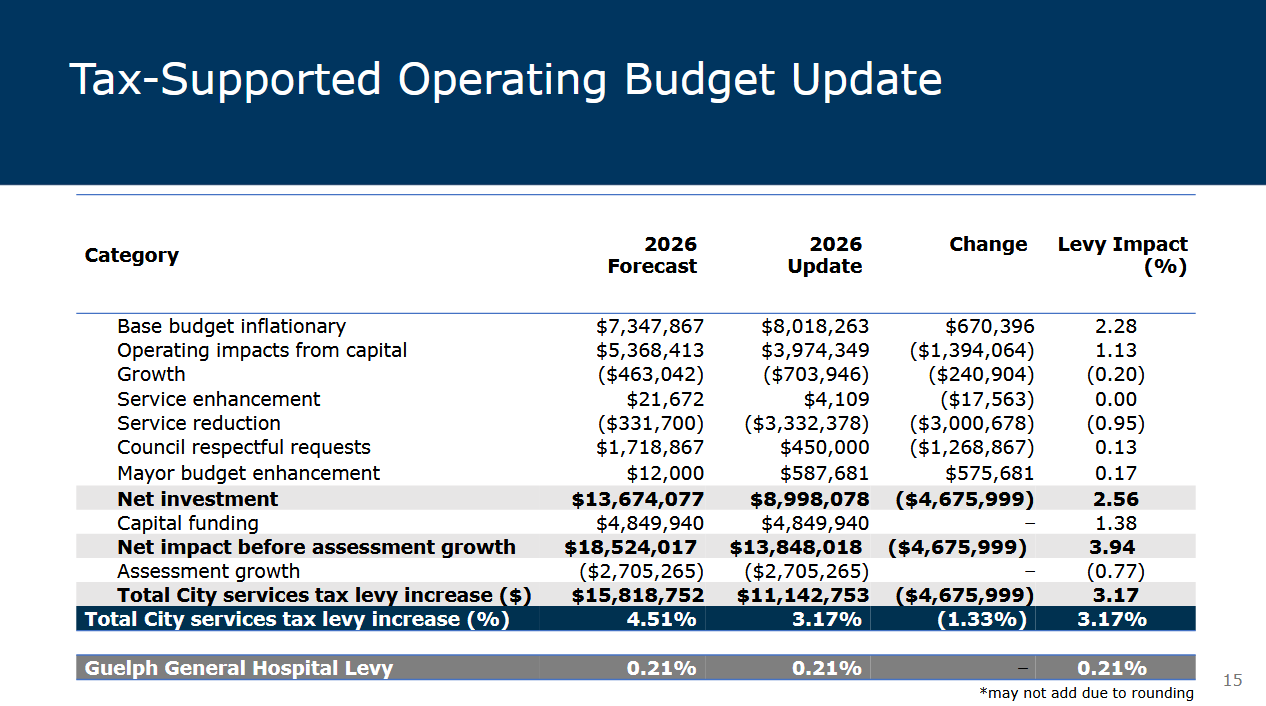
Colleen Clack-Bush, Deputy Chief Administrative Officer, Public Services takes over and notes that the base impact is 2.8 per cent, 70 per cent of the total levy increase for 2026 is just maintaining service levels as they already are. The City operates with a lean budget, focusing on efficiency, innovation and renewing contracts where they can.
The 2026 investments included updated revenue projections for select departments, increase in Transit ridership, increased budget to tackle aging infrastructure, increased employee compensation and supplies. Increase in compensation of $2.9 million, plus about $700k for frontline emergency services’ mental health, but there will be some savings from the carbon tax being removed.
Operating impacts from capital (worth 35 per cent of the total levy increase):
- Opening the South End Community Centre and Baker District Redevelopment
- Technology to safeguard and enhance digital environment
- Transit enhancements (route 98, digital signs, bus shelter maintenance)
- Solid Waste expansions for growth and downtown public spaces
- Fire dispatch system (NG911) software
- Operation of snow clearing equipment
- Maintenance of growth parks and trails
In terms of growth, there’s two new paramedic shifts and enhancing employee wellbeing. There was also a markdown of about $157,000 in housing pledge resourcing due to a glacial housing market.
Clack-Bush passes the baton to Stephen O’Brien, Deputy Chief Administrative Officer of Corporate Services. In terms of service enhancements, there are new bylaw officers, new money to (perhaps) implement internet voting in 2026, and increased investment in community benefit agreements. There are also service reductions, about $3.3 million worth. They’re in four categories: New and increased user fees, Reduced community facing services, Reduced financial capacity to meet strategic objectives, and Administrative changes.
This includes a transition to 24/7 paid parking lots, increasing public waste drop-off, and moving utility arrears to the tax bill. There’s also an end to snow removal from bike lanes and the park steward program, fewer cultural events like movies in the park, reducing active transportation priorities, sustainability, and youth subsidies in culture and recreation. Also, there’s a reduction in asset management, a reduction in environmental policy planning, and lower capacity for energy retrofits. Welcoming Street is also gone, but there is a possible extension too.
In terms of “respectful requests from council”, there’s an ask for more money in the affordable housing reserve, and enhanced support for Advisory Committee of
Council members to cover reimbursements and training expenses.
As for mayor’s enhancements there’s the one-year extension to Welcoming Street, making youth and senior ride free pilots permanent, support for community led G2G trail
connection between Woodlawn and Silvercreek and $70,000 to support Guelph’s Community Call to Climate Action.
Now Capital Funding! There’s an increase of $4.8 million in tax-supported capital
funding over the 2025 budget.
Back to O’Dwyer who lays out what all this adds up to…
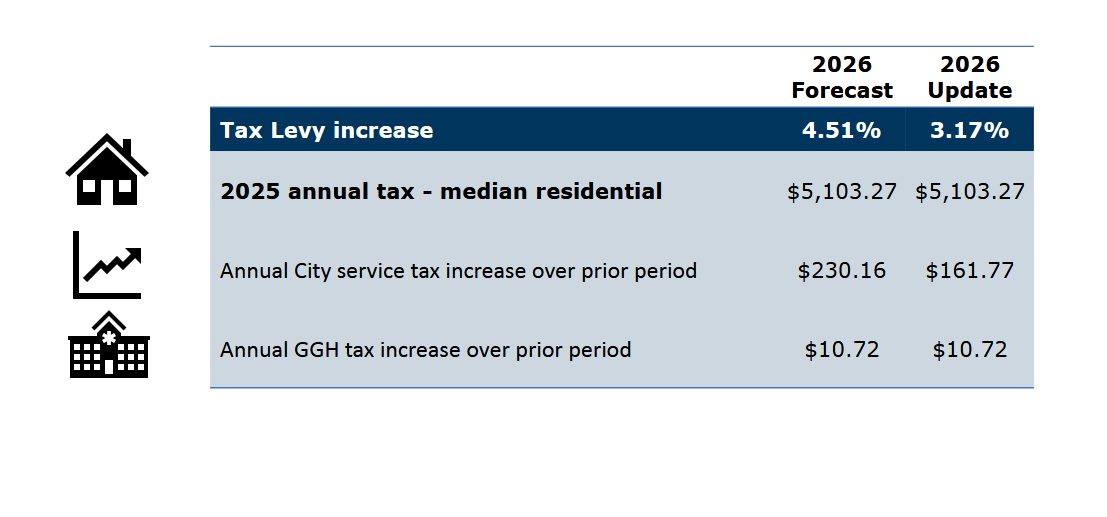
Issues with the reserves? Well., check this out.
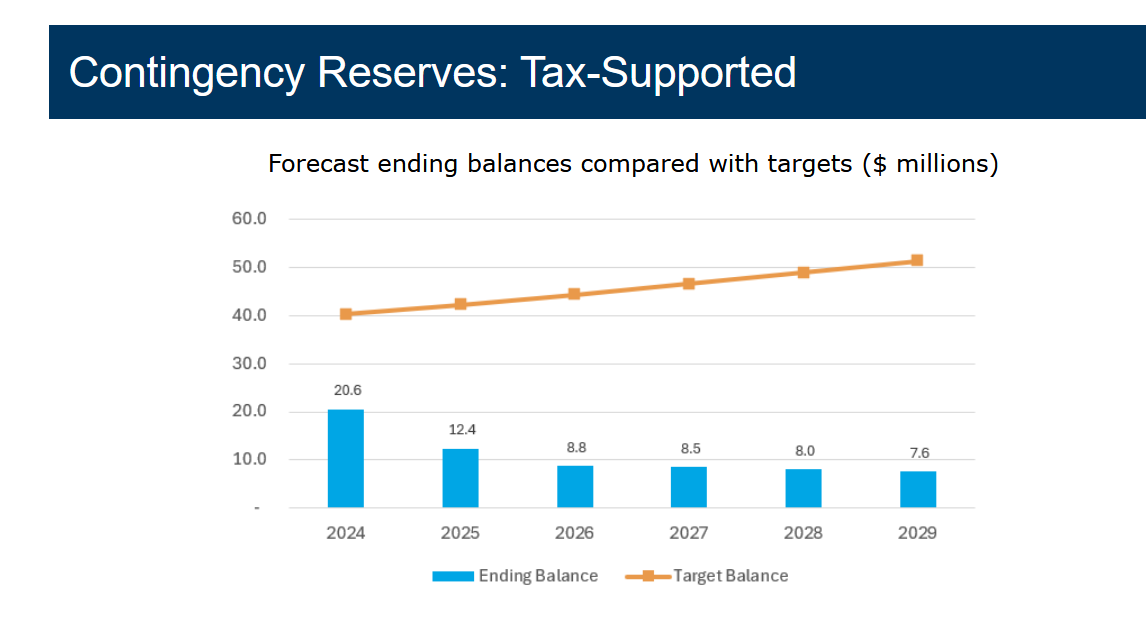
O’Dwyer notes that the usage of reserves for increased social services costs and the hospital levy have been a drain. The tax contingency will have a balance of less than a million dollars at the end of this year when it should have $5 million stored away. Staff are *strongly* recommending not using it for anything else in 2026. Replenishing the reserves is going to be a project for the next multiyear budget cycle.
Utility rate impact:
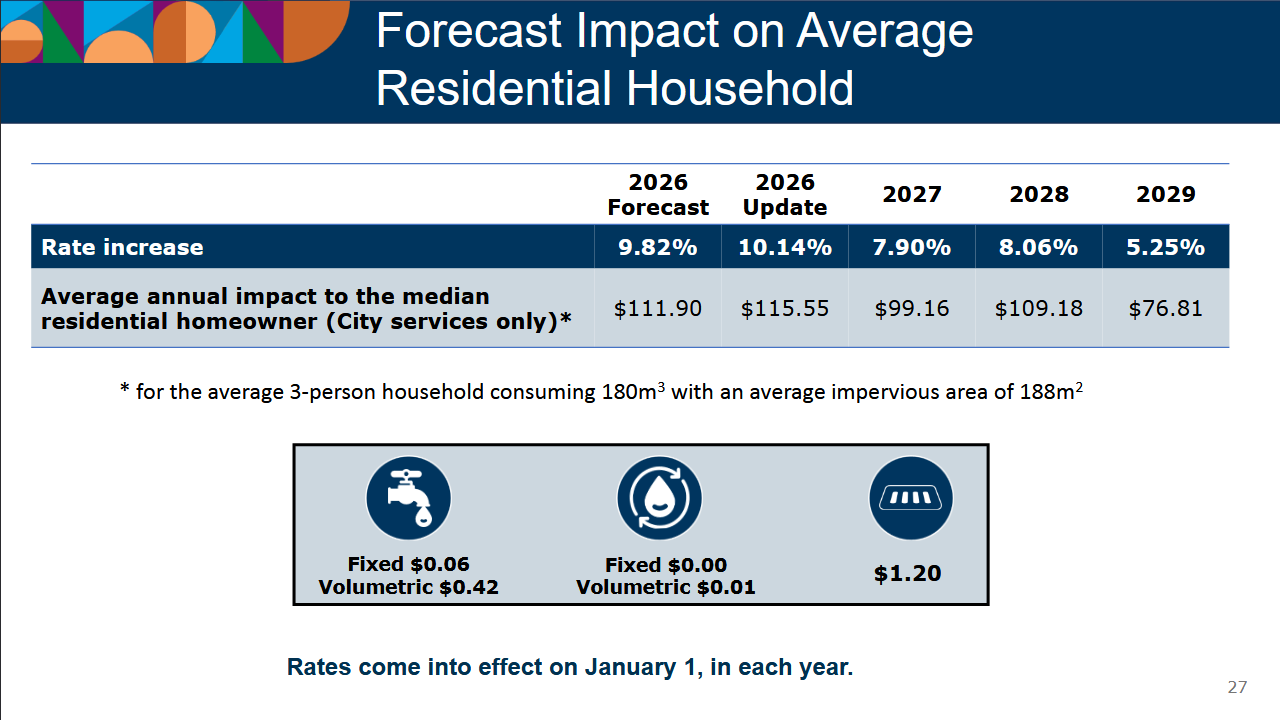
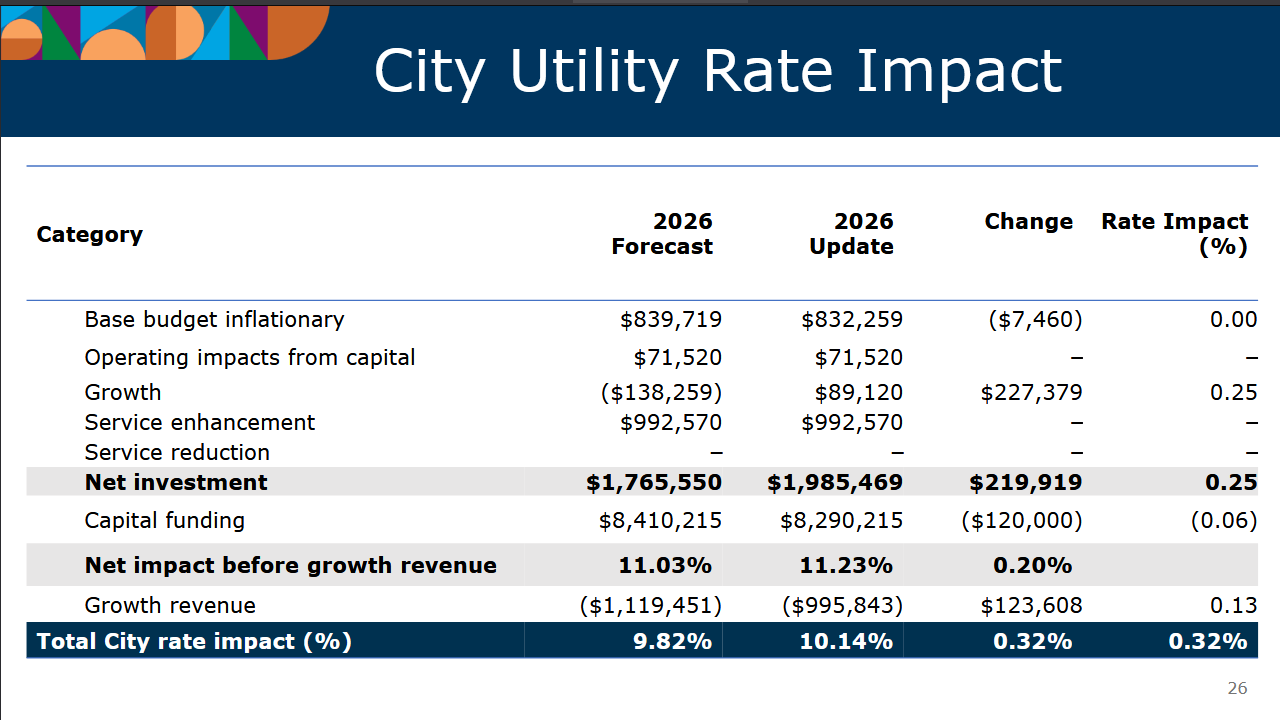
Keep mind that the Guelph portion of the GRCA is funded through utility fees.
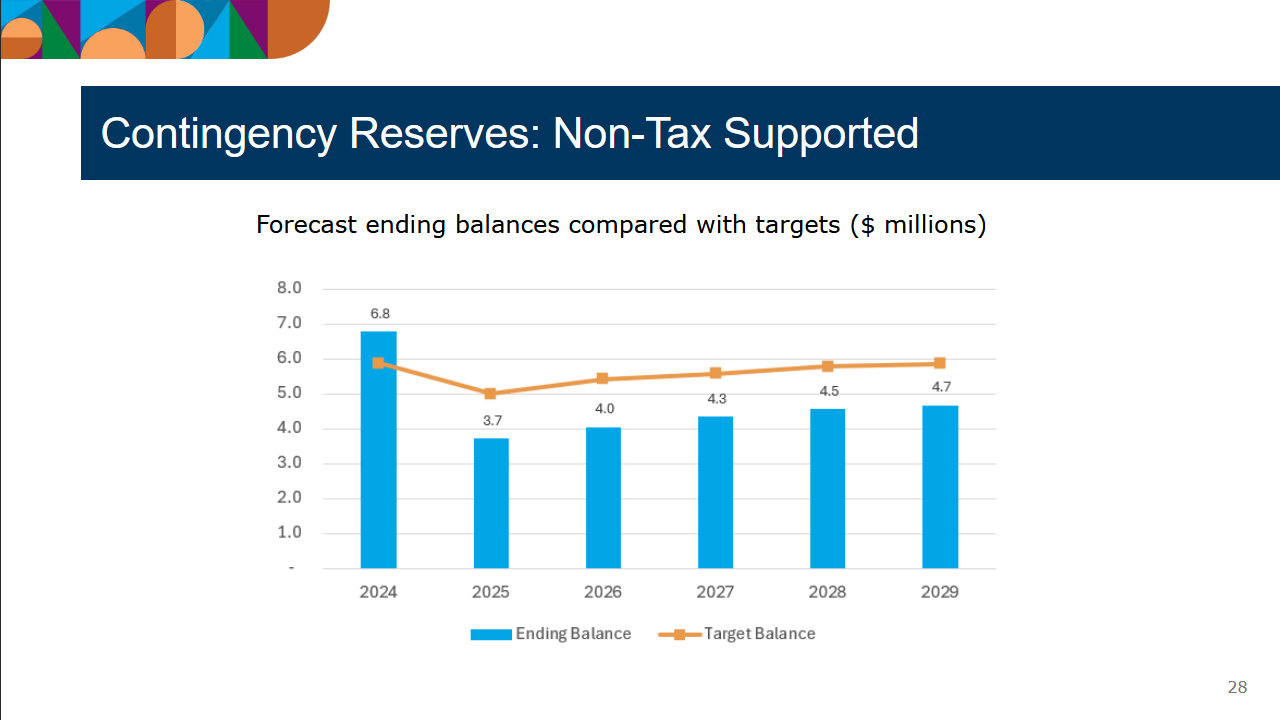
On the brightside the non-tax supported contingency reserves are holding up better.
Terry Gayman, Acting Deputy Chief Administrative Officer, Infrastructure, Development and Environment, is now going to talk about the Building Code update, which is funded through building permit fees, which means there have been issues with the housing market in decline.
The 2026 draft update reduces budgeted revenues by approximately $2.3 million, with
targeted expense reductions to protect core service delivery. The OBC stabilization reserve is expected to be depleted by the end of 2026 if something doesn’t radically change, and that may require interfund borrowing.
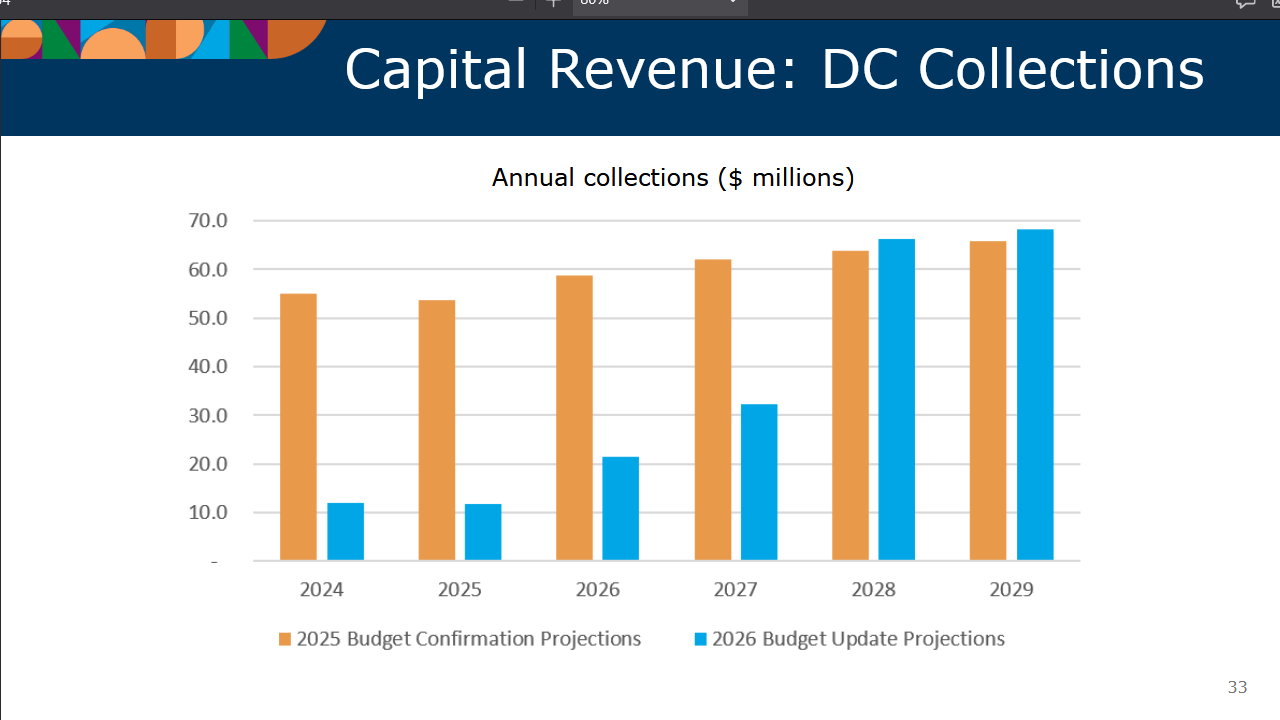
O’Dwyer is back to intro the Capital Budget. In 2025 a fully-funded capital budget and forecast was approved at council direction and the major change for 2026 has to do with DC collection (they’re lower than forecasted in the 2023 DC study.
For context (blue bars are actual). $104 million less in DC collections than predicted.
Capital work has been split between high priority and low priority, with downtown road work considered to be high. It also includes mandated projects, housing enabling infrastructure in high priority areas, safety concerns, and projects with a grant commitment or outside funding source.
2025 vs 2026 there are only minor changes between which areas are getting capital funding.
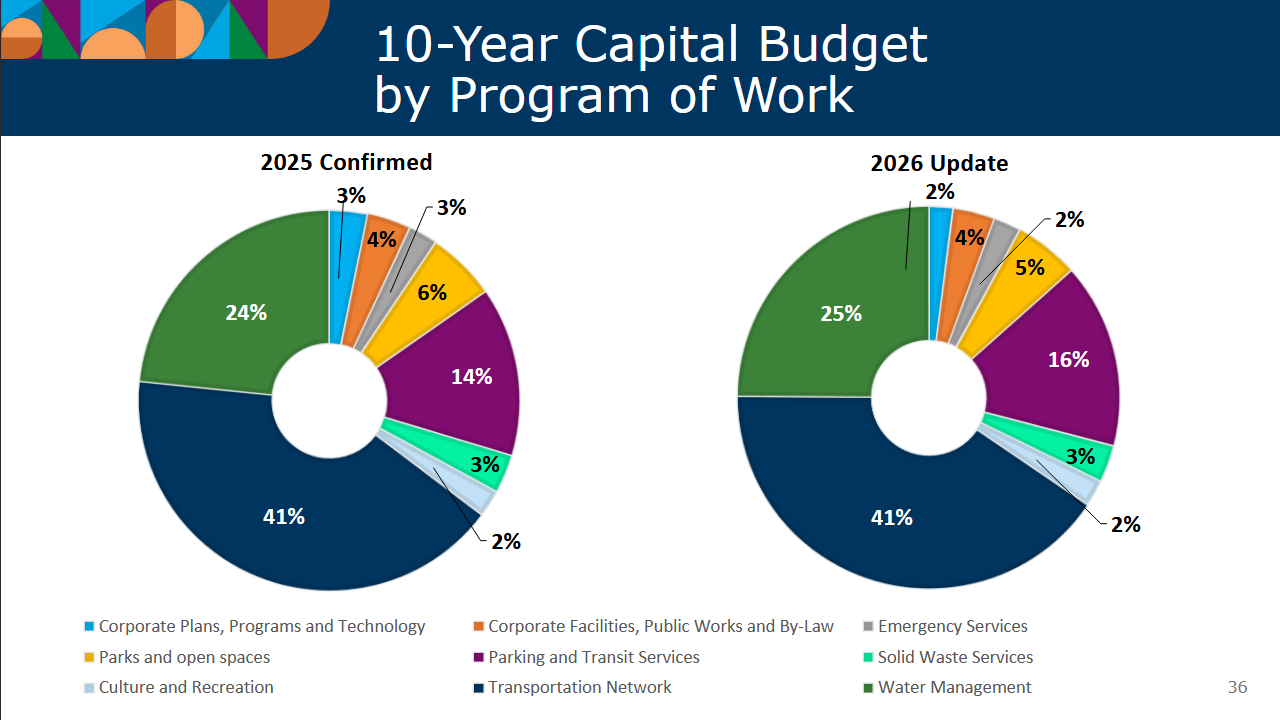 Gayman returns to note that 60 per cent of budget goes to infrastructure renewal, 30 per cent to growth and 10 per cent to service enhancements, though he does note that some projects overlap in all three buckets. Some medium priority projects have been delayed by a year or more in the name of affordability, but that may come back to bite in the form of higher maintenance costs.
In terms of renewals there’s downtown road construction, update stormwater in the Exhibition Park area, and new bio solids facility upgrades. New rec and admin upgrades have been deferred or slowed. The City is now expected to reach sustainable infrastructure in 2043/44.
In terms of growth, these projects have continued to move forward even with slowed housing numbers. Work on York and Speedvale will continue, Orin Reid Park upgrades will also proceed in 2026, but the Beaumont Park will have to be delayed due to technical issues on site. Also, funding assumptions will change for Vision Zero project if the Ontario government proceeds with cancelling automated speed enforcement cameras.
Housing enabling infrastructure: The City is focusing on downtown, the Guelph Innovation District (York Road Phase 4) and Clair-Maltby.
Clack-Bush is back to talk about service enhancements. The new fleet services building will start construction in 2026, that’s the lion’s share of the capital spending this year and has $70 million in investment from the feds. 14 new EV buses are planned through 2026, and enhancements to Sleeman Centre and River Run also in the offing. Still, there’s a pause to the 100 per cent renewable account in 2026.
Operating impact from capital by service area:
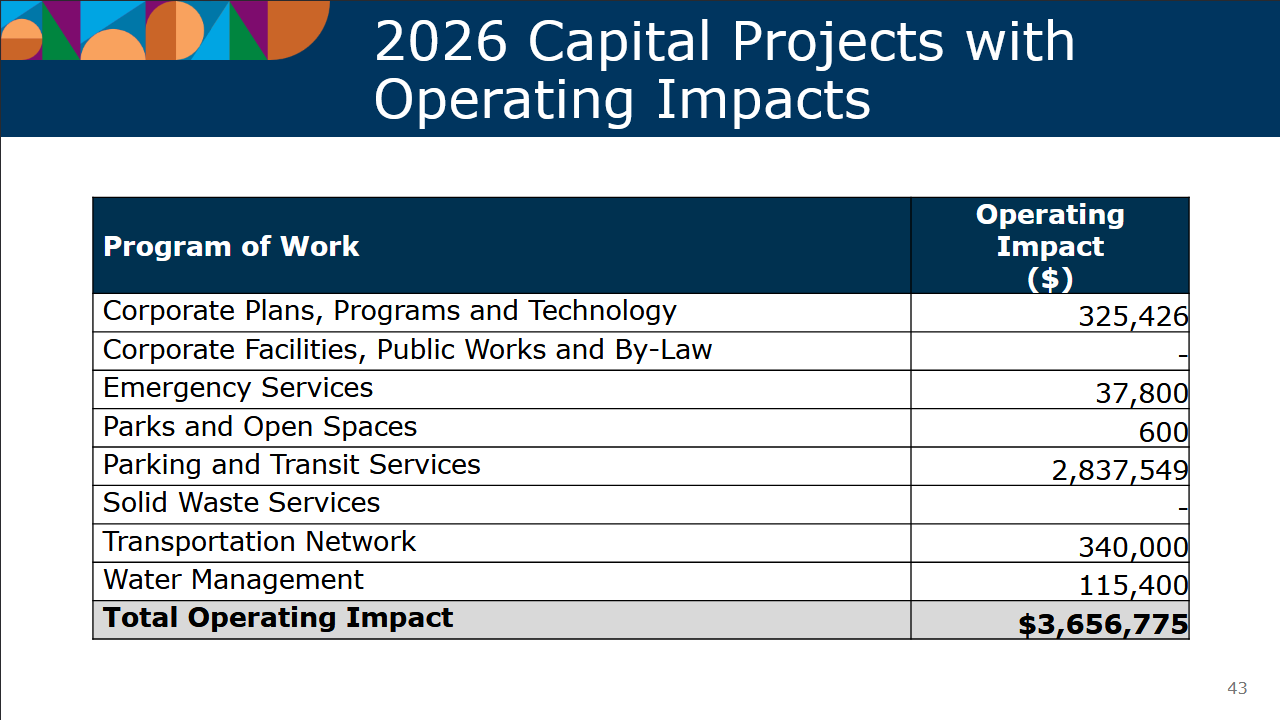 O’Dwyer is back once more to talk about capital financing…
Tax-supported funding was reduced in 2025 in the name of affordability and that continues in 2026. DC exemptions make up 19 per cent of spending and is biggest lag on funding capital right now.
As discovered in 2025, the transfers to water capital reserve fund were insufficient to support the plan, while wastewater reserves were higher than needed resulting in a likely surplus. Staff made some changes to rebalance both accounts by holding transfer to wastewater at 2025 levels and redirected to balance water now by 2032. Customers receiving only water will see a higher fee while people receiving only wastewater will see lower fees.
In terms of DC collection, there’s an assumption that they will bounce back by 2028, but it’s still unknown what the impact of new changes in Bill 17 will be and more info on that will come back in 2026 for the 2027 budget.
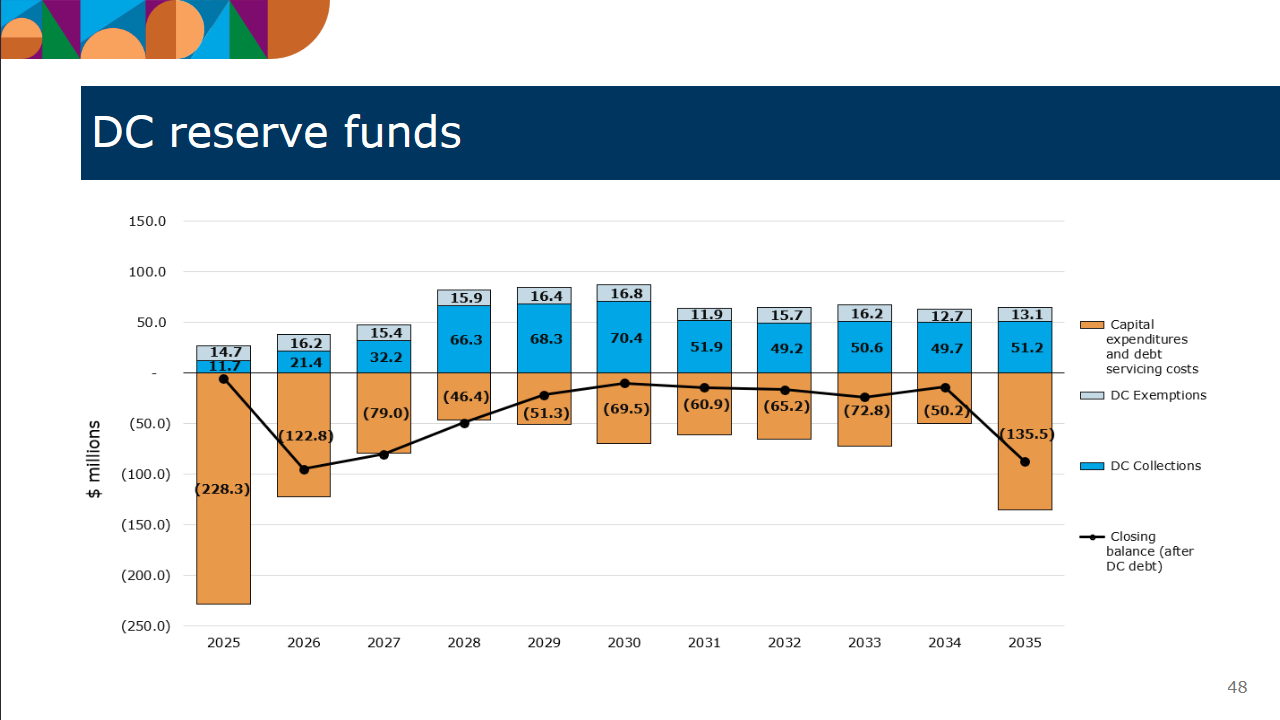
Debt forecast? It’s a mix of refinancing, previously approved projects and projects in the budget forecast. It will remain well below the City’s policy limit of 55 per cent though there will be a breach of S&P’s preferred limit of 30 per cent in 2027, 2028, and 2029. This *could* impact the City’s AAA credit rating.
Back to Baker to wrap up the presentation. She says the key takeaways are investments and value in our community, responding to slower growth and base budget changes responding to rising costs. She says the budget is responsive and responsible.
Mayor Guthrie calls for a 30-minute break!
We’re back, and Guthrie wants to try and coral the council questions around themes.
Cllr Allt asks why debt issuance is not the same as being in debt? O’Dwyer says debt is used strategically the move forward with projects with intergenerational benefits, it doesn’t make sense to save up for them and then built them. It’s a strategy to move important infrastructure renewal and used carefully with guard rails.
Allt asks about DC collection projections, are they realistic or optimistic? O’Dwyer says they’re based on 2023 background study, and they’ve been revised downward in near-term due to present economic conditions for the next few years, otherwise they remain the same though they will monitor and revise as needed.
Allt asks how much housing can the City realistically develop. Guthrie suggests that this might be more appropriate for the Committee of the Whole report next week and Allt says that would be fine and O’Dwyer agrees. That or the budget board so staff can offer a more detailed response.
Allt asks about use it or lose it provisions, will that help City balance costs? Gayman says building permit activity is still strong, just not as many mult-res projects, but the UIOLI should encourage development to come online quicker.
Allt asks about bylaw, and the growing service level expectation. What are those? Clack-Bush says this is specifically encampment response and issues downtown, they’ve been taking that as a negative variance and now they’re added permanently. Operations GM Doug Godfrey adds that this is bylaw because they’re also trying to raise revenue with issuance of fines.
Allt asks about specific transit changes. Clack-Bush says it’s an evolving plan with route 98, shelters, and digital signs. Transit GM Glenn Marcus says its about moving to a grid system, heavier access into the northwest industrial area and more hours on that 98 route.
Allt asks if the base will remain the same for public waste drop off. The GM of Environmental Services says it’s the multi-waste fees that’s going up $10, the base fee of $10 will be staying the same.
On the Climate Call to Action, what’s the $75,000 going for? Sales says that’s for community benefit agreement and they will work with the climate office to figure out how to best collect applications for that work.
Cllr Gibson notes that the opening of the South End Rec Centre and the new Library are driving operation increases, can any of those costs be spread out? Clack-Bush says the phase in plan is already accounted for in the rec centre (aiming Oct 2026 opening), O’Dwyer says they’ve also planning 2026 carefully for that phase-in.
Gibson asks about parking in City lots, that doesn’t include rec centres or facilities right? Clack-Bush says that’s for lots presently with paid parking.
Gibson asks if Safe Semester is still something that the City needs to invest so heavily in due to changing demos and behaviours. (That’s a takeaway.) On the tax-operating reserve he says that council has made the commitment to service that with surpluses, right? O’Dwyer says that’s true, but there wasn’t a surplus for 2024 and there probably won’t be one for 2025.
Gibson asks how the loss of DC revenue is impacting asset management. Gayman says they’re always looking to optimize the existing funds, and they will continue to monitor the impact of that. O’Dwyer adds that there prioritization framework, taking projects in capital forecast and ranked them based on priority of the growth and priority of the management.
Cllr Caton asks park staff about Sloan Hill Park (Beaumont), they’re wondering about more details around the timing of that development? Parks GM Gene Matthews says there are encroachment matters that need council’s resolution and this will be coming back sometime in the first half of 2026. In the meantime, design work will progress and there will be some engagement at some point.
Caton asks O’Brien about the impact of deferring the two I.T. roles. O’Brien says those roles are needed to move data governance issues forward, and they can’t move forward with A.I. efficiencies without it. It’s tricky work because the City has so much data in some many different formats, but they will be still be exploring ways to best utilize A.I. tools in City work. Caton asks which position gets the City more bang for its buck? Adam Fischer says that’s hard to answer on the spot and would rather do that through the budget board.
Cllr Downer asks about park stewardship program, how many volunteers do we get out of that $25k? Matthews says he says there’s hundreds of volunteers, but its also a valuable bit of outreach to the community in the form of community gardens to park clean-up and more. He says they will try and find new ways to hold on to those connections. Downer asks what the $25k buys? Matthews says its supplies and some season staff.
Downer asks about tree bylaw enforcement. How much will that cost and how will we deal with the bylaw now? Matthews says he’ll get the exact number but it’s 1.5 FTEs. They will continue to deal with it the way they have in the last six months, which is using an education-first approach, and by delaying other work.
Cllr Chew asks about frequency on transit, how are we ensuring the routes are being used to their optimum potential. Clack-Bush says they look at coverage and frequency, which is a balancing act. Marcus adds that as Transit looks to expansions, they are always looking at the best ways to get people where they’re going, and that’s being analyzed on a daily basis as new counts come in.
Chew asks about Orin Reid Park, is it possible to do it one piece at a time rather than all at once? Maybe the splash pad? Clack-Bush says they had to make very hard decisions and notes that there are other amenities in the south end coming online in 2026. Matthews adds that doing it piecemeal is not staff’s recommendation because there is a process to the development and concerns about ongoing impact to the community.
Chew asks about those potential consequences. Matthews says they’d have to do engagement to know what it is the the community would want to go first in the project, they don’t want to make assumptions.
Chew asks why the $1.4 million of playground equipment, why not defer that? Matthews says that playground equipment is on an 18-20 year replacement cycle, so delaying one starts a domino effect and might sacrifice safety. They do make adjustments though it a particular playground has shown more wear and tear.
Cllr Klassen asks about cutting Doors Open Guelph, because this is a very successful program. Clack-Bush says that’s about $6,500 while GM of Recreation Danna Evans notes there were 3,000 people through 11 sites this year, and money helps with site activation and volunteer recruitment and training.
Cllr Goller asks about the items that the tax supported contingency is covering in 2026. O’Dwyer says they can get a full list on the budget board, but the biggest one is phasing in the increased social services costs over four years.
Goller asks about the availability of those termite control funds. Gayman says a report will be coming in Q2 next year. GM of Planning Krista Walkey adds that it will be similar to the program the City’s already had in place, but the program itself won’t be in place till the spring.
Goller asks if any of the new snow removal equipment can be used for bike lanes. Clack-Bush says that the cut in the budget it for winter maintenance of all on-street bike lanes. Godfrey says the new equipment is a new sidewalk plow for newer areas of the city. Goller asks if this will impact trails. Godfrey says the trails won’t but the multiuse paths maybe.
Goller asks if the City will still be building separated bike lanes as they’re rebuilding roads. Gayman says that if that’s within the scope of a given project, they will proceed.
Goller asks about the meaning of “new investments in climate leadership” while cutting $18 million in 100RE funding. Sales says the new investments are the CBAs for climate leadership, and 100RE, says Gayman, is based more on opportunity but it doesn’t mean life cycle replacements don’t happen.
Goller asks if Guelph is abandoning commitment to get to net zero by 2050. Facilities Manager Ian Scott says that’s a bigger picture and they will be bringing a report back in Q1. There are a lot of projects and this will slow a few, but they’re still doing a lot. Baker adds that there are significant investments in fleet electrification in this budget, so there’s some balance.
Guthrie encourage council to use the budget board, and talk to him or staff. He understands that deleting is hard but he encourages councillors to look at deferrals and substitutions too. He notes that the feds are cutting and the “province is the province”, but the private and non-profit sector are cutting too. Yes, there are regulatory obligations, but there is a balance to maintain.
“People are struggling, that’s all I’m saying,” Guthrie says.
Meeting adjourned!
END OF THREAD!
 Guelph Politico