

Nothing really scary at this pre-Halloween council meeting, unless you’re devoid of compassion. Council revisited the Parks and Recreation Master Plan from Committee of the Whole with a wider accessibility lens this time, and then there was a special motion from one councillor about encouraging the creation of a Guaranteed Livable Income. There was also one last word about the Culture Plan, so let’s see all about it in this meeting recap!
Regular Meeting of City Council – October 24
The regular meeting of the month happened one week early because the last Tuesday of October is All Hallow’s Eve, and since some of the councillors have kids wanting to collect sugary treats for the occasion, we wrapped up a month of council business in advanced.
Much of the agenda from Committee of the Whole was ratified swiftly, but there was more to say around the Parks and Recreation Master Plan, especially in the realm of accommodation for those with accessibility needs. Two of the three main delegates referred to a slate of five recommendations that Councillor Erin Caton was planning to put on the floor saying that more of an effort needed to be made so that Guelph’s outdoor amenities could be enjoyable for everyone regardless of their ability.
It what was a trying night for Mayor Cam Guthrie in terms of agenda management, we had to navigate a question about when to include an appearance by Accessibility Advisory Committee Chair Lorelei Root, who was appearing to speak to Caton’s motions, which were amendments to the main recommendation. Typically, delegates don’t speak to amendments because any amending is done after delegations. Caton did provide advanced notice to the media about the five motions they had in mind, but apparently not all of their council colleagues got that notice.
Caton’s motions included a requirement for two wheelchair accessible features (talk tubes excluded) for every playground, service targets for playgrounds to have rubberized surfaces, and the use of economic need as a measurement for the appropriate locations of rubber surfaces. As Root explained, the motions would help close the distance between real accessibility and the more textbook definition of accessibility in the Accessibility for Ontarians with Disabilities Act (AODA). Woodchips in playgrounds being a good example of the difference because while AODA says that’s an accessible feature, people with wheelchairs and other mobility devices tend not to think so.
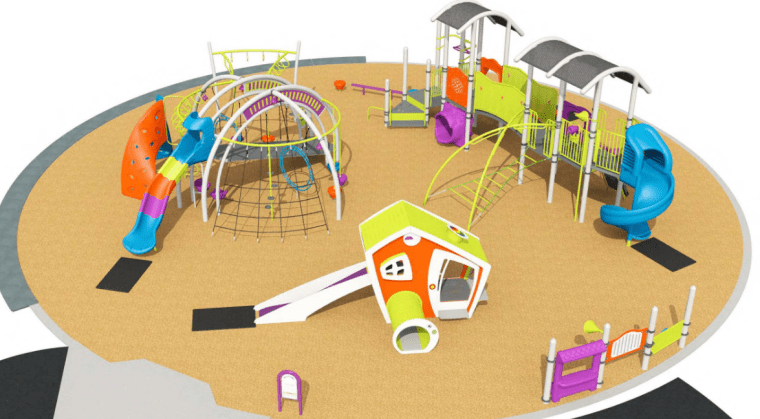
In conversations among council, there was an immediate impression that the horseshoe might have been over their skis trying to approve the five additional measures at this meeting without further engagement with staff and the AAC. There were also budget concerns, even though some of the motions wouldn’t require any drastic changes to the budget, but rubber surfaces and their installation are more expensive than the use of woodchips so the City might only be able to replace 2-3 playgrounds per year instead of 3-4. Also, the budget is set to be released next week and there isn’t enough time for revisions.
With so many unknowns, council opted to refer Caton’s five motions to staff and the AAC for further examination. Caton said they would support the referral once there was an assurance about a timeline to get a report back. Staff said that they could come back with a report in advance of the 2025 budget confirmation should any new service levels be required. The motions were unanimously referred, and the Parks and Rec Master Plan was unanimously approved.
In new business was a motion from Councillor Carly Klassen asking the mayor to pen a letter calling on the provincial and federal government to work collaboratively towards the implementation of a national guaranteed livable income. Klassen said that between the crises in housing, affordability and healthcare, the idea of a guaranteed livable income makes a lot of sense as a tool to combat poverty and inequality. Two community advocates delegated their agreement with that point of view.
There were members of council that needed some added convincing. Councillor Michele Richardson said that she would feel more comfortable if the motion asked the governments to “explore” rather than “implement” a guaranteed livable income, and Gibson seconded an amendment to make that change. Gibson said in his comments that he has a lot of concerns about the idea as a guaranteed income sounds like it might make work optional.
Councillor Rodrigo Goller implored council to keep the strong wording of the original motion rather than make assumptions about the potential recipients, which Gibson took as Goller assuming that he was calling people “lazy.” Goller said he was making no insinuations, just that council should pass the strongest motion possible. The amendment failed 5-8, and the original motions passed 10-3 with Guthrie, Gibson and Richardson voting against.
Lastly, there was a follow-up motion for the Culture Plan 2030. Councillor Linda Busuttil tabled the motion asking for a follow-up report about City owned cultural, archival and heritage artifacts and how best they can be incorporated into public displays or used for place making or adaptive reuse. The impetus of the motion for Busuttil was the fate of materials from the Mitchell Farmhouse, which DCAO Colleen Clack-Bush confirmed were in storage. She and DCAO Jayne Holmes had already gotten a jump on the motion by initiating a review of all artifacts in storage and compiling that in a master list of what’s stored and where. Busuttil’s motion was unanimously approved with the rest of the report.
Guthrie wrapped up the meeting by congratulating council on exactly one-year since the election, and he thanked council and staff on a consequential 365 days of council business.
Click here to see the complete recap of the meeting.
 Guelph Politico