

It’s still about a month before the budget process really gets underway, but there’s already a warning that things are going to be tricky for council if they have a hope of balancing all that they want to do while making it affordable of the people of Guelph. Bill 23 has dug us a deep hole and the crises of affordability and housing are making that hole even more difficult to fill, but is all hope lost? Perhaps there’s an answer in this council workshop…
Special Meeting of City Council – October 11
In a little over a month, city council will get their first look at the 2024-27 multiyear budget, but the special meeting this week was meant to tee up that future discussion with an overview of the process and a sneak preview of the contents in the next budget.
Skipping much of the background details, you should know that the budget process is complicated by Strong Mayor Powers. Although Mayor Cam Guthrie has opted to leave budgeting in the capable hands of City of Guelph financial staff, there’s still a tight 30-day process that begins immediately once the budget documents are made public, which is why the budget will be released on November 3 instead of the usual 10-day pre-meeting release for council reports.
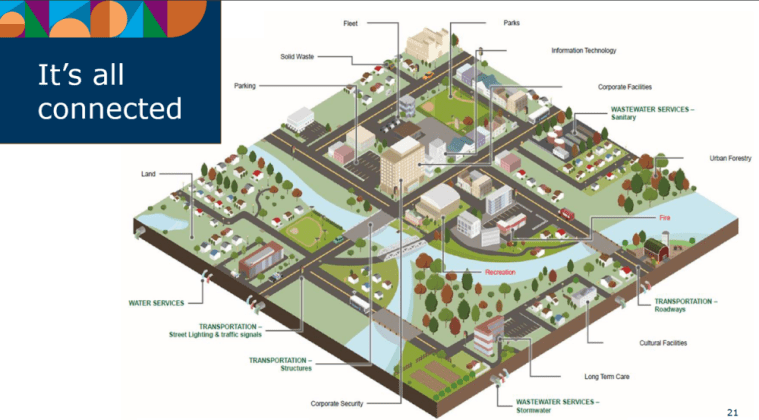
Much of the focus of the presentation was on asset management, which aims to balance strategic and master plans, climate action, capital projects, council and community input, operational and maintenance plans, and financial resources. This process is strained because of inflation and the loss of certain development charges and other fees due to provincial changes, and that means the City of Guelph will be constrained in how much it can do and how fast it can do it in.
The big news along these lines is the big hole, a $227 million shortfall over 10 years due to the exemptions to the DCs and other new discounts. Staff took special note of the provincial government’s promises about making municipalities “whole”, which has not yet come to fruition. They said that without financial assistance, it will become difficult for the City to keep up with infrastructure improvements, which will make it difficult for the City to keep up with its pledge to build 18,000 new homes by 2031.
But there are operational pressures too, especially compensation and benefits, fuel prices, insurance, parts and materials, and equipment. Another pressure is the increasing cost of social services and because of the differences between the Guelph and Wellington County fiscal year and the increased use of social services in 2023. The City is already starting 2024 $5.6 million behind, but staff are phasing in those increased costs over the next four years.
With all these things leaning on the budget, staff have already taken the liberty of providing a list of items that will require one-time funding that could be covered by reserve accounts in order to smooth out the big blow to the budget. These dozen items constitute a 1.57 per cent impact to the tax levy, but staff warned about the dangers of further dips into the reserves this budget cycle.
One final piece to consider: Staff are trying to figure out a good time on December 13 to schedule the override vote if Mayor Cam Guthrie decides to use his veto power over the budget.
In their questions, council sought advice on how best to balance community need with affordability. Staff would repeatedly mention the need for the provincial government to close the funding gap, but there are also still a number of unknowns around the full and complete impact on the changes to DCs and other fees; $227 million is still just an estimated guess to the loss.
There was also some expression of concern about the ability for council to chase pet projects, as well as apprehension that the budget shortfalls could mean service cuts or staff layoffs, which was an idea quickly dismissed. Council also asked for alternatives, potential adjustments perhaps justified by the asset management plan that would allow the City to do more with less with the capital budget.
(It was at this point that Councillor Dan Gibson tried to throw some shade on the federal government, blaming runaway spending as the primary driver of inflation, which prompted Councillor Dominique O’Rourke to retort that high inflation is a global phenomenon and that the damage caused by provincial government changes have been just as severe as inflation pressures.)
There was also some talk about getting a new deal for cities, including some advocacy around an increase to the so-called Heads-in-Beds levy. There was also a question about whether or not the City could use funding from the Housing Accelerator Fund the cover the loss in development fees, but Guelph hasn’t submitted their application yet, so its unlikely to affect the 2024 budget year.
For his last word, Guthrie talked about resurrecting his PILL, the Provincial Impacts Local Levy that will give Guelph residents a specific idea of how much more the provincial government is costing them on their property tax bill. He also said that he made a commitment to not use the Strong Mayor Powers on the budget, and implored his council colleagues to work with him to find the right balance when it comes to service and affordability.
Stay turned.
Click here to see the complete recap of the meeting.
 Guelph Politico