
This month’s Heritage Guelph meeting will be a trivia bonanza! How many (locally) famous hands held the deed for a particular house Queen Street? How many original features exist on a well-known downtown building that might need a little love? How many loaves of bread came out of building you not be aware was actually a bakery for about three decades, 100 years ago? Oh, and in sadder news, these might be the last days for one house in particular.
NOTE #1: If you would like to delegate to one of the items at the meeting, or to access an alternative meeting format, get in touch with the committee liaison before Friday April 5 at noon at jack.mallon [at] guelph.ca or by calling (519) 837-5616, ext. 3872.
NOTE #2: This meeting will take place in-person at City Hall and virtually on Cisco Webex. You can find the link on the agenda page for this meeting on the City’s website.
9 Omar Street: Intention to Demolish – What we have here is a house with a “small, single-storey, wood frame dwelling with a side gable roof and a transverse gable roof tail” near the corner of Omar and Alma Street, but what it is not is culturally significant. Although it’s on the heritage registry as a non-designated building, staff analysis says that the house does not meeting any of the nine prescribed criteria for heritage designation, ergo it can be demolished without regret.
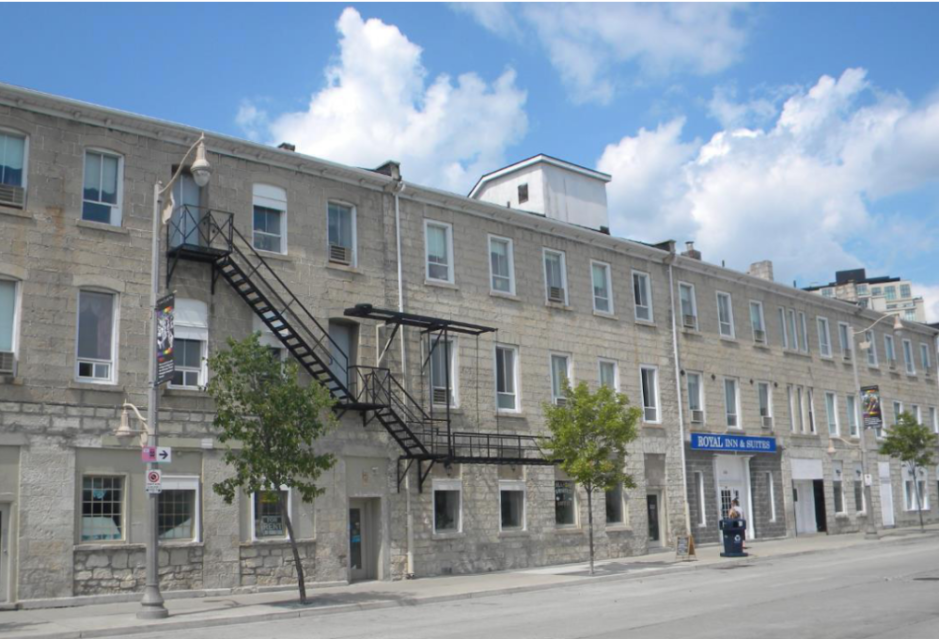
106 Carden Street: Cultural Heritage Evaluation Report – On the other end of Carden Street from City Hall is this building, which you might know as the Royal Inn and Suites. It might not look like it, but the building has a history that goes back to 1862, and more surprising then that, some of the features from that original construction can still be seen on the exterior of the building today. “Fortunately, the window and door openings, scale, roofline and limestone façade remain relatively unchanged from the building constructed in stages from 1862-1892. The wooden lintels above the main stable doors from the 1840’s livery are still visible on the eastern most block of the hotel,” the report reads. Those are a couple of the reasons why this building meets six out of the nine possible criteria for designation under Ontario Regulation 569/22. Staff will take committee’s notes before bring this back for formal designation a a future meeting.
100 Queen Street: Cultural Heritage Evaluation Report – This property was once owned by John Mitchell, a surveyor for the Canada Company who arrived in Guelph five years after its founding in 1832. This house, which is a “two and half-story hipped-roof building with a square footprint and two protruding gable-roofed bays” according to the report, doesn’t quite date that far back, but it was completed at the turn of the 20th century and was designed by Guelph architect Frye Colwill, who also designed the Torrance School on Waterloo Road and Worsted and Spinning Co. Factory (now the Mill Lofts). This house meets four out of the nine possible criteria for designation, which will come back to committee for approval at a future meeting.
72 Gordon Street: Cultural Heritage Evaluation Report – You might recognize this as the Schnurr Electric building on Gordon, but it actually dates back to the 1920s during a period where bread and other baked goods were produced in the building under several different companies. A “one-storey, flat roofed, red rug brick functional industrial building, split into 2 storeys on the south side,” the building meets five out of nine criteria under Ontario regulations.
 Guelph Politico